
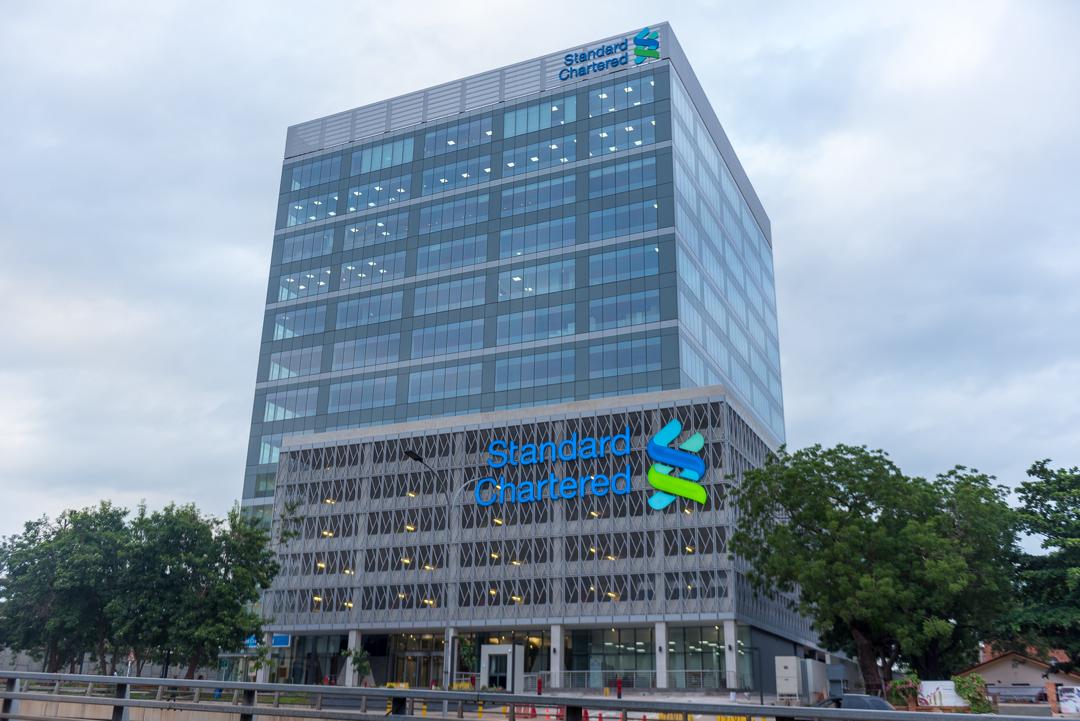

- Standard Chartered Q1 Profit Holds Steady at GH¢175.4m as Market Income Surges
Standard Chartered Bank Ghana PLC reported a broadly steady first-quarter profit for 2026, as a sharp rise in trading income and impairment gains helped offset weaker interest income and lower fee and commission income.
The bank posted a group profit after tax of GH¢175.4 million for the three months ended March 31, 2026, marginally lower than the GH¢176.1 million recorded in the same period of 2025. On a standalone bank basis, profit stood at GH¢170.0 million, compared with GH¢170.4 million a year earlier.
Profit before tax, however, increased significantly. Group profit before tax rose to GH¢263.2 million, from GH¢193.3 million in March 2025, while the bank’s separate profit before tax rose to GH¢255.6 million, from GH¢183.9 million. The difference between stronger pre-tax performance and flat after-tax profit reflected a higher tax and levy charge in the period.
Group operating income rose to GH¢424.5 million, from GH¢413.6 million a year earlier. On the bank-only basis, operating income increased to GH¢413.1 million, compared with GH¢402.2 million.
The improvement was driven mainly by trading income, which almost doubled to GH¢153.7 million, from GH¢77.8 million in March 2025. This provided a key earnings cushion at a time when more traditional banking income lines softened.
Interest income declined to GH¢250.2 million at the group level, from GH¢275.6 million a year earlier, while interest expense eased slightly to GH¢32.6 million, from GH¢33.6 million. As a result, group net interest income fell to GH¢217.6 million, from GH¢242.0 million.
Net fee and commission income also weakened, declining to GH¢58.5 million at group level, from GH¢80.8 million. Fees and commission income fell to GH¢77.6 million, while fee and commission expense rose to GH¢19.1 million.
A major support to earnings came from impairment recoveries. Standard Chartered Ghana reported a total impairment gain of GH¢49.0 million, compared with an impairment loss of GH¢3.8 million in the same period last year. This lifted operating income net of impairment charges to GH¢473.5 million, from GH¢409.8 million.
The bank also kept operating costs under control. Group operating expenses declined to GH¢210.3 million, from GH¢216.4 million, helped by a reduction in other expenses to GH¢53.0 million, from GH¢67.3 million. Personnel expenses, however, rose to GH¢145.6 million, from GH¢136.7 million.
The tax charge rose sharply to GH¢87.8 million, compared with GH¢17.3 million in March 2025, effectively absorbing much of the improvement in pre-tax earnings.
On the balance sheet, group total assets increased to GH¢17.28 billion, from GH¢15.59 billion a year earlier. Cash and cash equivalents stood at GH¢5.76 billion, while investment securities increased to GH¢4.26 billion, from GH¢3.48 billion. Non-pledged trading assets also rose to GH¢953.0 million, from GH¢511.6 million.
Loans and advances to customers declined to GH¢1.81 billion, from GH¢2.32 billion, suggesting a more cautious stance on credit growth or portfolio rebalancing during the period.
Customer deposits rose strongly to GH¢12.68 billion, from GH¢11.17 billion, reinforcing the bank’s funding base. Deposits from banks, however, declined to GH¢706.5 million, from GH¢922.1 million, while short-term borrowings fell to zero from GH¢467.1 million in March 2025.
Shareholders’ funds improved to GH¢3.01 billion, from GH¢2.28 billion, while net asset value per share rose to GH¢22.24, from GH¢16.88 a year earlier.
The bank remained strongly capitalised and liquid. Its capital adequacy ratio stood at 25.21 per cent, while Common Equity Tier One and Tier One ratios stood at 23.11 per cent each. The liquid ratio improved to 100.95 per cent, from 93.38 per cent in March 2025.
Asset quality remains a key area to watch. The bank reported a gross non-performing loan ratio of 27.03 per cent, up from 24.17 per cent a year earlier. However, the non-performing loan ratio less the loss category stood at 0.85 per cent, compared with 0.76 per cent in March 2025.
Standard Chartered Ghana said it recorded no default in statutory liquidity requirements and no sanctions during the period. Its dominant risks remain credit risk, liquidity risk, market risk and operational risk, managed under a risk framework consistent with the previous reporting period.
For investors, the first-quarter numbers show a bank with strong capital, liquidity and market-income performance, but with pressure on core lending and fee-based income. The surge in trading income and impairment recoveries helped protect earnings, while higher taxes limited growth in after-tax profit.

