

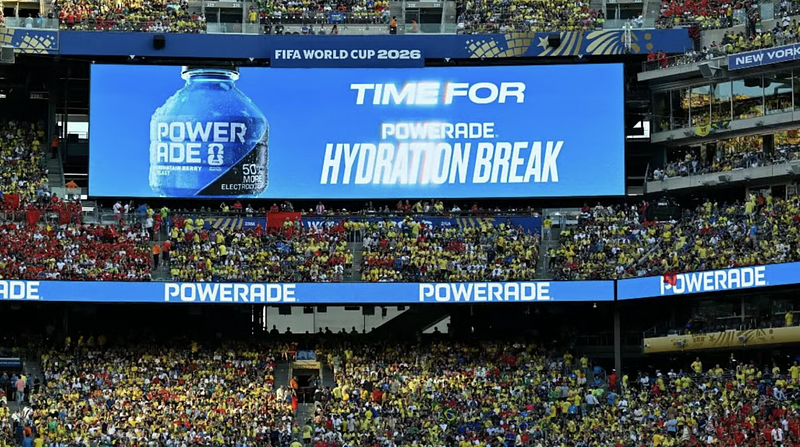

- FIFA’s Hydration Break Rule Creates New Revenue Stream for World Cup Broadcasters
FIFA’s mandatory hydration breaks at the 2026 World Cup were introduced as a player welfare measure. Less than a week into the tournament, they are already emerging as one of the most valuable new advertising opportunities in global sports broadcasting.
The rule, announced in December 2025, requires hydration breaks in every match of the expanded 48-team tournament, regardless of weather conditions. In March 2026, broadcasters were granted permission to sell advertising during those pauses.
That decision has created an entirely new category of commercial inventory in a sport that has historically given broadcasters fewer advertising windows than American football, basketball or baseball.
According to analysis by Gambling.com, Fox Sports, which is paying a reported US$485 million for its World Cup broadcast rights, could generate between US$249.60 million and US$332.80 million from hydration-break advertising alone.
If realised, that revenue could cover more than half of Fox’s reported rights fee from ad inventory that did not exist at the previous World Cup.
The calculation is based on FIFA’s broadcast rules, which allow a 20-second buffer before commercials begin and require networks to return to the live match feed at least 30 seconds before play resumes.
That leaves roughly two minutes and ten seconds of usable advertising time per break.
Across 104 matches, the analysis estimates that the breaks could produce as many as 832 commercial slots. At an average rate of US$300,000 per 30-second spot, the inventory would generate US$249.60 million. At US$400,000 per spot, the figure rises to US$332.80 million.
The figures are estimates, not confirmed sales numbers. But they underline the scale of the commercial opportunity created by the new rule.
For broadcasters, football has always presented a commercial challenge.
Unlike many US sports, the game runs continuously for 45 minutes each half, leaving fewer natural breaks for commercials. Broadcasters usually rely heavily on pre-match, half-time and post-match advertising, as well as on-screen sponsorship integrations.
Hydration breaks change that model.
They effectively split matches into quarters, creating advertising windows inside live play without waiting for half-time.
That has made the policy controversial.
FIFA has framed the change around player welfare, especially in a tournament hosted across venues in the United States, Canada and Mexico, where summer heat could affect player safety and performance.
That argument is not without merit.
Gambling.com’s analysis of climate and sports science data suggests that one in four matches could be played at temperatures of 26°C or above, a level at which heat stress begins to affect athletic performance.
High-risk outdoor venues include Miami, Philadelphia, Kansas City, Boston and New York. In a hotter-than-average summer, up to 14 of the 16 host stadiums could breach the 28°C threshold.
The 2025 Club World Cup also showed the limits of previous heat protocols, with players reportedly showing signs of heat stress even under conditions previously considered acceptable.
Still, the blanket nature of the rule has raised questions.
Under the previous approach, hydration breaks could be triggered when temperatures exceeded 32°C. That threshold has now been removed. Breaks are scheduled in every match, including those played inside fully air-conditioned and roofed stadiums in Dallas, Houston and Atlanta.
That is where the player welfare argument becomes more complicated.
If the rule is purely about heat protection, critics ask why it applies uniformly in controlled indoor conditions where heat risk is limited.
The early conduct of broadcasters has intensified the debate.
During the tournament opener between Mexico and South Africa, Fox reportedly ran full-screen commercials during hydration pauses and overran its slot by 40 seconds, causing viewers to miss live action when play resumed.
FIFA did not penalise Fox for the breach.
That decision has added to concerns that the hydration-break policy may be operating not only as a health measure, but also as a commercial accommodation for rights holders.
The contrast with Telemundo has been striking.
Telemundo’s Senior Vice President of Sports Content, Miguel Lorenzo, told Sports Business Journal that the network’s goal was to provide an uninterrupted viewing experience. Rather than cut away to commercials, Telemundo has opted to remain on the match feed during hydration breaks, using the time for replays, analysis and in-game storytelling.
Its announcers reportedly told viewers: “The World Cup is ours, we are not going to take a break from it.”
That contrast captures the strategic choice facing broadcasters.
Fox is monetising the new inventory. Telemundo is monetising viewer goodwill.
Both approaches carry risk.
For Fox, the revenue potential is obvious, but the danger is viewer frustration if fans miss live match action or feel the sport is being altered for commercial purposes.
For Telemundo, the no-break strategy may strengthen audience loyalty, but it also means leaving potentially valuable advertising money on the table.
The wider context is important.
The 2026 World Cup is the largest in tournament history, with 48 teams, 104 matches and broadcast partnerships across more than 220 territories.
FIFA has confirmed record-breaking media rights revenues for the tournament, with projected broadcast rights revenue of about US$3.92 billion, making it the highest-grossing broadcast deal for a single sporting event.
In that context, hydration breaks are not a small operational detail.
They sit inside the broader commercial expansion of the World Cup.
The tournament is bigger, the rights fees are larger, and broadcasters are under pressure to recover their investment.
For American broadcasters in particular, hydration breaks solve a problem they have long faced with football: how to insert more advertising into a sport that resists interruption.
As Dean Ryan, Betting Expert at Gambling.com, put it: “The hydration break didn’t just solve a heat problem — it solved an ad inventory problem that American broadcasters have always had with soccer.”
The tension now is whether FIFA can maintain the credibility of the welfare argument while broadcasters treat the pauses as premium commercial real estate.
There is nothing inherently wrong with broadcasters monetising rights they have paid heavily to acquire. The World Cup is a commercial product as much as a sporting spectacle.
But the moment ads interfere with live action, the balance shifts.
Viewers accept commercials before the game, at half-time and after the final whistle. They may be less forgiving if a hydration break causes them to miss a restart, a promising attack or a decisive moment.
FIFA’s decision not to penalise Fox after the reported overrun may therefore prove more important than the incident itself.
It suggests that enforcement around these new breaks will be closely watched.
If broadcasters are allowed to push commercial boundaries without consequence, the rule could become a test case in how far football can be stretched to fit television economics.
The 2026 World Cup may still justify hydration breaks on player welfare grounds, especially in outdoor venues exposed to extreme heat.
But the commercial implications are now impossible to ignore.
A rule presented as protection for players has created hundreds of new ad slots, potentially worth hundreds of millions of dollars.
The question is no longer whether hydration breaks are necessary.
It is whether FIFA can convince fans that the welfare logic remains stronger than the advertising opportunity it has unlocked.

