

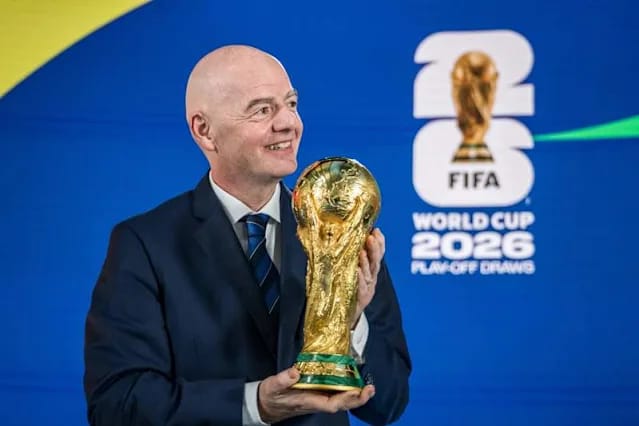

- Why Gianni Infantino Keeps Appearing on World Cup Broadcasts: FIFA Explains the Television Protocol Behind the Repeated Camera Shots
Viewers watching the 2026 FIFA World Cup have become accustomed to a familiar sight during almost every match. Whether the action is unfolding in the United States, Canada or Mexico, television cameras almost inevitably cut to FIFA President Gianni Infantino seated in the VIP section.
The recurring broadcasts have sparked widespread discussion among fans, with many questioning why the world football chief appears so frequently on television during live matches.
The explanation, however, lies in the way FIFA’s official World Cup television coverage is produced.
Unlike domestic leagues, where broadcasters control most aspects of their match coverage, every World Cup broadcast is generated by Host Broadcast Services (HBS), FIFA’s official production partner.
HBS produces the live television feed used by every rights-holding broadcaster around the world, including Fox Sports and Telemundo in the United States, the BBC and ITV in the United Kingdom, and numerous other television networks. These broadcasters are required to use the official international feed, meaning they do not decide independently when to show Infantino or other VIP guests during matches.
According to FIFA, there is an agreement requiring what is known as a “dignitary shot” during each half of every World Cup game.
These camera shots are intended to feature the highest-ranking officials or distinguished guests attending the match. They may include heads of state, members of royal families, football confederation leaders, federation officials, celebrities or other VIPs accredited by FIFA.
As FIFA president, Infantino naturally becomes one of the most prominent figures captured whenever he is present in the stadium.
A FIFA spokesperson insisted that the practice is standard procedure rather than an attempt to promote the organisation’s president.
“It is standard practice for seats which include football officials, public figures and celebrities to be shown as part of the match running order, whoever they may be,” the spokesperson said.
Infantino has made a remarkable effort to attend as many matches as possible during the expanded 48-team tournament.
During the group stage alone, he frequently attended two matches in a single day, travelling between host cities aboard a private jet provided by FIFA sponsor Qatar Airways.
On the tournament’s opening day, he watched Mexico face South Africa in Mexico City before flying approximately 285 miles to Guadalajara in time for South Korea’s clash with Czechia later that evening.
Four days later, he was in Seattle to watch Belgium take on Egypt before travelling to Los Angeles for Iran’s meeting with New Zealand.
Despite his extensive travel schedule, the enormous distances across North America have prevented him from matching his remarkable feat at the 2022 World Cup in Qatar, where he attended all 64 matches. With more than 100 matches played in the expanded tournament, attending every fixture has become virtually impossible.
The frequent television appearances have also attracted attention because of Infantino’s political future within world football.
The 56-year-old is expected to seek a third term as FIFA president in 2027, a victory that would extend his tenure until 2031 and give him 15 years in charge of football’s global governing body.
At present, no challenger has officially emerged to oppose his re-election bid.
Infantino has already secured public backing from three of FIFA’s six continental confederations, Africa (CAF), Asia (AFC) and South America (CONMEBOL), which together represent 110 of FIFA’s 211 member associations.
However, his presidency has continued to attract criticism during the tournament.
Several national associations have expressed concerns over refereeing decisions and disciplinary procedures, while others have questioned FIFA’s handling of political issues surrounding the competition. The tournament has also unfolded against the backdrop of travel restrictions affecting supporters from some participating nations, adding another layer of controversy to the event.
Even so, whenever television viewers notice the cameras turning toward the FIFA president during a match, it is less a spontaneous editorial decision than a feature built into the official World Cup broadcast protocol.
As the 2026 FIFA World Cup enters its decisive final stages, one thing appears almost certain: alongside the goals, celebrations and drama on the pitch, Gianni Infantino will remain one of the tournament’s most recognisable faces on television screens around the world.

