

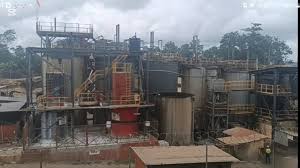

- Prestea Sankofa Eyes Revival After Securing New Strategic Investor
Prestea Sankofa Gold Limited is seeking a major operational turnaround after securing new investment from Guangzhou Hozdo Group, in a move expected to help stabilise the state-owned mining company and revive production capacity.
The company, a subsidiary of the Ghana National Petroleum Corporation, has faced years of operational pressure linked to ageing infrastructure, deteriorated plant systems and environmental concerns around legacy tailings dams.
According to The Vaultz News, the new partnership is expected to inject both capital and technical expertise into the mine, with the aim of addressing long-standing logistical, mechanical and environmental challenges.
The deal comes at a critical moment for the Prestea mining community, where the performance of the mine remains closely tied to employment, local economic activity and confidence in state-owned mining assets.
Western Regional Minister, Joseph Nelson, described the investment as an important opportunity to reposition the company after years of hardship.
“Prestea Sankofa has endured years of hardship, and I am confident that with this new investor, the company can be revitalized to better serve the nation and its people,” he said.
“My primary goal as regional leader is to support struggling enterprises and help them attract the investment they urgently need,” he added.
The investment is expected to support a broad modernisation programme, including the replacement and upgrading of critical machinery and the acquisition of new equipment to support rock mining.
That marks an important shift in the company’s operating model.
Historically, Prestea Sankofa operated largely as a processor of low-grade surface materials and historic waste. But management is now seeking to move the company toward a more diversified mining operation capable of meeting output targets more reliably.
The company’s Managing Director, Alhaji Ishaq Dauda, said the transition represents a move away from overreliance on legacy tailings and toward a stronger mining model supported by new technical capacity.
The new investment is also expected to support environmental upgrades.
Before the latest capital injection, management had already taken steps to stabilise the company’s processing foundation, including the replacement of critical Carbon-in-Pulp tanks.
The company is also constructing a modern tailings dam, a key environmental safeguard intended to reduce risks associated with older upstream-designed dams.
Those legacy dams have raised concerns because of their potential exposure to extreme weather events and other safety risks.
By investing in modern disposal facilities, Prestea Sankofa is seeking to bring its operations closer to contemporary environmental and safety standards, while addressing longstanding concerns around legacy contamination and tailings dam failure.
Beyond machinery and environmental systems, the company’s leadership is also placing emphasis on staff welfare.
Alhaji Dauda said the company had continued paying salaries over the past five months despite the lack of active production.
“For the past five months, despite a lack of production, salaries have been paid consistently,” he said.
That commitment is significant in a mining community where job security, household income and local business activity are closely linked to the mine’s survival.
By maintaining payroll during the transition, management appears to be trying to preserve skilled labour, avoid industrial unrest and create a more stable environment for the new investor to begin integration.
The investment also raises broader questions about the future of state-linked mining assets in Ghana.
At a time when government is seeking greater value retention from the mining sector, Prestea Sankofa’s attempted revival will be watched as a test case for whether state-owned or state-linked mining companies can be repositioned through strategic partnerships rather than allowed to decline.
The deal comes amid renewed national debate over resource ownership, mining lease renewals, royalties, local participation and the need to ensure that Ghana captures more value from its gold sector.
For Prestea Sankofa, the challenge is more immediate: turning new capital into production, jobs and safer operations.
The company’s long-term roadmap is to transform from a niche gold-recovery operation into a more versatile mining company with rock mining capabilities.
That will require more than money. It will require disciplined execution, credible technical management, environmental compliance and clear accountability over how the new investment is deployed.
With GNPC oversight and Guangzhou Hozdo Group’s technical support, the mine is being positioned for what officials describe as a new operational phase.
But the real measure of success will be whether the investment can move Prestea Sankofa beyond survival mode and into sustained production.
For the Prestea community, the stakes are high.
A revived mine could protect jobs, restore confidence, stimulate local enterprise and strengthen Ghana’s domestic mining capacity.
A failed turnaround, however, would reinforce old doubts about the ability of state-owned mining assets to operate efficiently, attract capital and compete in a sector dominated by global players.
For now, the message from the Western Regional Minister and company management is one of cautious optimism: Prestea Sankofa has found a lifeline.
The harder task is proving that the lifeline can become a genuine industrial recovery.

