


- From Ev’s to Solar Panels: Ghana’s First Female Green Engineering Cohort Graduates
Ghana’s clean energy transition will not be judged only by the number of solar panels installed, electric vehicles deployed or policy documents produced. It will also be judged by who gets trained, who gets employed, who builds the systems and who sits at the table when the country’s energy future is being designed.
That is why the graduation of the first cohort of 30 young women under the Female Engineering Academy is more than a ceremonial milestone. It is a statement about the type of energy transition Ghana wants to build: one that is not only greener, but also more inclusive, more practical and more deliberate about correcting old imbalances in science, technology and engineering.
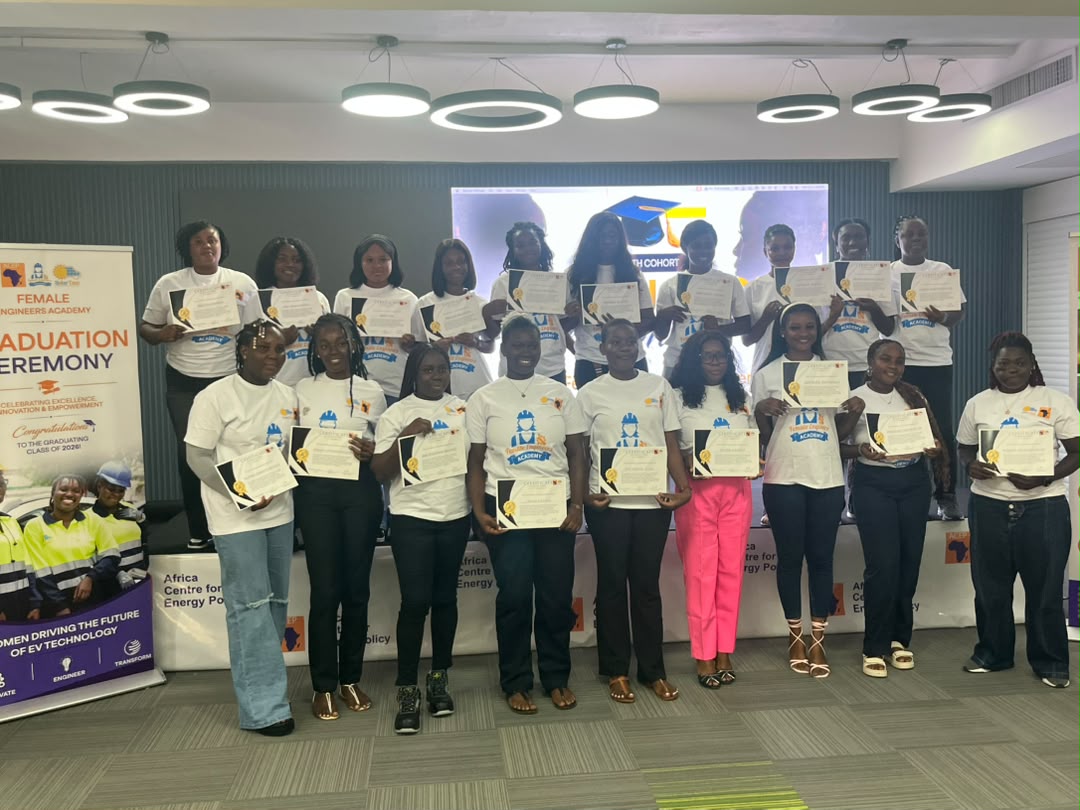
The Africa Centre for Energy Policy, in partnership with Solar Taxi Ghana and with support from the Ford Foundation, has graduated the first all-female cohort under the academy. The programme formed part of the inaugural phase of the Green Energy Technology Capacity Development Programme, known as GET-CADEP.
The initiative was designed to equip young Africans, particularly young women, with practical technical skills for the renewable energy and electric mobility sectors. The training covered electric vehicle maintenance, solar panel installation, solar system assembly and other renewable energy technologies. Participants also undertook industry internships with Solar Taxi Ghana, giving them direct exposure to the realities of the clean energy workplace.
For Ghana, this matters because the green economy is no longer a distant policy conversation. It is already taking shape through rooftop solar systems, battery storage, electric vehicles, clean cooking technologies, energy efficiency systems and new business models around decentralised power.
But while the technologies are changing, the skills pipeline remains underdeveloped. Even more worrying, women continue to be underrepresented in engineering, technical training, energy entrepreneurship and energy governance.
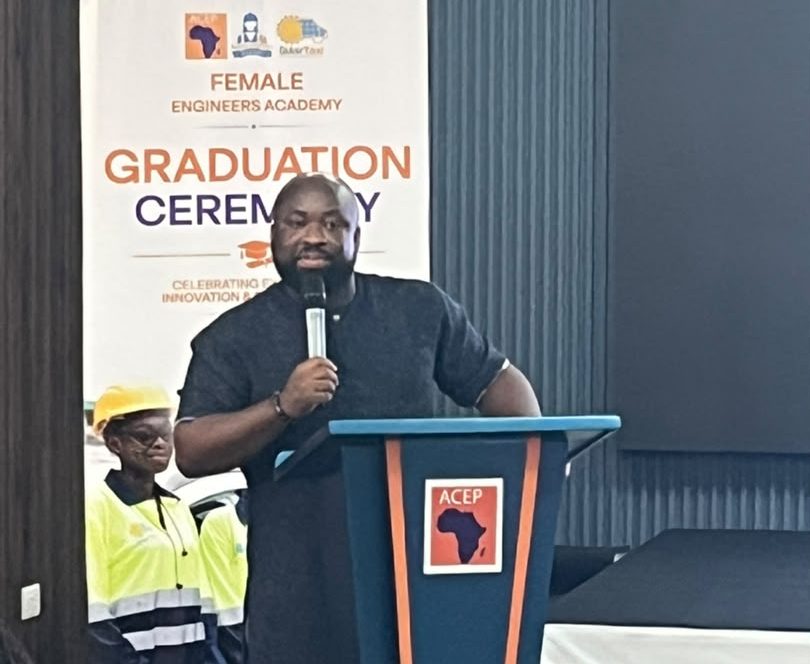
Delivering the keynote address at the graduation ceremony, Kodzo Yaotse of ACEP said the programme was based on the belief that Africa’s clean energy transition cannot succeed while women remain on the margins.
“The transition to clean, sustainable energy in Ghana and across Africa cannot succeed if it excludes half our population,” Mr Yaotse said.
That sentence captures the central argument behind the academy. Ghana cannot claim to be preparing for the energy future while drawing its technical workforce from only part of the population. A transition that excludes women from engineering and technology will reproduce the same inequalities that have long shaped the conventional energy sector.
The Female Engineering Academy therefore offers a more practical answer to a problem often discussed in abstract terms. Instead of merely calling for more women in science, technology, engineering and mathematics, the programme placed young women in workshops, exposed them to equipment, trained them in real technologies and connected them to industry.
Mr Yaotse described the academy as a deliberate response to the gender gap through practical training, mentorship and workplace exposure rather than rhetoric.
That distinction is important. Ghana has not lacked speeches about empowering women. What has often been missing is the bridge between aspiration and competence. Training programmes such as GET-CADEP help build that bridge by giving young women the technical confidence and industry exposure needed to compete in sectors traditionally dominated by men.
Electric mobility and renewable energy are among the fastest-growing parts of the global energy economy. As countries move to reduce emissions, improve energy security and lower dependence on fossil fuels, new technical skills will be needed across installation, maintenance, manufacturing, assembly, diagnostics, project design and after-sales services.
In Ghana, electric mobility is still young, but interest is rising. Solar energy is also expanding, driven by businesses, households and public institutions looking for reliable and affordable power. Both sectors will require technicians and engineers who understand the technology and can support deployment at scale.
The 30 graduates are therefore entering a market that is still forming. That gives them an opportunity not only to seek employment, but also to shape the industry.
Mr Yaotse urged the graduates to see their certificates not as an end, but as a foundation for careers in employment, entrepreneurship, research and public policy. He stressed that Ghana’s energy transition will require not only skilled technicians, but also women in leadership and decision-making positions.
Too often, women are encouraged to enter technical sectors only at the lower end of the value chain. They are trained as technicians but excluded from ownership, management, policy design and investment decisions. A truly inclusive energy transition must avoid that mistake. It must create pathways for women to become engineers, founders, researchers, financiers, regulators and executives.
This is where the Female Engineering Academy could have long-term importance. If properly sustained and expanded, it could become a pipeline for female talent across Ghana’s green economy.
The role of Solar Taxi Ghana in the programme is also worth noting. Training for the energy transition cannot be effective if it remains classroom-based. Clean energy technologies are practical. They must be handled, tested, installed, repaired and operated. By integrating the trainees into real operational environments, Solar Taxi helped close the gap between theory and practice.
Mr Yaotse commended the company for investing in the technical development of the trainees and exposing them to real industry conditions. He also acknowledged the Ford Foundation for supporting the implementation of the programme.
The ceremony further recognised excellence among the trainees. Princess Ama Gyekye was named the best graduating student from the Kumasi branch, while Delphine Semenyo Nkudede emerged as the best graduating student from the Accra branch.
Such recognition may seem symbolic, but it matters. In fields where young women are often made to feel like outsiders, visible achievement helps challenge stereotypes. It tells the next group of girls considering engineering that excellence in clean technology is not reserved for men.
If solar panels are imported but local technicians cannot install and maintain them properly, the market will struggle. If electric vehicles enter the country but the maintenance ecosystem remains weak, adoption will slow. If battery systems expand but local capacity is thin, Ghana will remain dependent on external expertise. Skills are therefore not an afterthought; they are infrastructure.
Ghana has a young population and a persistent unemployment challenge. The green economy is often presented as a source of future jobs, but those jobs will not automatically go to young Ghanaians. They will go to people with the right skills. Programmes such as GET-CADEP are therefore essential if the country wants the energy transition to create local employment rather than simply open another market for imported expertise.
For young women, the stakes are even higher. The energy sector has historically been male-dominated. Without deliberate intervention, the new green economy could repeat the same pattern. Ghana could build new industries while leaving women under-represented again.
ACEP, Solar Taxi and the Ford Foundation appear to be trying to interrupt that cycle early.
The graduation of 30 women will not by itself transform Ghana’s energy labour market. But it offers a model that can be expanded. More cohorts can be trained. More private companies can be brought in. Technical universities can be aligned. Banks and development partners can support graduate-led enterprises. Government agencies can create procurement and internship pathways.
The deeper opportunity is to build a national green skills strategy that deliberately includes women.
That would mean training not only engineers, but also installers, battery technicians, energy auditors, EV mechanics, project managers, solar entrepreneurs and policy analysts. It would also mean ensuring that women are not only invited into the sector, but supported to remain and grow.
The first cohort of the Female Engineering Academy has completed its training. The real test now begins. Will these graduates find jobs? Will they start businesses? Will the industry absorb them? Will policymakers build on this model? Will Ghana create enough demand for their skills?

