

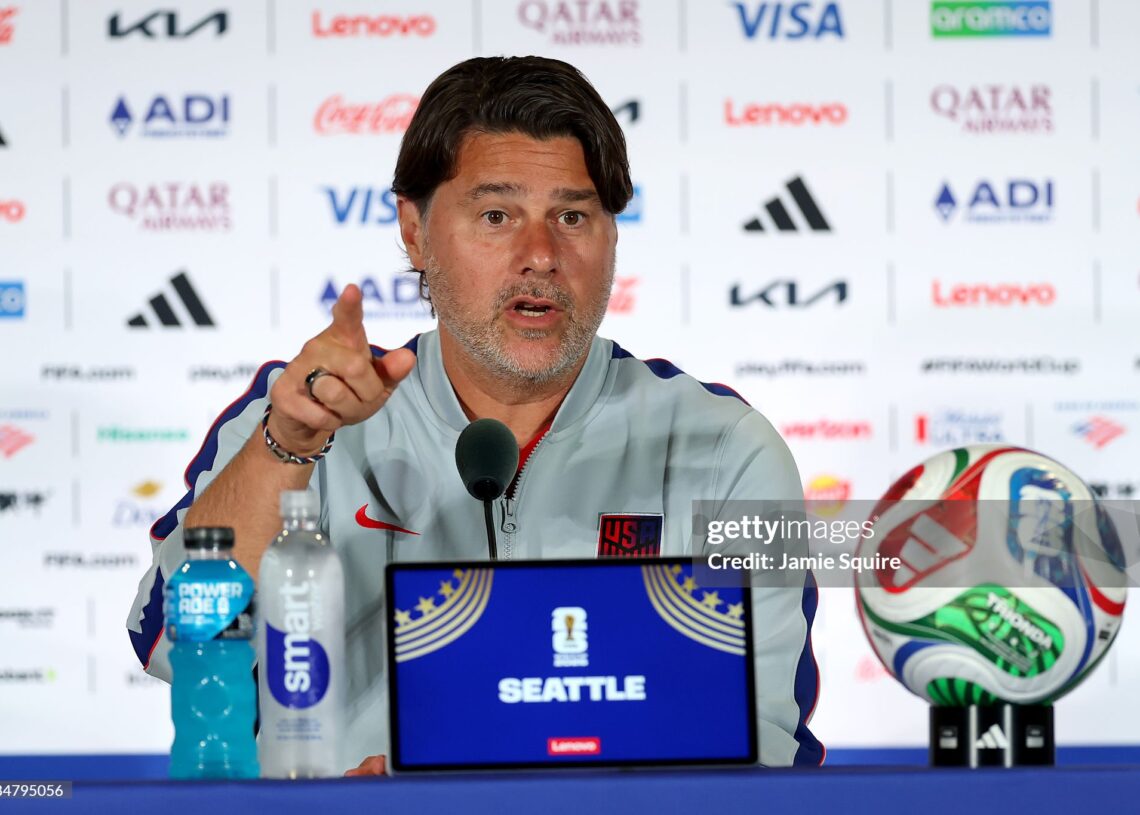

- Pochettino Agrees to Take Charge of Manchester United from November 18
Mauricio Pochettino has agreed to become Manchester United’s head coach from November 18, ending his tenure with the United States men’s national team to take charge of a club seeking to recover from a troubled start to its Premier League campaign.
United confirmed the agreement on November 13, saying it had also reached terms with the U.S. Soccer Federation for Pochettino and his staff to leave after completing their national-team responsibilities.
The appointment follows the dismissal of Michael Carrick, who was sacked after United won only one of 10 league matches and fell to 18th place, as reported at the time.
Pochettino is due to begin work at Old Trafford after leading the United States through its final fixtures against Haiti. U.S. Soccer confirmed that the November 14 and 17 matches would be his last in charge of the national team. His move is therefore agreed, but the handover is being timed around those international commitments.
United described the Argentine as a manager known for a “high-intensity, attacking style of football”, team-building and player development.
The club’s announcement also pointed to his record across several leagues, including his work at Southampton and Tottenham Hotspur, where he established the side as a regular Champions League contender and led it to the competition’s 2019 final.
His arrival gives United a coach with experience rebuilding teams and developing players. It also places him in a high-pressure role at a club whose immediate problem is not simply a shortage of ambition, but the need to turn that ambition into consistent results. United’s slide to 18th and its run of one league win in 10 matches have made the first task clear: arrest the decline.
The challenge is likely to involve more than changing tactics. Pochettino will have to assess the squad, restore confidence and decide how quickly he can impose his preferred style.
A high-intensity approach demands organisation, fitness and collective commitment. If players cannot sustain those demands, the team’s tactical identity may take time to develop.
That makes the timing significant. Pochettino arrives during the season rather than after a full pre-season, limiting the time available to reshape the team through training.
He will inherit a club under pressure to improve immediately, while also being expected to build a side capable of competing over the longer term. Results will shape how much patience he receives.
The manager’s previous work offers both a blueprint and a warning. At Tottenham, he built a cohesive team that competed at the top end of the Premier League and reached a Champions League final.
But translating that success to United will require adapting to a different squad, different expectations and a different institutional environment. A past record can show what a manager has done; it cannot guarantee that the same process will succeed again.
His most recent job was with the United States, which he led to the 2026 World Cup Round of 16. U.S. Soccer said he compiled 21 wins, 12 losses and two draws across 35 matches. The federation said he would remain responsible for the team through the conclusion of its current camp before departing.
The transition is notable because Pochettino had signed a new contract with U.S. Soccer through 2030 in August. His departure, only months later, reflects the pull of the United job and the scale of the task facing United.
It also means the United States will need to begin a coaching search while preparing for its next phase after the World Cup.
For United, the appointment may settle the question of who leads the team, but it does not resolve the deeper issues behind the poor results.
The club’s performance will depend on whether the players can execute Pochettino’s ideas and whether the wider football operation can provide the support required to build a stable team.
That will include decisions about recruitment, player roles and the balance between immediate needs and longer-term planning. If United’s difficulties are rooted partly in squad construction, a new head coach alone may not be enough.
Pochettino will need authority to make changes, while the club must show that its decisions beyond the touchline are aligned with the style and structure he is trying to establish.
There is also a question of how the club measures progress. A short-term improvement in results would ease pressure, but a sustainable recovery requires more than a brief run of wins. United need greater consistency, a clearer playing identity and a squad capable of maintaining performance across a demanding season.
Pochettino’s strengths in player development may be particularly relevant if United are to rebuild around a younger core. But development takes time, and the club’s current position leaves little room for a slow start.
He will have to balance the patience required to reshape a team with the immediate demand to move United away from the relegation zone.
His first days will be spent completing his duties with the United States before he begins work at Old Trafford on November 18.
That leaves a narrow window between the end of the international commitment and the start of his United tenure, with attention already turning to how quickly he can impose a new direction.
The appointment is a major decision for both sides: United gain an experienced coach with a record of building competitive teams, while Pochettino takes on one of English football’s most demanding jobs at a moment of acute instability.
His success will depend on whether the club can turn the promise of a fresh start into a coherent football project and whether that project can deliver results before the pressure becomes even greater.

