

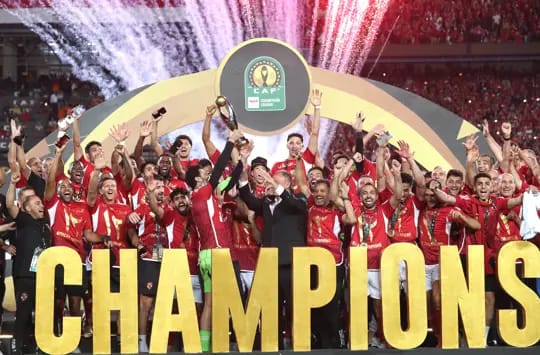

- North African Clubs Tighten Grip on CAF Champions League as Sundowns Seek to Break Pattern
When Mamelodi Sundowns welcome FAR Rabat to Pretoria this weekend for the first leg of the 2025/26 TotalEnergies CAF Champions League final, they will do so with history pressing heavily on both sides.
On the surface, it is a meeting of two ambitious clubs separated by geography, football culture and domestic realities. But the final reflects a much larger continental trend the gradual northward shift of power in African club football.
This is not merely South Africa against Morocco. It is a contest between one club seeking to challenge an established pattern and another trying to reinforce a regional dominance that has defined the modern era of the CAF Champions League.
Africa’s premier club competition was first staged in 1964 as the African Cup of Champions Clubs. In its early years, the tournament belonged largely to sub-Saharan Africa, with winners emerging from Cameroon, Côte d’Ivoire, Mali, Ghana, Guinea, DR Congo and Congo-Brazzaville.
The inaugural champions, Oryx Douala of Cameroon, set the tone for a period in which Central and West African clubs were among the strongest forces on the continent. Between 1964 and 1975, North African clubs won only two titles Ismaily of Egypt in 1969 and MC Alger of Algeria in 1976, while clubs such as Hafia, TP Mazembe, Canon Yaoundé and Asante Kotoko helped define the competition’s early character.
That balance would gradually change.
By the late 1970s and early 1980s, North African clubs began to assert themselves with greater consistency. Algeria’s JS Kabylie, Egypt’s Al Ahly and Zamalek, Morocco’s Raja Casablanca and Tunisia’s Club Africain became symbols of a more organised, better-resourced and tactically disciplined era of African club football.
Between 1981 and 1994, North African sides won nine of 14 titles, a clear sign that continental power was beginning to migrate northwards.
The decisive shift came in 1997, when the competition was rebranded as the CAF Champions League and a group-stage format was introduced. The change increased visibility, revenue potential and professionalism — and North African clubs adapted faster than most of their rivals.
Since then, their dominance has become difficult to ignore.
Clubs from Egypt, Morocco, Tunisia and Algeria have won most of the titles in the modern Champions League era, with Egyptian sides in particular setting the benchmark for consistency and continental ruthlessness.
At the centre of that story is Al Ahly. With 12 CAF Champions League titles, the Cairo giants remain the most successful club in African football history. Their recent dominance, including victories in five of the last six completed seasons before 2025, has turned them into the model that other African clubs try to copy but rarely sustain.
Morocco’s rise has been equally important. Raja Casablanca, Wydad Casablanca and FAR Rabat have helped build the country’s continental reputation. Wydad’s triumphs in 2017 and 2022 underlined Moroccan football’s modern depth, while FAR Rabat’s return to the final, 41 years after their 1985 title, signals both revival and continuity.
Tunisia and Algeria have also remained part of the northern power bloc, with Esperance, ES Sétif and JS Kabylie continuing to give the region a strong continental footprint.
Sub-Saharan Africa has never disappeared from the Champions League conversation. But its modern successes have been more episodic than era-defining.
Enyimba of Nigeria’s back-to-back victories in 2003 and 2004 remain one of the competition’s great achievements. TP Mazembe revived Central Africa’s standing with titles in 2009, 2010 and 2015. Mamelodi Sundowns gave South Africa its second continental crown in 2016.
Yet the problem has been sustainability.
Where North African clubs have built systems, stronger domestic competitions, deeper squads, better infrastructure and regular continental continuity, many sub-Saharan clubs have struggled with unstable financing, player turnover, governance weaknesses and limited commercial depth.
This is what makes the 2025/26 final significant.
For FAR Rabat, victory would reinforce North Africa’s claim as the dominant region in African club football. It would also mark a powerful return for a club that last won the continent’s top prize in 1985.
For Mamelodi Sundowns, the final offers something more than another trophy. It is a chance to push back against decades of northern supremacy and strengthen the argument that South African club football can compete structurally with the continent’s most successful regions.
Sundowns’ back-to-back finals in 2025 and 2026 already point to a club operating with a level of consistency rare outside North Africa. A second Champions League title would elevate them from ambitious challenger to sustained continental force.
The numbers tell the broader story. Since 1964, North African clubs and sub-Saharan African clubs have each won roughly comparable numbers of titles across the full history of the competition. But context matters: over the last 25 years, North African sides have won more than two-thirds of available titles, turning early balance into modern dominance. That is why this final carries symbolic weight.
The CAF Champions League began as a genuinely pan-African battleground. Over time, it has become something closer to a northern stronghold, interrupted occasionally by powerful challengers from the south, west and centre of the continent.
This weekend in Pretoria, history will not be erased in 90 minutes. But it can be tested. For FAR Rabat, the final is an opportunity to extend a regional story of supremacy. For Mamelodi Sundowns, it is a chance to show that African club football’s balance of power can still move again.
CAF Champions League winners (1964–2025)
1964 – Oryx Douala (Cameroon)
1965 – Stade d’Abidjan (Côte d’Ivoire)
1966 – AS Real Bamako (Mali)
1967 – TP Mazembe (DR Congo)
1968 – TP Mazembe (DR Congo)
1969 – Ismaily (Egypt)
1970 – Asante Kotoko (Ghana)
1971 – Canon Yaoundé (Cameroon)
1972 – Hafia (Guinea)
1973 – Vita Club (DR Congo)
1974 – CARA Brazzaville (Congo)
1975 – Hafia (Guinea)
1976 – MC Alger (Algeria)
1977 – Hafia (Guinea)
1978 – Canon Yaoundé (Cameroon)
1979 – Union Douala (Cameroon)
1980 – Canon Yaoundé (Cameroon)
1981 – JS Kabylie (Algeria)
1982 – Al Ahly (Egypt)
1983 – Asante Kotoko (Ghana)
1984 – Zamalek (Egypt)
1985 – FAR Rabat (Morocco)
1986 – Zamalek (Egypt)
1987 – Al Ahly (Egypt)
1988 – ES Sétif (Algeria)
1989 – Raja Casablanca (Morocco)
1990 – JS Kabylie (Algeria)
1991 – Club Africain (Tunisia)
1992 – Wydad Casablanca (Morocco)
1993 – Zamalek (Egypt)
1994 – ES Sétif (Algeria)
1995 – Orlando Pirates (South Africa)
1996 – Zamalek (Egypt)
1997 – Raja Casablanca (Morocco)
1998 – ASEC Mimosas (Côte d’Ivoire)
1999 – Raja Casablanca (Morocco)
2000 – Hearts of Oak (Ghana)
2001 – Al Ahly (Egypt)
2002 – Zamalek (Egypt)
2003 – Enyimba (Nigeria)
2004 – Enyimba (Nigeria)
2005 – Al Ahly (Egypt)
2006 – Al Ahly (Egypt)
2007 – Étoile du Sahel (Tunisia)
2008 – Al Ahly (Egypt)
2009 – TP Mazembe (DR Congo)
2010 – TP Mazembe (DR Congo)
2011 – Esperance (Tunisia)
2012 – Al Ahly (Egypt)
2013 – Al Ahly (Egypt)
2014 – ES Sétif (Algeria)
2015 – TP Mazembe (DR Congo)
2016 – Mamelodi Sundowns (South Africa)
2017 – Wydad Casablanca (Morocco)
2018 – Esperance (Tunisia)
2019 – Esperance (Tunisia)
2020 – Al Ahly (Egypt)
2021 – Al Ahly (Egypt)
2022 – Wydad Casablanca (Morocco)
2023 – Al Ahly (Egypt)
2024 – Al Ahly (Egypt)
2025 – Pyramids FC (Egypt)

