

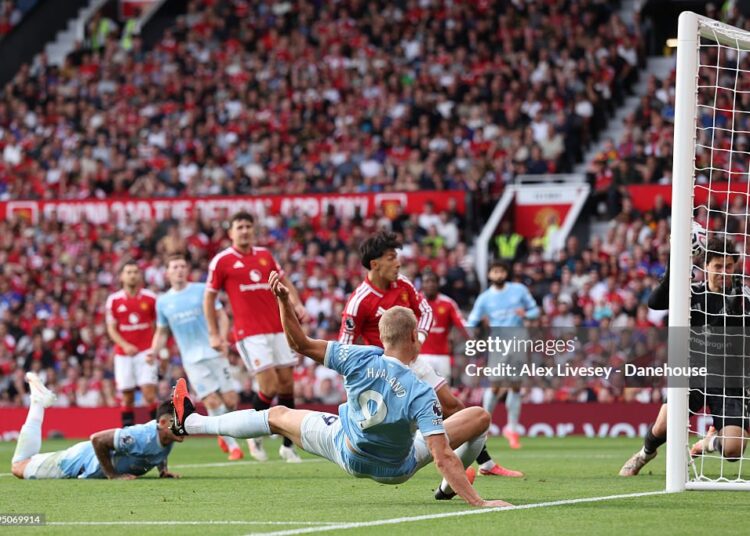

- Pro Ref Admits VAR Error in Haaland’s Manchester Derby Winner
The Premier League’s refereeing body has admitted that an error was made in allowing Erling Haaland’s winning goal in Manchester City’s 1-0 victory over Manchester United, intensifying scrutiny of VAR after a decision that ultimately settled one of English football’s biggest fixtures.
Haaland scored in the 60th minute at Old Trafford, finishing Josko Gvardiol’s cross at the back post after City had already been reduced to 10 men following Phil Foden’s dismissal in the first half.
The goal was initially ruled out for offside, but VAR overturned the on-field decision after determining that Haaland had been played onside by Manchester United defender Patrick Dorgu.
The controversy centred not on Haaland’s position, but on Manchester City midfielder Enzo Fernandez, who was in an offside position and attempted to play the ball before it reached the Norwegian striker.
Fernandez did not make contact, but his movement appeared to affect United defender Lisandro Martinez as he tried to deal with Gvardiol’s delivery. That raised the question of whether Fernandez had interfered with an opponent despite not touching the ball.
Pro Ref acknowledged after the match that the VAR had failed to assess the likely impact of Fernandez’s position and should have sent referee Michael Oliver to the pitchside monitor for an on-field review.
“It was established that Enzo Fernandez did not play the ball and therefore that makes any offside offence subjective,” the refereeing body said.
“However, on this occasion, the VAR did not recognise the likely impact of his position and should have recommended an on-field review.”
Pro Ref said it had contacted Manchester United to acknowledge what it described as an “error of judgement” and confirmed that the incident would be formally reviewed.
The admission is significant because the disputed goal was the only score in the Manchester derby and allowed City to secure all three points despite playing most of the match with 10 men.
Foden had been shown a straight red card in the 23rd minute after kicking out at United captain Bruno Fernandes while the midfielder was on the ground.
City nevertheless remained competitive and Haaland’s second-half finish ultimately proved decisive, extending his strong record in Manchester derbies.
The Premier League Match Centre had initially defended the VAR intervention, explaining that Haaland had been found to be onside and that Fernandez, while standing in an offside position, had not played the ball.
That explanation, however, focused heavily on contact with the ball rather than the wider offside law governing interference with an opponent.
Pro Ref’s later statement effectively acknowledged that the decision required a subjective assessment of Fernandez’s influence on the defenders around him, making it the type of incident that should have been referred back to the on-field referee.
Manchester United reacted strongly after the game.
Defender Lisandro Martinez described the outcome as an “injustice”, while manager Michael Carrick said he was confused by the interpretation that allowed the goal to stand.
The controversy has since had consequences for the officials involved.
Reuters reported on Monday that VAR Matt Donohue and assistant VAR Blake Antrobus had been stood down from Premier League duties for the following weekend after the refereeing leadership reviewed the incident.
The two officials are expected to remain unavailable at least until after the international break, according to reporting on the fallout from the derby decision.
The decision to remove the officials adds another layer to the debate over VAR’s role in English football.
VAR was introduced to correct clear and obvious errors and assist with factual decisions such as offsides, but incidents involving interference, intent and impact remain heavily dependent on interpretation.
The Haaland goal exposed precisely that tension.
Technology was able to establish that Haaland himself was onside, but the decisive issue was whether Fernandez’s actions from an offside position affected Martinez’s ability to defend.
That is ultimately a judgement call rather than a purely technological one.
The refereeing body’s admission therefore raises a broader question about where the line should be drawn between VAR making a decision itself and asking the referee to review subjective incidents on the monitor.
In this case, Pro Ref has concluded that the VAR crossed that line.
The admission will not change the result. Manchester City retain their 1-0 victory and the three points gained at Old Trafford.
But the fallout is likely to extend beyond a single derby.
With the officials stood down and Pro Ref promising a formal review, the incident is set to become another important test of how the Premier League applies VAR in situations where technology can establish a player’s position but cannot, on its own, determine the effect that player has on an opponent.
For Manchester United, the frustration is straightforward: the refereeing body has now acknowledged that the process used to award the decisive goal was flawed.
For the Premier League, the harder challenge is ensuring that the next subjective offside decision is handled differently before, rather than after, the final whistle.

