

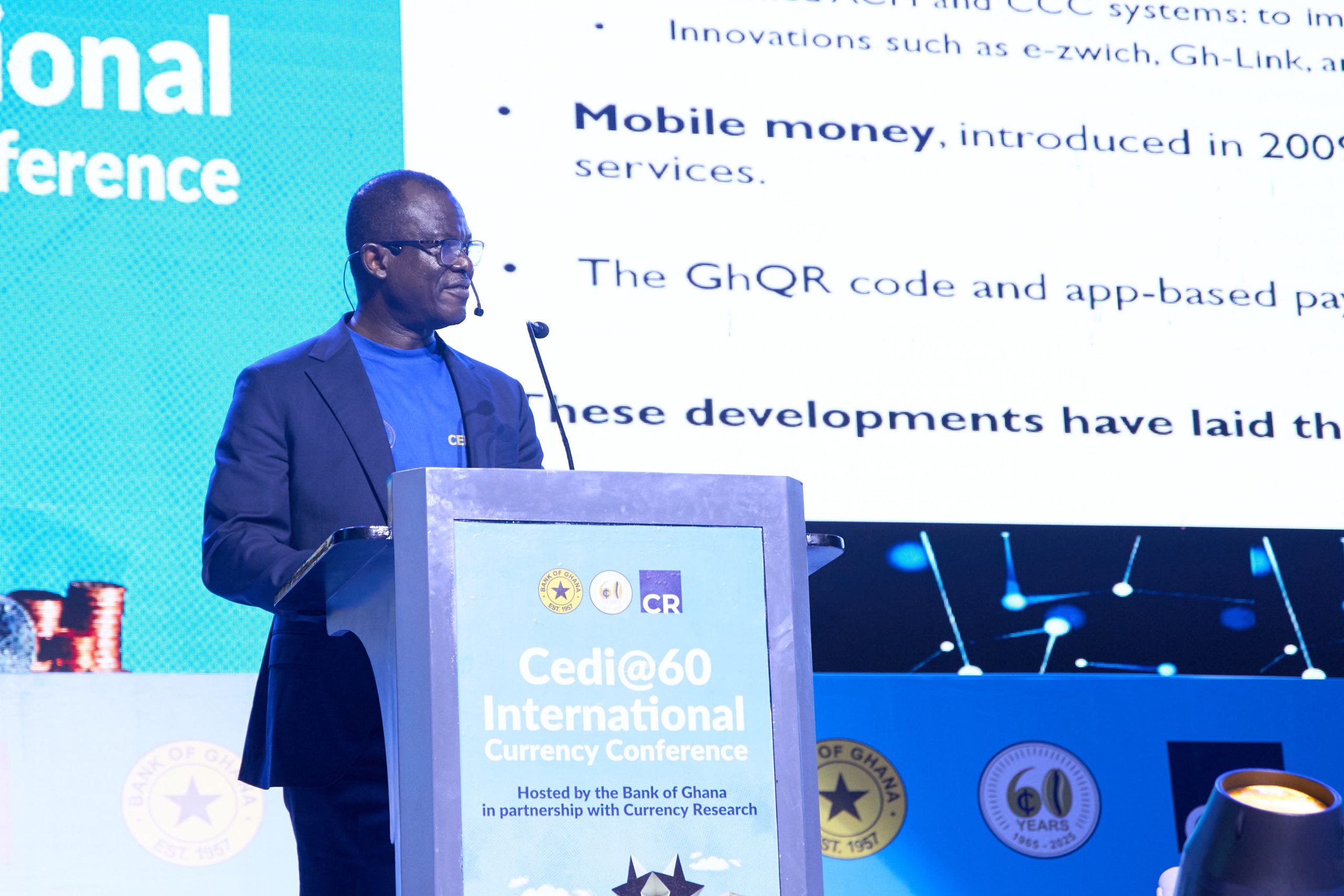

eCedi to Anchor Ghana’s Next Phase of Digital Finance Transformation, Says First Deputy Governor
Ghana’s drive toward a fully digital financial ecosystem has received fresh momentum as the Bank of Ghana (BoG) outlines a strategic vision for the eCedi, positioning it as a catalyst for efficiency, inclusion and monetary policy effectiveness.
Delivering a keynote address at the Cedi@60 International Currency Conference in Accra, First Deputy Governor of the Bank, Dr Zakari Mumuni, stated that despite significant progress in the payments ecosystem, “cash remains the most interoperable value” in the economy—underscoring the need for a sovereign digital currency backed by the central bank.
According to him, the eCedi represents “the next frontier of Ghana’s digital journey,” building on decades of reforms including the Ghana Interbank Settlement System, GhIPSS innovations, mobile money interoperability and the establishment of the FinTech and Innovation Office.
Dr Mumuni noted that mobile money’s rise from 3.4% of RTGS transaction value in 2015 to nearly half by 2024, illustrates the structural shift toward digital payments and the urgency for a central-bank-issued digital instrument that is secure, interoperable and resilient.
He argued that the eCedi will complement existing digital payment channels by:
• Enhancing payment efficiency and reliability, even during periods of market stress;
• Deepening financial inclusion through low-cost digital wallets and offline capabilities;
• Strengthening trust, transparency and security by reducing fraud and illicit transactions;
• Providing a platform for fintech innovation and expanded digital commerce;
• Improving monetary policy transmission through better visibility of money flows.
The First Deputy Governor emphasised that Ghana is uniquely positioned for CBDC adoption given its robust national ID system, digital address infrastructure, and a vibrant community of tech-savvy consumers and entrepreneurs.
However, he cautioned that challenges remain, particularly digital literacy gaps, cybersecurity threats, and limited device and connectivity access in underserved communities. He said the BoG has prioritised strong data protection, high security standards and offline transaction functionality as part of the design architecture.
Describing the eCedi as a “strategic instrument for national development,” Dr Mumuni asserted that its rollout will support financial sovereignty, reduce currency management costs, empower MSMEs, and strengthen Ghana’s competitiveness in Africa’s rapidly expanding digital economy.
“The eCedi marks a pivotal step in our digital transformation,” he said. “It will ensure that Ghana’s digital future is modern, secure, efficient, inclusive, and uniquely Ghanaian.”

