

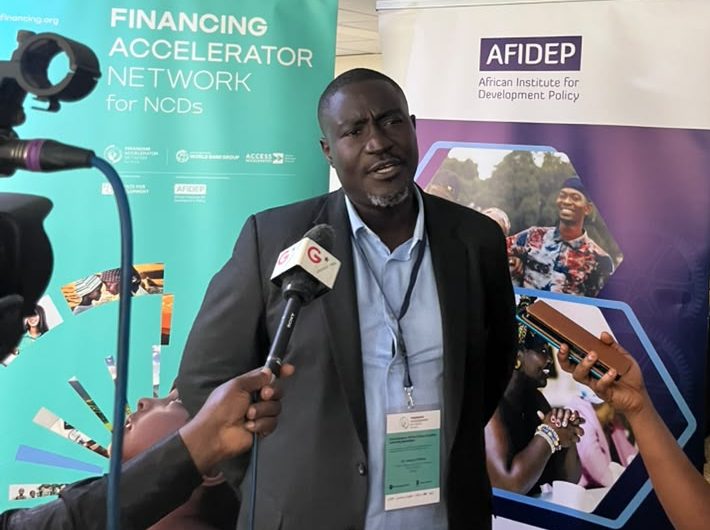

- Africa’s Health Financing Model Is Becoming Unsustainable as Chronic Diseases Rise — Dr Otieno
African governments must overhaul the way they finance healthcare and shift significantly more resources towards prevention, screening and primary healthcare as the rising burden of non-communicable diseases threatens household incomes, public budgets and the sustainability of health insurance schemes, according to Dr Jackson Otieno of the African Institute for Development Policy.
Dr Otieno, Senior Research and Policy Analyst-Director at AFIDEP, said the traditional model of financing individual diseases through largely separate programmes is becoming increasingly ill-suited to the continent’s changing disease profile.
Speaking in Accra on August 19 on the sidelines of the 2026 Sub-Saharan Africa Cross-Country Learning Workshop organised under the Financing Accelerator Network for NCDs, he argued that universal health coverage will remain difficult to achieve unless health systems are redesigned around the long-term cost of chronic disease.
“Ideally, when you talk of universal health coverage, we are talking about the government providing people with access to services, and those services, they should be able to access them when they need it without any financial burden,” he said. “That is what we talk about when you hear households are spending more on out-of-pocket. It is because the governments are not able to provide those services within those cost provisions.”
The financing challenge is becoming more acute as Africa undergoes a wider epidemiological transition. Dr Otieno said non-communicable diseases, which previously occupied about four positions among the 10 leading causes of mortality in many countries, are increasingly accounting for between six and eight of the top 10.
That shift matters because chronic conditions such as cancer, cardiovascular disease and diabetes create a fundamentally different cost structure from many infectious diseases.
A patient treated for malaria may recover after a relatively short course of care, while cancer can require repeated diagnostics, chemotherapy, medicines, specialist consultations and prolonged follow-up over months or years.
The financial impact extends well beyond hospital bills. Dr Otieno said households dealing with cancer and other severe NCDs can absorb extremely high costs, while family members may also lose income because of time spent providing care.
“If you’re a household member [who] has been screened or has been diagnosed with cancer, how much does it cost households? It costs households on average of 60% and above. And where cases are such as cancer, they cost households even over 90%,” he said.
“You are looking at the money you have to get to do the chemo. But you’re also spending time taking care of that person, which is non-monetised. If you monetise that, it becomes a serious issue.”
The broader economic consequence is a double burden. Governments face rising healthcare costs at the same time as households lose productive working hours and patients may withdraw partly or entirely from economic activity, weakening incomes and potentially reducing the tax base.
For Dr Otieno, that makes prevention not only a public health intervention but a financing strategy. He argued that African governments should direct significantly more resources towards primary healthcare, early screening, public education and risk reduction before patients require expensive specialist treatment.
“Why don’t we now step back and ask ourselves, is it now not the right time to invest more, prioritise primary healthcare?” he asked.
He also questioned the efficiency of maintaining multiple vertical programmes at community level. In many countries, separate health workers can be assigned to immunisation, HIV, maternal health and other programmes even though they serve the same households and communities.
A more integrated model, he argued, could allow community-level personnel to conduct multiple interventions, including hypertension screening and identification of early warning signs of chronic disease. Such integration could lower delivery costs and make better use of scarce health workers at a time when governments are operating under tight fiscal constraints.
National health insurance schemes should also be redesigned to make prevention more central. Dr Otieno suggested that routine NCD screening could become a standard and deliberate benefit attached to insurance coverage.
“Why don’t we make the deliberate effort, for example, just to say, be very sure the first charge of that insurance is screening for NCDs,” he said. “So immediately when you renew the insurance cover or immediately the years pass, we all need to go through screening and early diagnosis just so that we catch some of these conditions early in time.”
The underlying economics are straightforward. Earlier diagnosis can reduce the number of patients who eventually reach stages requiring the most expensive forms of treatment, while also improving the chances that conditions can be managed before they become debilitating.
“If you have a scheme that is quite predominantly being utilised by people with cancer, you can’t sustain that scheme,” Dr Otieno warned. “But if you spend more money in prevention, if you spend more money in screening, if you spend more money on providing the right information [and] education, then you’re trying to limit those people who go through.”
The warning is especially relevant to African countries pursuing universal health coverage through national insurance systems. Expanding enrolment without changing the composition of spending could leave insurance schemes increasingly exposed to expensive chronic conditions as populations age and NCD prevalence rises.
Dr Otieno also called for higher overall public expenditure on healthcare. He said countries should invest at least 5.00% of GDP in health, compared with an African average of about 2.00%, while directing at least 15.00% of national budgets towards the sector and moving towards expenditure of roughly US$86 per person.
The 15.00% threshold reflects the longstanding Abuja commitment, but progress across African countries has remained uneven. For governments facing debt-service pressures and competing demands on education, infrastructure and social protection, raising health allocations to those levels will require difficult fiscal choices.
Dr Otieno nevertheless argued that increasing the size of the health budget without changing spending priorities would be insufficient. For Ghana, he acknowledged steps to strengthen health financing, including the decision to redirect previously capped health-related revenues to the National Health Insurance Scheme, but said spending should be reprioritised towards prevention and health promotion.
“We want them to increase the allocation, but we also want them to reprioritise where that money goes. One, start with prevention, promotive. That is what we want them to do,” he said.
The distinction is crucial because hospital construction and specialist care remain necessary, but they address only the consequences of rising chronic disease if prevention remains weak. Without earlier intervention, governments risk continuously expanding the most expensive parts of the health system simply to keep pace with new cases.
For households, the problem is equally stark. Universal health coverage is meant to protect citizens from financial hardship when they seek care, but if chronic diseases continue to require high out-of-pocket spending, nominal insurance coverage may provide limited real protection.
The Accra workshop, taking place from August 19 to 20, is focused on accelerating the integration of NCD services, essential medicines and diagnostics into universal health coverage reforms across Sub-Saharan Africa. The discussions reflect growing recognition that NCD financing cannot remain a peripheral component of health policy as the disease burden shifts.
Dr Otieno’s argument ultimately reframes the financing debate. The choice confronting governments is not simply whether to spend more on health, but whether to continue absorbing the rapidly rising cost of late-stage disease or restructure expenditure around prevention and primary care before those costs become even more difficult to control.
As NCDs consume a growing share of household and public resources, that decision will increasingly determine whether universal health coverage remains financially achievable. For African governments, prevention is therefore becoming not just the cheaper option, but potentially the condition for keeping health insurance and public budgets sustainable over the long term.

