


Civil Society Coalition Joins Supreme Court Case on Future of Special Prosecutor’s Office
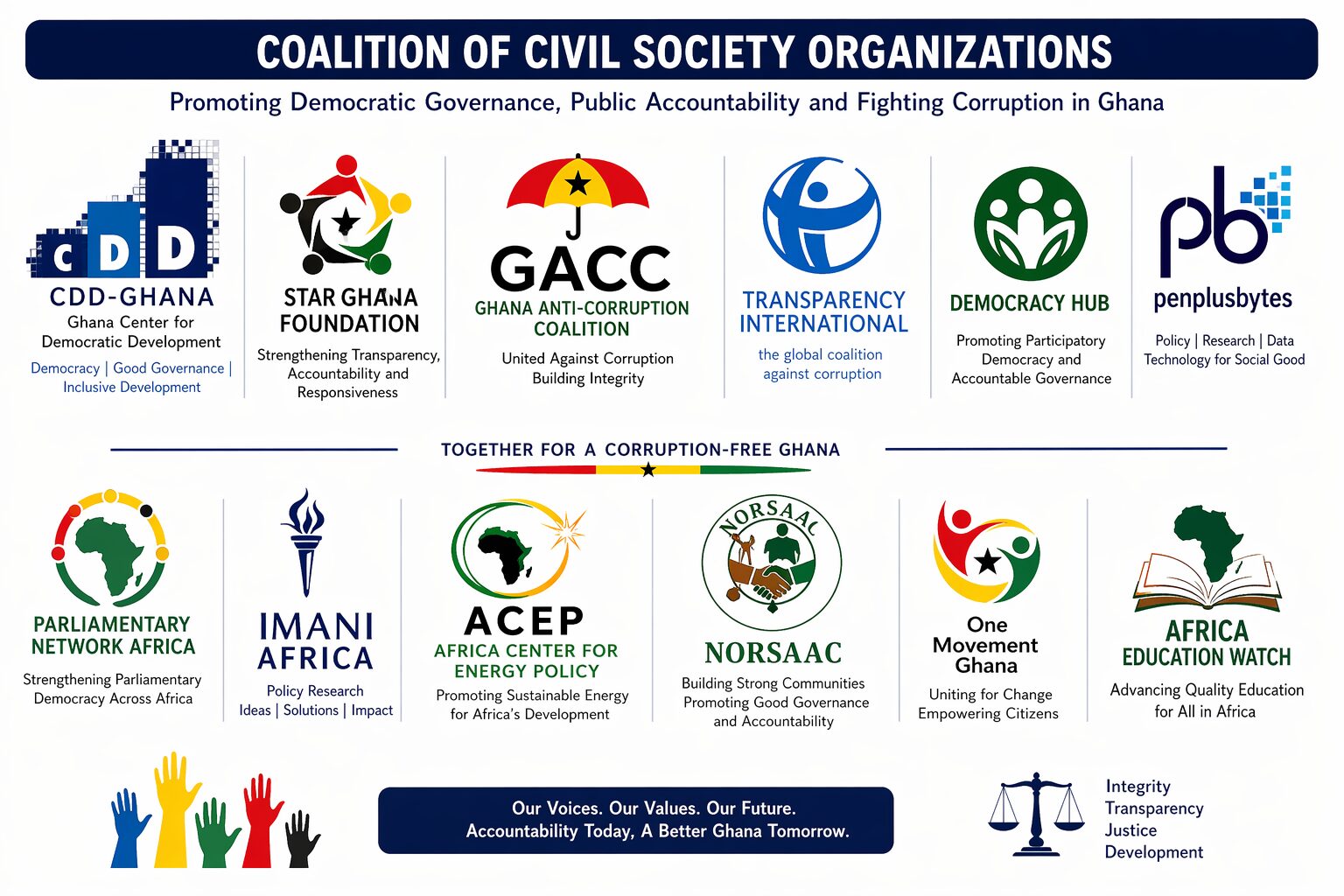
The Supreme Court has granted a Civil Society Coalition permission to intervene as amici curiae in an ongoing case challenging the constitutionality of aspects of the Office of the Special Prosecutor Act, 2017, Act 959. The coalition said the court’s decision gives civil society groups an opportunity to place before the justices their considered views on the civic advocacy, policy deliberations and legislative processes that led to the establishment of the Office of the Special Prosecutor.
“Earlier today, the Supreme Court granted our application to intervene as amici curiae in the ongoing case challenging the constitutionality of aspects of the Office of the Special Prosecutor Act, 2017 (Act 959),” the coalition said in a press statement issued on Tuesday, May 19, 2026.
The intervention places civil society actors at the centre of one of the most consequential legal tests facing Ghana’s anti-corruption framework, as the court examines questions that could affect the powers, structure and future operation of the Office of the Special Prosecutor.
According to the statement, the coalition intends to assist the Supreme Court with historical and policy context on how sustained civic advocacy contributed to the creation of the OSP.
“The grant of our request allows us to place before the Court the considered views of the coalition on the history of the sustained civic advocacy, policy deliberations and legislative processes that culminated in the creation of the Office of the Special Prosecutor,” the coalition noted.
The group said its participation would also allow it to draw the court’s attention to international best practices and comparative case law on prosecutorial powers, as well as the practical consequences the case could have for Ghana’s anti-corruption fight.
“The grant of leave to intervene in the matter also affords us the opportunity to draw the Court’s attention to the wider body of international best practices and comparative case law on the exercise of prosecutorial powers, as well as to the practical consequences of the case on the fight against corruption,” the statement added.
The coalition thanked the Supreme Court for granting leave and acknowledged the Attorney-General’s decision not to oppose its application to intervene.
The case is expected to carry significant implications for Ghana’s anti-corruption architecture, particularly around the independence, mandate and prosecutorial authority of the OSP.
Civil society groups were among the key advocates for the creation of the Office of the Special Prosecutor, which was designed to investigate and prosecute corruption and corruption-related offences involving public officers, politically exposed persons and private individuals implicated in public sector corruption.
The coalition said it looked forward to assisting the court on questions that would shape Ghana’s anti-corruption architecture “for a generation.”
For governance observers, the Supreme Court’s decision expands the range of voices in a case that goes beyond legal interpretation and enters the broader question of how Ghana builds independent institutions capable of confronting corruption without weakening constitutional accountability.
The outcome could therefore determine not only the legal boundaries of the OSP’s prosecutorial powers, but also the credibility of Ghana’s wider anti-corruption reform agenda.

