


- Women Must Be Central to Reparatory Justice Agenda – President Mahama
President John Dramani Mahama has said any credible reparations framework for the transatlantic slave trade must recognise the distinct suffering endured by enslaved African women and girls, warning that historical redress will remain incomplete if it fails to confront gendered exploitation.
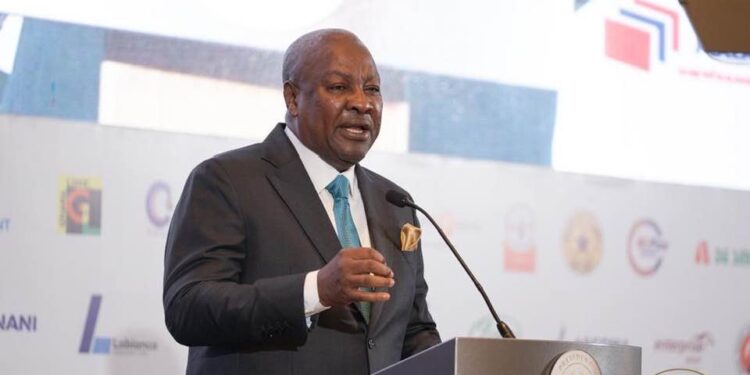
Speaking at the Heads of State Session of the Next Steps High-Level Consultative Conference on Reparatory Justice in Accra, President Mahama said the experiences of women must be placed at the centre of truth-telling, memorialisation, restitution and justice.
He said the violence of slavery was suffered by millions of African men, women and children, but women and girls were subjected to additional forms of exploitation that have often received limited attention in mainstream historical accounts.
“Any framework for truth-telling, memorialisation, reparatory justice, or historical reckoning that fails to recognise the specific experience of women will remain incomplete,” President Mahama said.
The statement adds a gender dimension to Ghana’s growing advocacy for reparatory justice, which has gained renewed prominence as African and diaspora leaders seek to transform historical recognition into practical mechanisms for redress.
President Mahama said enslaved women did not only suffer forced labour, displacement, family separation and racialised violence. Their bodies and reproductive capacity were also exploited as instruments for sustaining slavery across generations.
That experience, he argued, requires a reparations conversation that does not treat slavery as a gender-neutral crime.
His comments broaden the reparatory justice debate beyond compensation, apology and restitution of cultural artefacts, placing women’s trauma, resistance and memory at the heart of the process.
For Ghana, the message is strategically significant.
The country has positioned itself as a leading African voice in the global reparations movement, building on the legacy of Pan-Africanism, diaspora engagement and historical memory.
But President Mahama’s remarks suggest that Ghana wants the movement to address not only the general harm of slavery and colonial exploitation, but also the unequal and often hidden burdens borne by women.
The President paid tribute to women who resisted slavery and oppression, citing Harriet Tubman and Sojourner Truth as examples of courage and defiance.
He also acknowledged the many unnamed women whose resilience helped preserve families, communities and hope under brutal conditions.
That recognition matters because the history of slavery has often elevated male resistance leaders while underplaying the role of women as organisers, protectors, cultural custodians and freedom fighters.
Women resisted in multiple ways: through escape, rebellion, preservation of language and culture, protection of children, community building and spiritual resilience.
A reparatory justice framework that recognises these roles would help correct the historical erasure of women’s agency.
President Mahama also said women continue to play an important role in the modern struggle for reparatory justice, including as scholars, activists, jurists and policymakers.
This point links the past to the present.
It suggests that women are not only victims whose suffering must be remembered, but also leaders whose voices must shape future reparations architecture.
The implication is that any global reparations framework must include women in its design, negotiation, implementation and monitoring.
If women are excluded from the decision-making process, the framework risks reproducing the same forms of historical marginalisation it seeks to correct.
The President’s intervention comes as Ghana and other countries push for a more structured international reparatory justice agenda.
The broader conference in Accra is focused on moving the reparations debate from recognition to action, with emphasis on truth-telling, education, memorialisation, legal pathways, restitution and stronger partnerships between Africa, the African diaspora and the international community.
President Mahama said Ghana’s advocacy had gained international recognition following the adoption of a United Nations General Assembly resolution championed by the country.
The resolution acknowledged the scale, brutality and lasting effects of the trafficking of enslaved Africans and racialised chattel enslavement.
For Ghana, the UN recognition provides diplomatic momentum.
But the President’s remarks indicate that recognition alone is not enough. The next phase must turn historical acknowledgement into practical outcomes.
These outcomes could include research into the gendered dimensions of slavery, public education, memorial sites, archives, restitution programmes, legal advocacy and development initiatives that address the continuing legacies of historical injustice.
A gender-inclusive reparations framework would also require more deliberate documentation of women’s experiences.
Many records of slavery were produced by slave traders, colonial authorities and plantation owners. These records often treated enslaved people as property and rarely captured the emotional, reproductive, cultural and communal dimensions of women’s suffering.
To correct that gap, historians, archivists, educators and researchers will need to recover women’s stories through oral histories, family memory, cultural records, court documents, abolitionist writings, church records, museum collections and diaspora archives.
Such work is not only academic.
It is central to justice.
A society cannot repair what it refuses to fully understand.
President Mahama’s emphasis on women therefore challenges governments, museums, schools, universities and international organisations to rethink how the history of slavery is told.
It also speaks to contemporary debates about gender justice.
The historical exploitation of enslaved women has long-term consequences that are visible in racial inequality, economic exclusion, health disparities, family disruption and cultural dispossession experienced by descendants of enslaved Africans.
Reparatory justice, if it is to be meaningful, must recognise these intergenerational effects.
The President was careful to frame the reparations agenda not as an attempt to assign personal guilt to today’s generation, but as a call to accept responsibility for the enduring consequences of historical injustice.
“History does not ask us to inherit guilt, but it asks us to inherit responsibility,” he said.
That formulation is politically important.
It shifts the conversation away from blame and toward responsibility, repair and shared humanity.
Opponents of reparations often argue that current generations should not be held accountable for crimes committed centuries ago.
President Mahama’s framing responds to that argument by insisting that the issue is not inherited guilt, but inherited consequences.
The effects of slavery and colonial exploitation did not end when formal systems were abolished. They shaped wealth, institutions, trade, education, land, race relations and global power structures.
If the consequences remain, he suggested, then responsibility also remains.
The President also said the success of the current generation will not be measured merely by the resolutions adopted, but by whether recognition is translated into meaningful action.
This is perhaps the most important test of the reparations movement.
Conferences, declarations and speeches can raise awareness, but the agenda will ultimately be judged by institutional progress.
That progress must include legal strategies, educational reform, cultural restitution, financial commitments, policy frameworks and measurable programmes that address historical and continuing inequality.
Gender must be built into those mechanisms from the beginning.
For example, memorialisation should tell the stories of enslaved women and girls, not only famous male leaders or generalised narratives of suffering.
Education curricula should explain the reproductive exploitation and sexual violence that formed part of slavery’s economic logic.
Restitution processes should consider cultural objects, sacred items and archives connected to women’s histories and communities.
Legal advocacy should include the specific harms suffered by women as part of the broader claim for reparatory justice.
Development initiatives linked to reparations should also consider women’s economic empowerment, health, education and leadership.
This approach would make reparatory justice more complete and more honest.
It would also align historical justice with present-day gender equality.
President Mahama’s comments therefore deepen the moral and policy content of the reparations debate.
They remind the global community that slavery was not experienced in a single way.
The violence of enslavement was racial, economic, social, cultural and gendered.
A reparations framework that ignores any of these dimensions risks producing incomplete justice.
For Ghana, the challenge is now to help translate this gender-inclusive vision into the practical architecture of the global reparations movement.
That means ensuring that women are represented on advisory panels, legal committees, research bodies and cultural restitution processes.
It also means supporting scholarship, public education and international advocacy focused on enslaved women and girls.
The President’s message was clear.
Reparatory justice cannot be selective.
It cannot remember labour while forgetting reproductive exploitation. It cannot remember resistance while erasing women’s courage. It cannot speak of historical repair while excluding the voices of those whose suffering was compounded by gender.
If reparations are to be meaningful, women must not be an afterthought.
They must be central to the framework, the memory and the action.

