


- Ato Forson Says New Economy Will Reshape Ghana’s Production Base
Finance Minister Dr Cassiel Ato Forson has described the government’s New Economy programme as a four-year plan to reshape Ghana’s economic structure, placing the coming 2027 Budget at the centre of a promised shift from stabilisation towards production, investment and jobs.
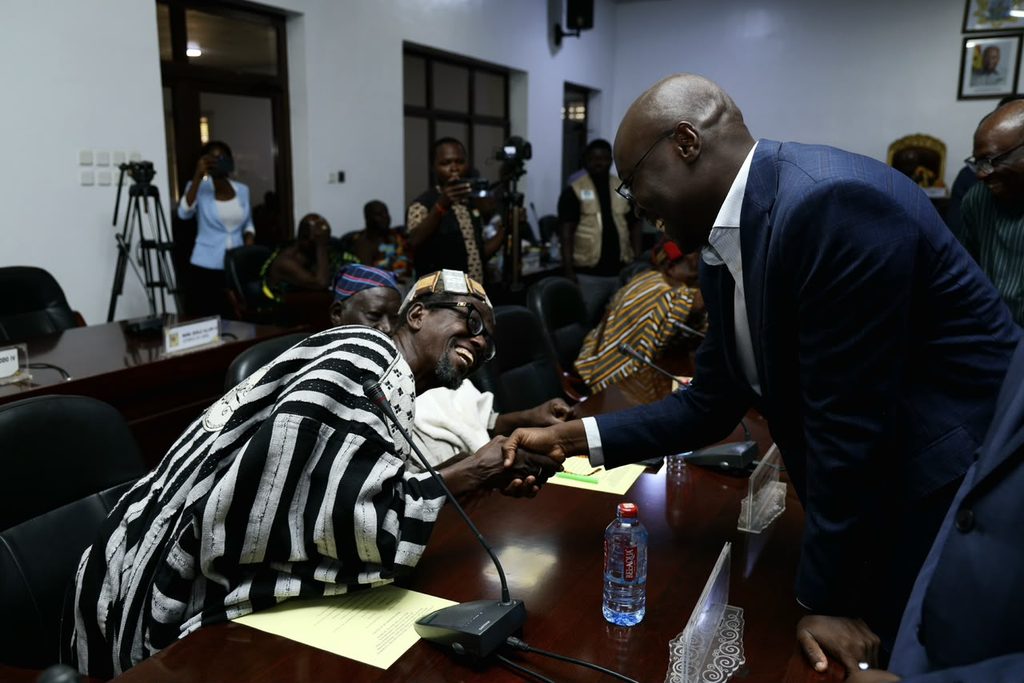
“The New Economy is the Government of Ghana’s four-year programme to transform the structure of the Ghanaian economy,” he told the National House of Chiefs. The programme is due to be unveiled alongside the 2027 Budget on November 12.
The government has said it intends to invest US$10 billion between 2027 and 2030, or about US$2.5 billion a year, across priority sectors.
The ambition is to expand local manufacturing and commercial agriculture, process more raw materials in Ghana, reduce dependence on imports, increase exports and create employment. Government has identified agriculture and agro-processing as a major part of the plan, with President John Mahama previously saying they would receive US$5 billion over four years.
The chiefs are an important audience for a programme that will depend on more than budget allocations. Traditional authorities influence access to land, local legitimacy and community relationships factors that can determine whether agricultural, industrial and infrastructure projects move from announcement to construction and operation.
Their support may help implementation, but the programme will also need clear terms for land use, compensation, local participation and accountability.
The plan arrives as Ghana’s economy continues to grow, while the composition and employment effects of that growth remain central questions.
Real GDP expanded by 6.2% in the first half of 2026, but non-oil growth slowed to 5.9% from 8.2% in the first half of 2025. The headline growth figure is solid; the slowdown outside oil points to the challenge of sustaining momentum through a broader base of productive activity.
The employment question is more pressing. Ghana Statistical Service data show that close to two million people aged 15 to 35 were not in employment, education or training in the third quarter of 2025.
The figures also show that young women made up more than six in ten of this group. A transformation plan will need to demonstrate how investment in priority sectors translates into accessible, durable work, rather than relying on growth alone as a proxy for job creation.
Government has said the New Economy is intended to move Ghana beyond stabilisation and towards an economy that creates jobs and grows through domestic production. The Finance Ministry has described it as a programme for wealth generation and sustainable growth.
Those objectives make the quality of investment as important as its scale: the plan needs to show how resources will raise productivity, support businesses and connect local producers to markets.
The forthcoming Budget will therefore need to answer practical questions about the US$10 billion target. How much will come from public funds, private investment and development finance?
Which projects will be prioritised, and how will the government prevent the same investment from being counted under multiple programmes?
What performance measures will show whether the money has increased production, exports and employment?
Those questions matter because Ghana’s 2026 Budget already made a substantial capital-spending commitment. It allocated GH¢57.5 billion for capital expenditure, including funding for the Big Push infrastructure programme.
But first-half fiscal data showed capital spending of about GH¢22.2 billion against a programmed GH¢36.6 billion. The gap underlines the difference between allocating resources and getting projects funded, procured and completed.
That execution record will shape how investors and businesses assess the New Economy. A programme that promises to build processing capacity, expand agriculture and support exports will need predictable financing, sound project preparation and transparent procurement. It will also need reliable infrastructure especially energy, transport, irrigation and logistics so firms can produce at competitive cost.
Fiscal discipline remains a constraint and a foundation. The government has committed to maintaining a primary surplus of 1.5% of GDP in 2026, with the IMF’s programme framework allowing the target to fall to 0.5% from 2027, provided progress continues on revenue mobilisation and public financial management.
Any additional investment must fit within a credible financing plan and avoid recreating the debt and payment pressures that Ghana has been working to contain.
The plan’s growth targets will be another test. The government is aiming for growth above 6% a year, with an inflation target of 7% plus or minus two percentage points. These are ambitions, not outcomes.
Their credibility will rest on how well the proposed investment addresses constraints in production and how quickly projects begin delivering measurable results.
For traditional authorities, the economic transformation agenda has direct local implications. Agricultural investment can create demand for land, water and infrastructure; processing plants can change local employment and supply chains; mining and critical-mineral projects can raise questions about environmental effects and how much value remains in communities. Consultation with chiefs will matter, but so will publishing clear standards for local jobs, procurement and community benefits.
The 2027 Budget is expected to provide the first detailed account of how the New Economy will work. It should set out funding sources, project selection criteria, timelines, responsible agencies and public reporting measures.
Annual disclosures on money committed and spent, production capacity created, exports generated and jobs sustained would make it possible to assess whether the programme is changing the structure of the economy.
The New Economy’s promise is significant. Its credibility will depend on whether the country can convert a four-year investment commitment into functioning infrastructure, stronger businesses and livelihoods that last.
The chiefs have been briefed on the vision; the Budget now needs to show how it will be delivered.

