

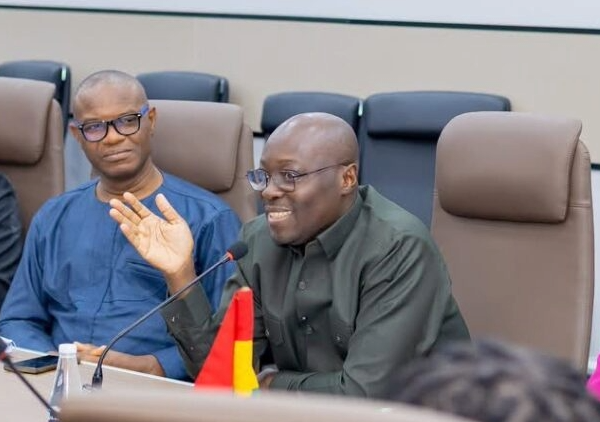

- Ato Forson Tells Businesses to Invest as Ghana Prepares US$10bn Economic Plan
Finance Minister Cassiel Ato Forson has urged businesses to resume investment and expansion, declaring that Ghana’s “golden era” is beginning as the government prepares a US$10bn economic transformation programme for the 2027 Budget.
Dr Forson told the leadership of the Association of Ghana Industries and senior business executives that the government would protect the macroeconomic gains achieved over the past year while using the next budget to shift the economy towards production, exports and job creation.
“Feel free to invest because we will sustain the gains,” he said. “The golden era for Ghana is beginning, and our new blueprint will be announced in the 2027 Budget.”
“That is why the 2027 Budget will move Ghana from stability to transformation.”
The language is deliberately ambitious. It seeks to persuade businesses that the recent improvement in Ghana’s macroeconomic indicators is durable enough to justify longer-term commitments of capital.
But the distance between economic stabilisation and a sustained investment cycle remains considerable.
For businesses, confidence depends not only on lower inflation or interest rates. It also requires predictable taxes, reliable electricity, access to credit, efficient logistics and confidence that government will not respond to future revenue pressures with abrupt policy changes.
The 2027 Budget will therefore be judged less by the scale of its promises than by whether it resolves the constraints preventing manufacturers from turning macroeconomic stability into additional output.
Kofi Nsiah-Poku, President of the Association of Ghana Industries, acknowledged the improvement in the economy but said attention must now shift towards growth and employment.
“We are grateful for what you have achieved so far,” he told the Finance Minister.
“We now know that we have achieved stability, and it is time for us to grow so that we can create jobs.”
The statement captures the private sector’s central concern.
Stability is necessary because high inflation, exchange-rate volatility and rising interest rates make it difficult for businesses to plan. But stability alone does not guarantee that companies will invest.
An economy can achieve lower inflation while credit remains too expensive or unavailable. A stable exchange rate can reduce uncertainty but cannot compensate for unreliable power, delayed public-sector payments or weak consumer demand.
The government must therefore show how its “New Economy” programme will improve the expected return on private investment.
Dr Forson said the meeting with AGI formed part of consultations on the 2027 Budget.
“We are preparing a new direction for the country,” he said. “I called this meeting to engage you on what will help you expand, export more and create more jobs.”
Consultation is important, but businesses will expect the final budget to demonstrate how their recommendations shaped specific tax, infrastructure and financing decisions.
President John Dramani Mahama has announced plans to invest US$10bn in strategic sectors over four years under the New Economy programme.
The full blueprint is expected to be presented in the 2027 Budget, with the government describing it as the vehicle that will move Ghana beyond crisis management towards productive growth.
“We want to produce more, add value and create more jobs for the Ghanaian economy,” Dr Forson said.
“This means addressing the fundamental challenges we face as a country.”
The Finance Ministry has said the programme will target job creation, wealth generation and growth based on domestic production.
“Stabilisation was never the destination. It was the price of entry,” Dr Forson said earlier during consultations on the programme. “Ghana has paid that price. What comes next is the work that changes lives at scale the work of transformation.”
The scale of the proposed investment immediately raises questions about financing.
A US$10bn programme over four years would require an average of US$2.5bn annually if spending were distributed evenly. That is substantial for a government still managing debt-service pressures and attempting to rebuild access to capital markets.
The 2027 Budget will need to specify how much of the programme will be funded directly by the state, how much will come from development partners and what proportion is expected from private investors.
It must also distinguish between firm financing commitments and anticipated investment.
Without that clarity, the US$10bn figure could represent an aggregation of government spending, private capital and projects at different stages of readiness rather than money immediately available for deployment.
The strongest version of the programme would identify projects, financing sources, implementation timelines and the institutions responsible for delivery.
It would also explain how the government intends to select investments and prevent the programme from becoming a collection of politically attractive but commercially weak projects.
Dr Forson said the government had deliberately reduced the cost of capital and would work to push it lower.
Ghana’s monetary policy rate stands at 14 per cent after the Bank of Ghana’s Monetary Policy Committee maintained it in September.
The policy rate has declined significantly from the restrictive levels associated with the country’s recent inflation and currency crisis. But the rate charged to businesses depends on more than the central bank’s benchmark.
Commercial lending rates reflect banks’ funding costs, credit risk, operating expenses and the returns available on government securities.
If lending to government remains attractive and relatively less risky, banks may still prefer public debt to financing manufacturers, particularly small and medium-sized enterprises without substantial collateral.
Reducing the cost of capital therefore requires more than cutting the policy rate.
It requires fiscal discipline that limits government’s demand for domestic financing, stronger credit-information systems and mechanisms that reduce the risks banks associate with productive-sector lending.
Businesses also need longer-term capital. Short-tenor loans are poorly suited to investments in factories, machinery and export capacity that may take several years to generate returns.
The Finance Minister asked industry to support domestic revenue mobilisation, arguing that higher revenue would reduce the government’s reliance on borrowing.
“We need your support to raise the necessary revenue so that the government does not borrow beyond its means, as we saw in 2022,” he said.
The principle is difficult to dispute. A government that consistently spends beyond its revenue base will eventually borrow more heavily, accumulate arrears or reduce essential investment.
But the method of raising revenue matters.
Higher tax rates imposed on a narrow group of compliant businesses can reduce investment while leaving the informal economy largely untouched.
The more sustainable approach would broaden the tax base, improve compliance, simplify administration and reduce leakages.
Industry will expect the 2027 Budget to show that government expenditure will be subjected to the same discipline being demanded of taxpayers.
Businesses are more likely to support revenue measures if they can see a credible connection between the taxes they pay and improvements in energy, transport, digital infrastructure and public services.
Ghana’s improving macroeconomic position gives the government a stronger platform from which to pursue transformation.
Inflation has fallen substantially from crisis-era levels, monetary policy has become less restrictive and business confidence has improved.
The government has also demonstrated renewed access to the domestic medium-term bond market, including a GH¢3.15bn four-year issuance at 12 per cent.
Yet risks remain. Public debt is still elevated, the external sector faces commodity-price and reserve pressures, while businesses continue to confront high utility, logistics and financing costs.
The Finance Minister’s appeal to “invest with confidence” is therefore an invitation to believe that the policy environment will remain stable beyond the immediate recovery.
Investors will require evidence that fiscal discipline will survive spending pressures, that tax policy will remain predictable and that the US$10bn programme will be financed without recreating the imbalances the government is attempting to escape.
The 2027 Budget has consequently assumed significance beyond an annual statement of revenue and expenditure.
It will be the first detailed test of whether the government’s transformation language can be converted into an investable programme.
Ghana may indeed be approaching a more promising economic period. But a “golden era” will not be established by improved indicators or declared in a speech.
It will begin when businesses can borrow, invest, produce and export with reasonable confidence that the rules and the stability underpinning them will endure.

