

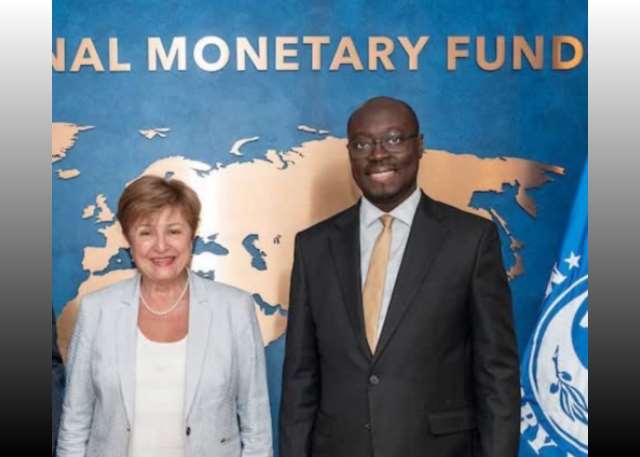

- IMF Praises Ghana’s Economic Gains as the New Economy Budget Raises the Stakes
The International Monetary Fund says Ghana’s reforms are beginning to deliver greater stability and stronger growth, signalling a shift in its engagement with the country from crisis response towards longer-term resilience.
The assessment is welcome after years of economic distress. It also raises a harder question: can Ghana make the recovery durable without relying on favourable commodity prices, tight spending controls and external support?
IMF spokesperson Julie Kozack said Ghana’s growth had exceeded expectations and that the country was seeing greater macroeconomic stability. The reforms, she said, were “now bearing fruits … in terms of stability and the strength of the economy.”
That is an important change in tone, but it is not a declaration that Ghana’s economic vulnerabilities have disappeared. The distinction matters. Stability can improve quickly when inflation falls, the currency strengthens and confidence returns.
Resilience takes longer: it depends on institutions, productive investment and public finances strong enough to withstand the next shock.
Ghana has made measurable gains since the crisis that forced it to seek support from the IMF. The Fund’s July review recorded real GDP growth of 6.00% in 2025 and 6.40% year on year in the first quarter of 2026. Inflation had declined to 5.30% in June, while gross international reserves reached US$11.90 billion by the end of 2025.
The IMF also upgraded Ghana’s risk of debt distress from high to moderate, two years earlier than expected when the programme began.
The latest review adds to that picture. IMF staff said Ghana’s economy grew by 6.20% year on year in the first half of 2026, driven by investment, and projected growth of 5.70% for the full year. Inflation was 5.50% in October, below the Bank of Ghana’s target band of 8.00% ±2 percentage points.
The Fund reached a staff-level agreement on the first review of Ghana’s 36-month Policy Coordination Instrument, but the agreement still requires approval by IMF Management and the Executive Board.
The PCI is a non-financing arrangement. Its importance is not that it supplies new cash, but that it gives the Fund a continuing role in monitoring reforms and gives investors and development partners a signal about the government’s policy commitments.
Ghana’s earlier Extended Credit Facility programme ended in July, after disbursements of about US$3 billion. The next phase is meant to anchor reforms after emergency financing, when the responsibility for sustaining confidence rests more heavily on the country’s own decisions.
That shift is particularly relevant after the 2027 Budget, which commits GH¢30 billion to the New Economy programme in its first year. The allocation is part of a four-year US$10 billion plan intended to raise production, exports and employment. It marks a move from stabilisation towards investment-led growth.
But it also puts pressure on the government to show that new spending can expand productive capacity without weakening the fiscal gains that helped restore confidence.
The budget targets a primary surplus of 0.50% of GDP in 2027, down from 1.50% in 2026. The government says the New Economy allocation will be funded through this fiscal space and revenue measures, rather than new taxes. The overall deficit is projected at 3.60% of GDP on a cash basis and 2.90% on a commitment basis.
Those numbers make the quality of spending critical. Investment in agriculture, energy, manufacturing and value addition may help reduce import dependence and strengthen future export earnings. But an allocation is not yet an outcome.
Projects must be selected carefully, procured transparently and completed on time. If expenditure rises faster than productive capacity, the result could be renewed pressure on prices, borrowing and the exchange rate.
The IMF’s recent assessment points to the same implementation test. Its priorities include strengthening domestic revenue mobilisation, improving public financial and investment management, and tighter oversight of state-owned enterprises, particularly in the energy and cocoa sectors. These are not technical footnotes. They determine whether public investment creates durable assets or becomes another source of arrears and fiscal risk.
External resilience remains another fault line. The Fund’s November review noted that reserves had declined in recent months.
The authorities responded by shifting foreign-exchange intermediation from the Bank of Ghana to GoldBod and introducing a higher gold sale requirement for large-scale miners. The IMF said consistent implementation, alongside greater exchange-rate flexibility, would be essential to rebuild reserves.
This is a reminder that stability remains exposed to the same forces that have shaped Ghana’s past crises: commodity-price swings, foreign-exchange pressures and spending obligations that exceed available revenue.
Gold and cocoa earnings can support the cedi and public finances, but they cannot substitute indefinitely for a broader and more reliable export base.
The recovery also needs to reach households and firms. Lower inflation reduces the pace at which prices rise; it does not restore purchasing power already lost. Strong GDP growth is meaningful, but its effect depends on whether it creates jobs, raises incomes and improves access to finance.
The government’s New Economy programme will ultimately be judged on those outcomes, not just on its headline allocation.
The IMF’s praise should therefore be read as recognition of progress, not a clean bill of health. Ghana has moved beyond the most acute phase of the crisis, and its reforms have helped restore confidence.
Now it must demonstrate that stability can support sustained investment without reopening the fiscal and external pressures that made the crisis so costly.
The next test is whether Ghana can turn reform into resilience: a stronger revenue base, more disciplined public investment, healthier state enterprises and exports less vulnerable to the price of a few commodities. The IMF says the gains are bearing fruit. The task ahead is to make sure they take root.

