

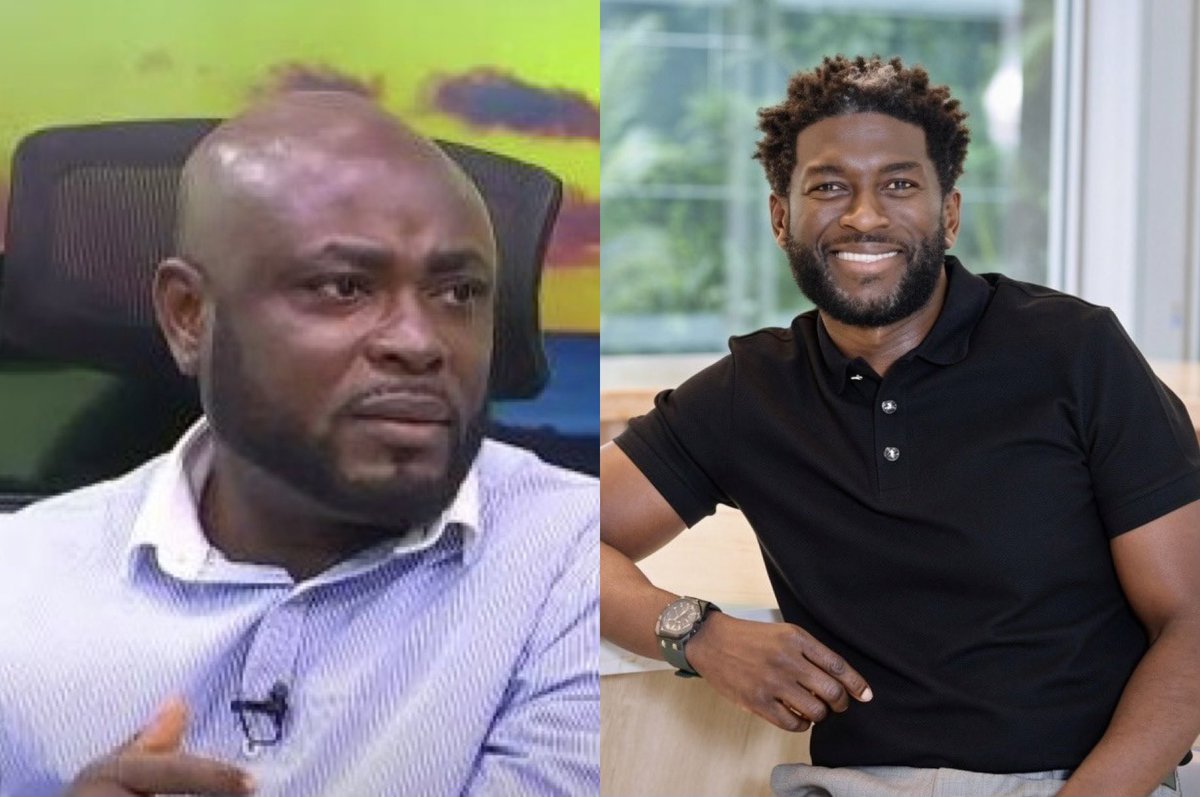

- Lawyers For Larry Dogbey File Appeal Against Custodial Sentence Over Petraco Petition Publication
Lawyers for journalist Larry Alans-Dogbey have filed a Notice of Appeal challenging the seven-day custodial sentence imposed on him by High Court Judge Justice Isaac Addo after he was convicted for contempt of court in proceedings involving businessman Kevin Okyere and Springfield Exploration and Production Limited.
The appeal, filed at the Court of Appeal, seeks to overturn the conviction and sentence delivered on June 25, 2026, by the High Court, General Jurisdiction Division, Court 4, Accra.
Mr Dogbey, who is named in the appeal as the 2nd Defendant/Respondent/Applicant/Appellant, is challenging the whole decision of the High Court, including both the finding of contempt and the sentence of seven days’ imprisonment.
The case arises from publications relating to a petition by Petraco Oil Company SA, which alleged fraud exceeding US$90 million involving Kevin Okyere, Geena Malkani Punjabi, Emmanuel Ansah Bernasko and others.
The appeal argues that the publications were based on matters of public interest and on official or verifiable documents, including a Supreme Court decision, documents from the Economic and Organised Crime Office, a Ministry of Energy letter, UK court documents and other materials concerning dealings in Ghana’s oil and gas sector.
In the Notice of Appeal, Mr Dogbey’s lawyers contend that the trial judge erred in law by convicting him for breach of an interlocutory injunction order which they describe as void and unenforceable.
They argue that the injunction order, dated June 11, 2025, amounted to an unconstitutional prior restraint on freedom of expression because it restrained statements said to be intended to undermine and tarnish reputation before any final judicial determination that the publications were defamatory.
The appeal further argues that the order was vague, ambiguous and incapable of clear understanding.
According to the lawyers, the operative part of the injunction restrained Mr Dogbey from publishing “statements intended to undermine and tarnish” the plaintiff’s reputation, language they say improperly introduced a subjective test based on alleged intention rather than the plain effect of the publication.
They also contend that the trial judge acknowledged in the judgment that the wording of the order was “vague” but still proceeded to convict Mr Dogbey for breaching it.
A major plank of the appeal is that contempt proceedings are quasi-criminal and must be proved beyond reasonable doubt.
The lawyers argue that the trial court erred by inferring intention from publication alone and by allegedly shifting the burden onto Mr Dogbey to prove the truth of his publications, rather than requiring the applicant to prove contempt beyond reasonable doubt.
They also contend that the court failed to properly evaluate evidence that, in their view, contradicted any inference of malicious intention.
The appeal cites Mr Dogbey’s 20-year career as a journalist, the public interest character of the publications, reliance on official and credible sources, and what the lawyers describe as admissions during cross-examination concerning default on a US$50.00 million loan.
The Notice of Appeal also argues that the High Court erred by convicting a journalist for reporting on a Supreme Court decision and official public documents.
The lawyers describe the conviction as imposing an unconstitutional gag order on the press and an attack on the freedoms of expression and media guaranteed under Articles 162 and 165 of the 1992 Constitution.
They argue that the press has a constitutional duty to report on matters of public interest, including judicial decisions and official government documents, and that such reporting should not be the subject of contempt proceedings where it is accurate, fair and based on official sources.
The appeal also challenges the trial court’s reliance on the Montie FM case, arguing that the case is distinguishable.
According to Mr Dogbey’s lawyers, the Montie FM case involved threats against Supreme Court justices, which they describe as a direct attack on the judiciary, whereas the present case involved publications on matters of public interest concerning a businessman dealing with state assets.
The lawyers further argue that the trial judge misapplied the sub judice rule by holding that the mere pendency of a defamation suit made further publication on the subject matter contemptuous.
They contend that Mr Dogbey was not trying the case in the court of public opinion, but informing the public on matters of genuine public interest, including a UK court charge sheet alleging fraud, a petition to EOCO alleging systematic fraud and economic crime, the withdrawal of the unitisation directive by the Ministry of Energy and a US$100.00 million loan facility agreement.
The appeal also raises concerns over the proof of service relied upon in the contempt proceedings.
In one of the grounds, the lawyers allege that the trial court erred by relying on a purported WhatsApp screenshot as proof of service, claiming the screenshot was demonstrably forged, fake and photoshopped.
They argue that the screenshot showed a “Hi” message on the left side of the chat and that, under WhatsApp’s user interface, messages appearing on the left are received by the account holder who took the screenshot.
The lawyers further state that Mr Dogbey has denied knowing the deponent, communicating with him, possessing or using the telephone number involved, or sending any “Hi” message to him.
They argue that if the alleged forged nature of the service documents is established, it would constitute fraud on the court and render any order obtained by fraud void.
The appeal also challenges the severity of the sentence, describing the seven-day imprisonment as harsh, excessive and wrong in principle.
The lawyers argue that Mr Dogbey is a law-abiding journalist of more than two decades with no prior criminal record, and that a non-custodial sentence should have been imposed, particularly given the constitutional protections afforded to the press.
The reliefs sought from the Court of Appeal include an order allowing the appeal and setting aside the contempt conviction, an order setting aside the seven-day prison sentence and discharging Mr Dogbey, and a declaration that the interlocutory injunction order dated June 11, 2025 is void and of no legal effect.
The appeal also seeks an order setting aside the interlocutory injunction, or in the alternative, substituting the custodial sentence with a non-custodial sentence.
The Notice of Appeal was dated July 1, 2026, at Kpatsa and Associates, Worlanyo Chambers, and signed by Peter Okudzeto Esq as counsel for Mr Dogbey.
Persons listed to be served include Kevin Okyere, described as the applicant in the contempt proceedings in the court below, and the Attorney-General.
The appeal now places before the Court of Appeal broader questions touching on contempt, media freedom, prior restraint, fair and accurate reporting, constitutional protection of journalism, and the limits of court orders in matters involving public interest reporting.
The outcome will be closely watched by lawyers, journalists, civil society groups and media freedom advocates because of its implications for reporting on court documents, official petitions and allegations involving public resources and state-linked commercial interests.

