

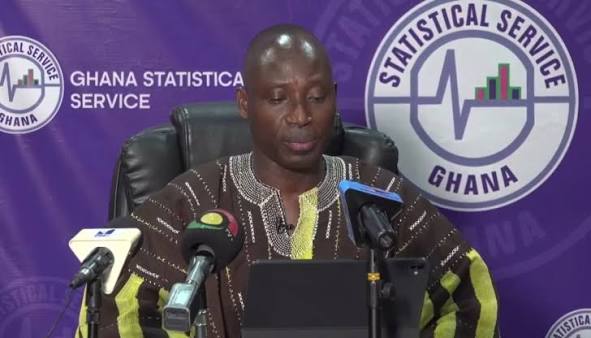

- Informal Border Trade with Neighbours Exceeds Formal Trade By 54.23% – GSS Report
Ghana’s informal cross-border trade with Togo, Burkina Faso and Côte d’Ivoire reached about GH¢31.00 billion in the first three quarters of 2025, exposing the scale of an economy that has long operated outside formal customs records but remains central to food supply, jobs, regional commerce and border livelihoods.
A new Ghana Statistical Service report on informal cross-border trade shows that the movement of goods across Ghana’s land borders is far larger than previously captured in official trade statistics. Between January and September 2025, informal trade with Ghana’s three land neighbours was about 1.54 times the value of formal trade with the same countries, which stood at GH¢20.10 billion. This means informal trade was roughly 54.23% higher than recorded formal trade over the period.
The report is significant because it brings into official view a major part of Ghana’s real economy that had largely remained invisible. Informal cross-border trade covers goods that move between Ghana and neighbouring countries without being fully captured in customs declarations. These goods include cooking oil, cattle, grain, fuel, vegetables, oil seeds, manufactured goods and other everyday items traded by border communities.
The GSS said informal cross-border trade is “not a small corner of the economy but a pillar of it,” accounting for about 6.00% of Ghana’s total trade during the first three quarters of 2025. The share was even stronger in Ghana’s trade with its neighbours, where informal activity made up more than two-thirds of total trade with Togo, roughly two-thirds with Côte d’Ivoire and about half with Burkina Faso.
The data show that informal trade rose from GH¢10.60 billion in the first quarter to GH¢10.90 billion in the second quarter, before declining to GH¢9.40 billion in the third quarter. Although the third-quarter fall suggests some moderation, the overall numbers confirm that cross-border informal trade is a major channel of economic exchange, especially in regions where formal employment and formal trade infrastructure remain limited.
The most striking policy warning from the report is food security. Food products made up 49.40% of informal imports by the third quarter of 2025, while Ghana’s informal food trade deficit doubled from about GH¢400.00 million in the first quarter to about GH¢800.00 million in the third quarter. Cooking oil was identified as the single largest food import.
That finding should worry policymakers. It suggests that Ghana’s food system is more dependent on unrecorded cross-border flows than official data may have shown. If a large share of food entering the country moves through informal channels, then food security planning based only on formal import data will underestimate real consumption needs, supply vulnerabilities and price transmission risks.
The regional pattern also matters. Togo remained Ghana’s primary source of informal imports, with its share rising from 53.20% in the first quarter to 56.40% in the third quarter. Ghana’s trade with Togo was largely informal, with the informal share increasing from 70.50% in the first quarter to 77.80% in the third quarter.
By contrast, Ghana recorded sustained trade surpluses with Burkina Faso and Côte d’Ivoire, but its deficit with Togo widened from GH¢725.50 million in the first quarter to GH¢994.10 million in the third quarter. That represents a 37.02% deterioration and points to Togo’s growing role as a major informal supply route into Ghana.
Burkina Faso remained Ghana’s main export destination, accounting for the largest share of formal exports and an average of about 37.60% of informal exports across the three quarters. Livestock flowed mainly from Burkina Faso, while vegetables and oil seeds came largely through Togo.
The report also shows that border trade is highly regionalised. Upper East recorded the highest informal export value, peaking at GH¢1.44 billion in the second quarter, while Volta recorded the highest import value, reaching GH¢1.73 billion in the same period. Paga emerged as the single most-used crossing for goods coming into the country.
Behind the figures are thousands of small traders and transporters. Men handled about 70.00% of exported goods, while women accounted for more than 60.00% of imports. Most goods moved not by heavy trucks, but by tricycles and motorbikes, underlining how small-scale, frequent and personal the trade is.
This gender split is important. It suggests that any attempt to formalise informal cross-border trade without considering women traders could damage livelihoods, weaken household income and disrupt food supply chains. Formalisation must therefore be designed around the realities of small traders, not imposed as a punitive customs exercise.
The GSS methodology also gives weight to the findings. Preparations began with a profiling exercise that validated 340 active border points. After excluding footpaths, inactive points and places with inadequate infrastructure or security conditions, 321 border points were initially covered. For 2025 monitoring, the number was reduced to 206 border points after excluding 115 points that together contributed less than 10.00% of total informal cross-border trade recorded earlier.
The report’s policy message is clear: Ghana should not try to shut down informal trade. It should understand, support and gradually integrate it. Informal trade sustains jobs, feeds households, supports border communities and strengthens regional linkages. But because much of it is unrecorded, government loses potential revenue, traders lack formal protection and policymakers plan with incomplete data.
The GSS recommends simple registration and licensing systems for small traders, linked to credit and training; investment in border roads, posts and data systems; stronger local production of heavily imported goods such as rice, cooking oil and livestock; and deeper cooperation with neighbouring countries to harmonise rules and share trade data in real time.
The report should therefore be read as more than a trade document. It is a food security report, a gender report, a regional integration report and a fiscal policy report.
For Ghana, the lesson is direct. The economy does not end at formal customs posts. A large part of real commerce moves through smaller crossings, border markets, tricycles, motorbikes and community networks. These flows may be informal, but they are not marginal.
The task now is to bring this GH¢31.00 billion border economy into policy without destroying the flexibility that makes it work.

