

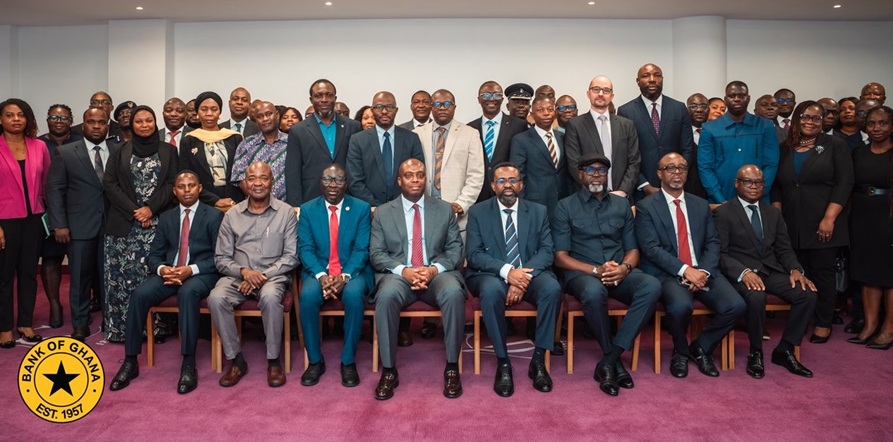

AML/CFT Now a National Responsibility, Government Tells GIABA Assessors
Government has reaffirmed Ghana’s commitment to strengthening its anti-money laundering, counter-terrorist financing, and counter-proliferation financing (AML/CFT/CPF) framework, as the on-site phase of the country’s Mutual Evaluation officially commenced in Accra.
Speaking at the opening of the exercise, the government said the evaluation marks a critical moment of accountability, offering Ghana the opportunity to demonstrate effective implementation of reforms rather than mere compliance on paper.
According to the government, the on-site Mutual Evaluation goes beyond a procedural requirement and represents a test of Ghana’s resolve to safeguard the integrity of its financial system, protect the economy, and uphold investor confidence.
Ghana noted that it has deliberately pursued a path of reform and results, using its National Risk Assessment as a practical diagnostic tool to identify vulnerabilities across sectors, institutions, products, and borders. This process, authorities said, has driven policy adjustments, institutional reforms, and renewed political commitment to addressing financial crime risks.
As part of these efforts, coordination at the highest level has been strengthened through the Inter-Ministerial Committee on AML/CFT, while the Financial Intelligence Centre (FIC) has seen improvements in its operational independence and analytical capacity.
The government further indicated that law enforcement agencies, supervisors, regulators, and prosecutors have deepened collaboration, enhanced the use of financial intelligence, and placed greater emphasis on measurable outcomes, including investigations, prosecutions, convictions, and asset recovery.
It stressed that AML/CFT is no longer viewed as a narrow technical obligation limited to a few institutions, but as a shared national responsibility that is critical to preserving Ghana’s financial stability, economic resilience, and international reputation.
While acknowledging that challenges remain and that risks continue to evolve, the government said Ghana has built a framework that is credible, responsive, and anchored in sustained political will.
Authorities described the Mutual Evaluation as a partnership rather than an examination, noting that the findings and recommendations from assessors will help further refine systems, strengthen effectiveness, and align Ghana more closely with international best practices.
The government reaffirmed that Ghana’s commitment to combating money laundering, terrorist financing, and proliferation financing remains unwavering, grounded in both international obligations and the country’s long-term national interest.
It also encouraged open engagement, constructive scrutiny, and candid dialogue between evaluators and domestic institutions throughout the assessment period, expressing confidence that the exercise will reflect the strong cooperation between Ghana, GIABA, and the wider global AML/CFT community.

