


- Senegal Moves Closer to New US$2.2bn IMF Programme as Faye Backs Debt Treatment
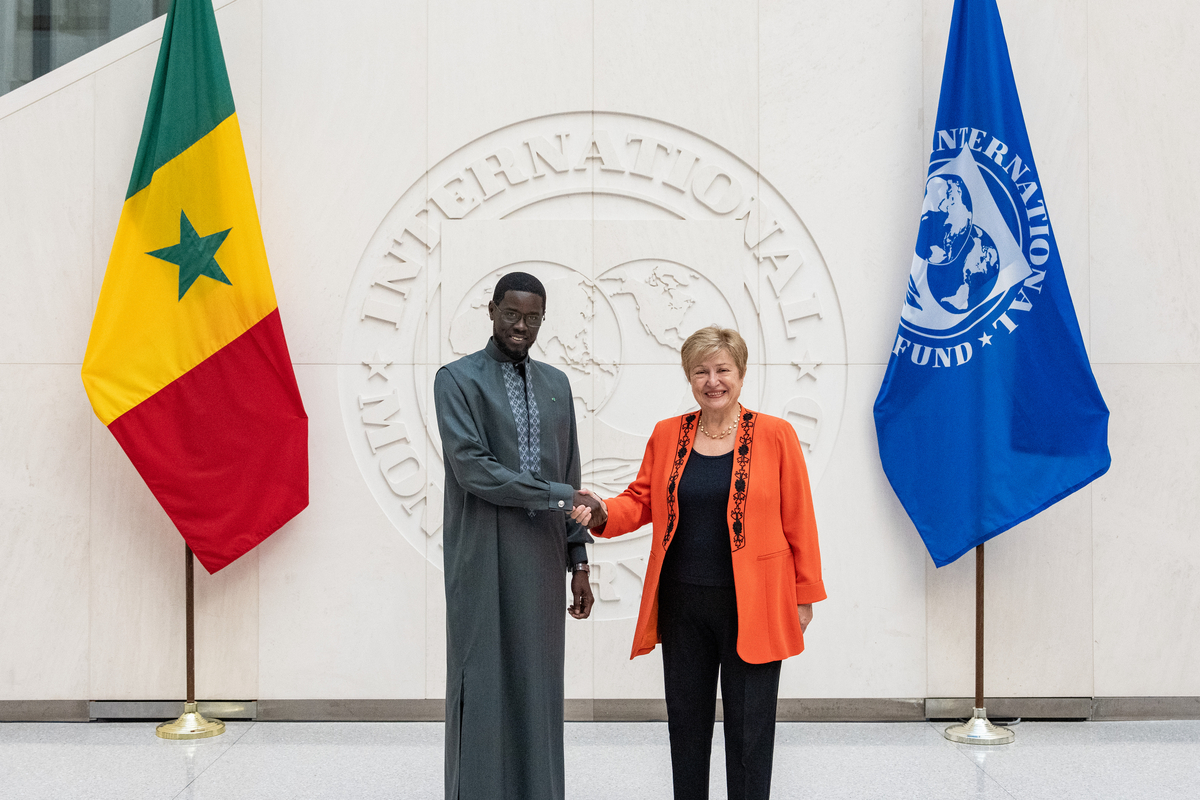
Senegal has moved closer to securing a new US$2.2 billion programme from the International Monetary Fund after President Bassirou Diomaye Diakhar Faye and IMF Managing Director Kristalina Georgieva reaffirmed their commitment to reaching an agreement quickly, with debt treatment now central to restoring the country’s fiscal sustainability.
The talks in Washington came two weeks after IMF staff and Senegalese authorities reached a staff-level agreement on a proposed 36-month Extended Credit Facility worth about US$2.2 billion, equivalent to SDR1.537 billion or 475% of Senegal’s quota. The arrangement remains subject to IMF management and Executive Board approval, financing assurances from Senegal’s partners and corrective action linked to the country’s earlier public-finance misreporting case.
Georgieva said following the meeting that Senegal had made encouraging progress in strengthening its economy and improving prospects for investment, employment and growth, while welcoming the government’s intention to pursue a debt treatment and its determination to restore fiscal sustainability.
“I especially commend the authorities’ intention to pursue a debt treatment and for their determination to swiftly restore fiscal sustainability,” she said.
The statement marks an important transition in Senegal’s economic repair process. The immediate question is no longer simply whether Dakar requires external support, but whether it can establish a credible debt and reform package capable of restoring confidence while preserving enough fiscal space for investment and social programmes.
Senegal’s debt difficulties intensified after authorities uncovered liabilities that had not been fully reflected in earlier public accounts. A subsequent reconciliation exercise revised central government debt for end-2023 from 74.4% to 111% of GDP, with the IMF saying the increase largely reflected previously undisclosed liabilities.
That episode disrupted Senegal’s previous relationship with the Fund and has made transparency and debt management central to negotiations over the new programme.
The proposed ECF arrangement would therefore go beyond providing fresh financing. It is designed to restore macroeconomic and debt sustainability, strengthen domestic revenue mobilisation, improve oversight of public debt and state-owned enterprises, increase social spending and support sustainable private-sector-led growth.
Reuters has reported that Senegal intends to pursue an enhanced version of the G20 Common Framework while excluding CFA franc-denominated debt from the restructuring perimeter. The government has also described its preferred approach as debt reprofiling through longer maturities and potentially lower interest costs rather than a conventional restructuring.
That distinction matters because protecting domestic CFA-denominated obligations and concessional debt could leave external commercial creditors carrying a larger share of the adjustment. A group of international bondholders has already organised and appointed White & Case as legal adviser ahead of negotiations.
For Senegal, the challenge will be to restore debt sustainability without undermining growth and employment.
The IMF estimates that real GDP expanded by 6.7% in 2025 as oil production entered its first full year, while inflation remained at 1.4%. But non-hydrocarbon growth slowed to 2.2% before rebounding to 4.7% year-on-year in the first quarter of 2026.
Oil production can raise headline GDP and export revenues, but it does not automatically generate sufficient employment or income growth across the wider economy. Senegal therefore needs an adjustment programme that stabilises public finances while improving the environment for businesses, investment and employment outside the hydrocarbon sector.
Georgieva’s emphasis on investment, jobs and growth reflects that balancing act.
Fiscal consolidation can restore confidence, but an adjustment that compresses productive investment or social expenditure too severely risks weakening the growth required to make Senegal’s debt burden more manageable over time.
The IMF programme attempts to address that tension through stronger domestic revenue mobilisation, expenditure rationalisation and reinforced social safety nets, including targeted cash transfers. It also proposes reforms aimed at improving the business environment and financial inclusion. IMF backing is expected to help catalyse additional financing from the World Bank, African Development Bank and other development partners.
The wider significance extends beyond Senegal.
The country is becoming another test of whether the international sovereign-debt architecture can deliver faster and more predictable restructurings after lengthy processes in countries including Ghana and Zambia.
World Bank President Ajay Banga has said he wants Senegal’s treatment to proceed more rapidly, pointing to lessons from earlier restructurings and changes intended to improve the G20 Common Framework.
Speed matters because prolonged debt negotiations can leave governments caught between restricted access to capital markets and insufficient external financing, weakening investment and delaying economic recovery.
Senegal still faces several hurdles before the proposed IMF arrangement reaches the Executive Board.
The Fund says further decisive corrective action is required in relation to the previous misreporting case, while Senegal must also secure the necessary financing assurances from creditors and development partners.
Faye’s Washington meeting should therefore be viewed as important momentum rather than final programme approval.
The staff-level agreement has established the broad framework, but a difficult phase now follows as Senegal engages creditors, completes corrective measures and seeks to reconcile debt relief with development priorities.
For investors, credibility will be critical. Senegal will need to demonstrate that stronger debt reporting, improved fiscal transparency and more effective institutional oversight can prevent a repeat of the failures that undermined confidence.
For the government, debt treatment must ultimately become a bridge back to sustainable growth rather than an end in itself.
If Senegal can secure the US$2.2 billion programme, complete a credible debt operation and preserve productive investment, the country could emerge with stronger fiscal institutions and a more resilient financing model.
But the margin for error remains narrow. The real measure of the IMF reset will be whether debt relief and external support translate into stronger private investment, more jobs and a fiscal position capable of sustaining growth without returning Senegal to another cycle of financial distress.

