


- Iran Begins World Cup Camp in Turkey Amid Participation Uncertainty
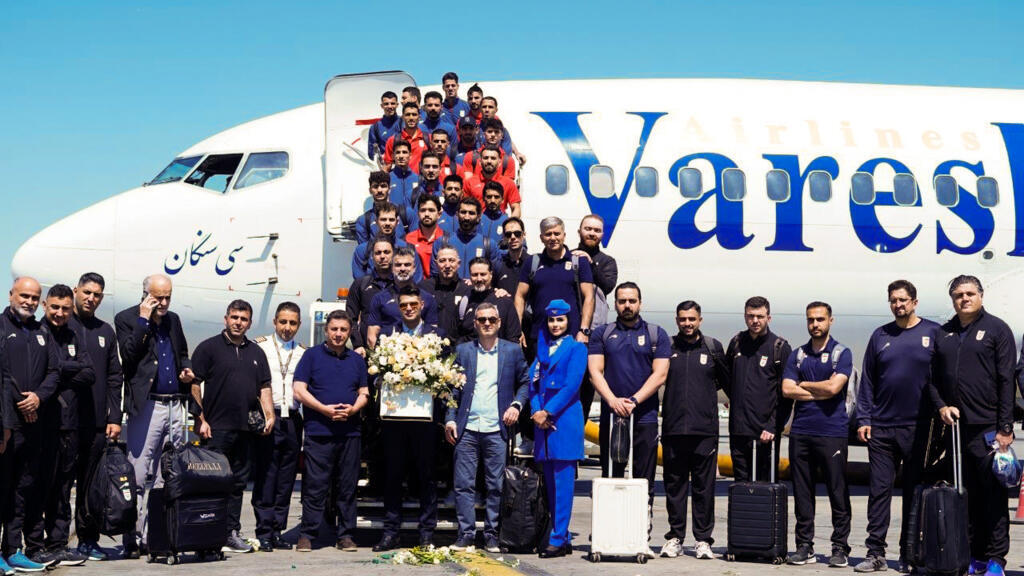
Iran’s national football team has arrived in Turkey to begin preparations for the 2026 FIFA World Cup, even as uncertainty persists over the practical and diplomatic hurdles surrounding their participation in the tournament. The squad landed at Antalya Airport on Monday before travelling to Belek, the Turkish resort town that has become a preferred base for international football teams seeking controlled training conditions ahead of major competitions.
Players and officials were seen dressed in black team apparel as they boarded buses to their training base, signalling the start of Iran’s formal World Cup build-up despite continuing questions over visas and geopolitical tensions involving the United States, Israel and Iran.
The 2026 FIFA World Cup will be jointly hosted by the United States, Canada and Mexico from June 11 to July 19, making Iran’s participation politically sensitive given its strained relations with Washington and recent regional tensions.
Iran are expected to compete at the tournament, but their path to the competition has become complicated by diplomatic and immigration concerns.
FIFA Secretary-General Mattias Grafstrom recently said he had held positive discussions with Mehdi Taj, President of the Iran Football Federation, and expressed confidence that Iran would participate in the tournament as planned.
That assurance, however, has not fully settled concerns.
The uncertainty intensified after Taj was reportedly denied entry into Canada for the recent FIFA Congress in Vancouver over alleged links to the Islamic Revolutionary Guard Corps, which is classified as a terrorist entity by both the United States and Canada.
The episode has raised questions about whether Iranian football officials, players and technical staff will face delays or restrictions in securing entry clearances for the tournament.
Iranian officials and FIFA have since indicated that visa applications for the team will be processed in Turkey ahead of their planned departure to the United States.
The team is scheduled to establish its World Cup base at the Kino Sports Complex in Tucson, Arizona, in early June.
Iran had also requested that their group-stage matches be moved from the United States to Mexico because of the political situation. But FIFA President Gianni Infantino maintained that all fixtures would remain at their originally designated venues.
That decision leaves Iran on course to open their Group G campaign against New Zealand in Los Angeles on June 15, before facing Belgium and Egypt later in the group stage.
For Iran, the challenge is now twofold.
On the pitch, the team must prepare for a difficult group against opponents with different tactical profiles. Belgium remain one of Europe’s strongest football nations, Egypt bring African pedigree and elite attacking quality, while New Zealand offer physicality, structure and tournament discipline.
Off the pitch, however, Iran’s World Cup campaign is already being shaped by diplomacy, security scrutiny and uncertainty over travel logistics.
The Turkey camp therefore carries more significance than a routine pre-tournament preparation base. It offers Iran a neutral environment to train, process documentation and shield the squad from some of the political noise surrounding their participation.
For FIFA, the situation presents an early governance test ahead of a tournament that will take place across three countries and involve teams from politically sensitive jurisdictions.
World Cup qualification is supposed to guarantee sporting participation. But in practice, immigration rules, sanctions, national security designations and diplomatic tensions can complicate that principle.
Iran’s case shows how global football is increasingly forced to operate within a more fragmented geopolitical environment. For the players, the message from the team’s arrival in Turkey appears clear: preparation must continue regardless of uncertainty.
The squad’s movement to Belek suggests that Team Melli are attempting to focus on football while administrators work through the visa and diplomatic issues that could affect their journey to North America.
Any delay in visa approvals, restriction on officials, or renewed diplomatic dispute could disrupt Iran’s schedule and add pressure before their opening match in Los Angeles. For now, Iran’s World Cup campaign has effectively begun in Turkey, not with the usual optimism of a pre-tournament camp, but under the shadow of politics, security concerns and a participation question FIFA will be keen to settle before the tournament begins.

