


- From Local Content to Operatorship: GNPC Sets Out Its Next Phase
The Ghana National Petroleum Corporation is seeking a bigger role in oil and gas operations, with plans for new commercial subsidiaries, a possible pathway for Ghanaian investors to own shares and a training programme for 75 graduates.
The strategy aims to make the state-owned company a world-class operator while widening local participation across the petroleum value chain.
But the ambition is taking shape against a difficult backdrop: Ghana’s crude oil output fell to 37.30 million barrels in 2025, down 22.70% from 48.24 million barrels in 2024. Output has fallen from a 2019 peak of 71.44 million barrels.
The production slide raises the stakes for GNPC’s strategy. Building institutional capacity and creating new commercial vehicles will matter only if they help unlock investment, develop new resources and reverse declining output.
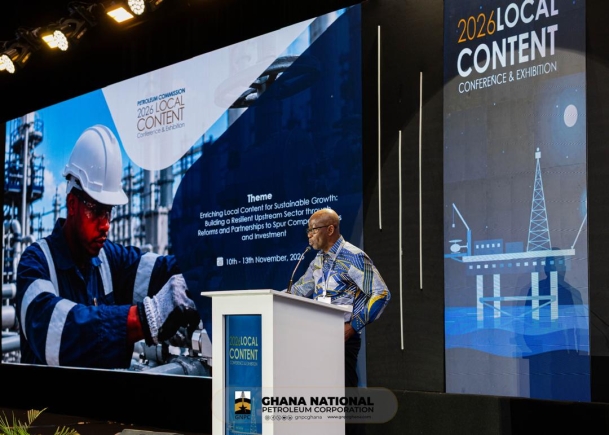
Chief Executive Kwame Ntow Amoah described the corporation’s long-term goal as moving “from an emerging operator to a world class operator technically proficient, commercially competitive and able to manage complex petroleum assets to deliver sustainable value for Ghana.” He was speaking at the 2026 Local Content Conference and Exhibition in Takoradi.
The plan includes establishing additional subsidiaries with distinct mandates. Proposed structures are expected to cover oil and gas trading and shared services for GNPC and the wider energy sector.
The corporation says they could create opportunities for partnerships with Ghanaian and international firms, with a possible route to listing on the Ghana Stock Exchange to broaden ownership among local individuals and companies.
This shifts the local-content debate beyond the number of contracts awarded to Ghanaian suppliers. If the proposed shareholding route is developed, local participation could include ownership of commercial assets and a stake in the returns they generate.
That would be a more consequential form of participation but it would also require transparent rules on valuation, governance, shareholder rights and how risks are shared.
A listing does not automatically guarantee broad Ghanaian ownership. The structure of any offer, the minimum investment size and the information available to investors will determine who can participate.
If new companies are created to hold valuable commercial operations, the public will also need clarity on how those entities relate to the parent corporation, what assets they control and how their performance will be reported.
The operational ambition is not new. GNPC’s stated strategy sets a goal of becoming a technically strong, commercially efficient and financially independent exploration and production operator by 2030. It identifies the years to 2026 as a period for consolidating the operatorship drive, followed by a 2027–2030 phase focused on strengthening its capacity as an operator.
The latest plans put that strategy into a broader commercial context. Subsidiaries may help separate functions, build specialist expertise and attract partners.
Yet corporate structures alone cannot supply the technical competence needed to plan, finance and manage complex petroleum projects. That will depend on staff experience, capital discipline, access to technology and the ability to work effectively with other operators.
The proposed two-year graduate training programme for 75 newly employed graduates is one part of that capacity-building effort. It is intended to give participants practical experience and prepare them for future leadership roles in GNPC and the petroleum industry.
The programme may help replenish technical and professional skills, but its impact will depend on the quality of training and whether graduates gain exposure to operational work rather than remaining confined to administrative functions.
The Voltaian Basin project provides a near-term test. GNPC says years of geological and geophysical studies have brought the project to the drilling-preparation stage. Conductor casing, an early component in well construction, has been transported to the site.
The corporation hopes to complete the remaining contractual processes and mobilise a rig by the end of 2026. That is a target for rig mobilisation; it does not yet establish when drilling will begin or whether commercial quantities of hydrocarbons will be found.
The basin is a frontier exploration opportunity, which means the commercial outcome is uncertain. Technical studies and drilling will determine whether resources can be developed at a cost that makes production viable.
The Voltaian project therefore tests more than GNPC’s ability to put equipment on site. It tests whether the corporation can manage exploration risk, mobilise partners and capital, and communicate progress without treating a prospective resource as a proven reserve.
There is also potential in stranded and marginal discoveries. GNPC has been assessing whether shared infrastructure and hub-based development could make such resources commercially feasible.
Its analysis covers potential fields in the Tano Basin containing more than one billion barrels of oil and about 2.5 trillion cubic feet of gas. These figures describe estimated potential across fields under assessment, not production that is already available.
A cluster-based approach could reduce the cost of developing smaller discoveries by connecting them to existing facilities or a common production hub.
The commercial challenge is to determine which fields can support the cost of infrastructure and generate returns under realistic assumptions about prices, production and operating expenses. Partnership and shared investment may help, but only where responsibilities and returns are clearly defined.
That work has urgency because falling production affects more than GNPC’s ambitions. It can reduce petroleum receipts available to the state, weaken the contribution of oil to exports and make Ghana more dependent on future discoveries to sustain the sector.
The 2025 production fall demonstrates that local participation and operatorship must be linked to a credible plan for maintaining and growing production.
GNPC’s new structures could widen Ghanaian participation, while the graduate programme and exploration work could strengthen its technical base. The corporation’s challenge is to connect those strands to measurable results: new investment, progress on exploration, commercial development of viable resources and a sustainable increase in production.
The central test of a “world-class” operator will not be the number of subsidiaries it establishes or the number of local shareholders it attracts.
It will be whether GNPC can manage petroleum assets efficiently, account transparently for public resources and deliver lasting value as Ghana’s existing fields mature. The production decline makes that test immediate. The new strategy now has to show how a wider Ghanaian stake in the sector can help reverse it.

