

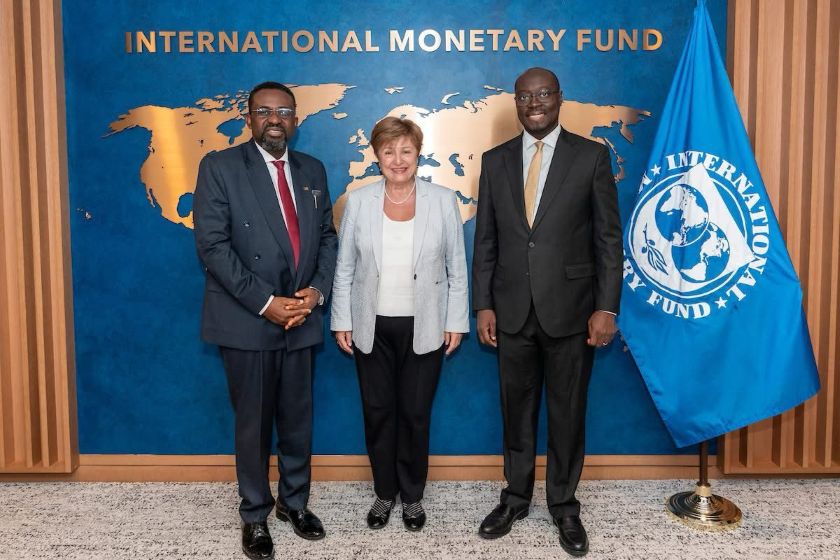

Ghana Exits US$3 Billion IMF Bailout with Final US$371m Disbursement
Ghana has completed its three-year rescue programme with the International Monetary Fund, unlocking a final US$371 million disbursement and shifting its relationship with the Fund from emergency financing towards a non-financing framework intended to preserve fiscal and monetary discipline.
The IMF Executive Board on Monday completed the sixth and final review of Ghana’s 39-month Extended Credit Facility arrangement, bringing total disbursements under the programme to about US$3 billion. The Board also concluded the country’s 2026 Article IV consultation and reviewed the government’s request for a 36-month Policy Coordination Instrument.
The final payment amounts to SDR265.90 million, or approximately US$371 million, correcting earlier estimates that placed the outstanding tranche at a lower figure. The original ECF arrangement was approved in May 2023 when Ghana was grappling with high inflation, a rapidly depreciating currency, unsustainable public debt and the loss of access to international capital markets.
The programme’s conclusion marks a significant milestone for the government, but it also begins a more difficult phase in which Ghana will be expected to maintain stability without further bailout financing.
The proposed Policy Coordination Instrument does not provide new IMF funds. Instead, it will subject Ghana’s economic policies and reforms to continued Fund monitoring, while signalling to investors, development partners and creditors that the government remains committed to policies of a standard associated with IMF lending programmes.
The IMF said Ghana’s performance under the ECF had been broadly satisfactory, with substantial improvements in macroeconomic stability and debt sustainability since the programme began.
Real gross domestic product grew by 6.00% in 2025 and accelerated to 6.40% year-on-year in the first quarter of 2026, supported by activity across several sectors. The Fund expects growth to moderate to 4.80% in 2026 before stabilising at about 5.00% over the medium term.
Inflation fell to 5.40% at the end of 2025 and eased further to 5.30% in June 2026, reflecting tight monetary policy, appreciation of the cedi and improvements in food supply.
The current account recorded a surplus equivalent to 7.90% of GDP in 2025, supported by historically high gold prices, while gross international reserves nearly doubled to US$11.91 billion, equivalent to four months of prospective imports.
The government’s primary fiscal balance also swung to a surplus of 2.10% of GDP, while the IMF upgraded Ghana’s risk of external and overall debt distress to moderate, two years earlier than anticipated when the programme was approved.
The improvement followed progress in restructuring domestic and external debt. Ghana has signed debt-relief agreements with more than half of its bilateral creditors and reached agreements in principle with a similar share of external commercial creditors. Discussions with the remaining commercial creditors are continuing.
The IMF approved a waiver relating to a temporary breach of the end-December 2025 ceiling on Bank of Ghana claims on the central government and public entities.
The breach was attributed to cost-sharing arrangements under the central bank’s Domestic Gold Purchase Programme and was described as small and temporary. The waiver was granted after corrective measures were taken by the authorities.
The gold-purchase programme remains one of the key areas of concern as Ghana enters the post-bailout period.
The Fund said preserving central bank independence would require the full transfer of the programme to the Ghana Gold Board, the permanent discontinuation of quasi-fiscal activities and implementation of the government’s commitment to recapitalise the Bank of Ghana by 2032.
Under the 2026 budget, the government is targeting a primary surplus of 1.50% of GDP, consistent with the fiscal responsibility framework introduced during the IMF programme.
The Fund said the improved debt trajectory had created limited fiscal space under the new PCI, allowing the government to address development and social needs while maintaining its target of reducing public debt to 45.00% of GDP by 2034.
From 2027, Ghana could lower the primary surplus target to 0.50% of GDP without threatening debt sustainability, provided the authorities strengthen domestic revenue mobilisation, public financial management, investment planning and oversight of state-owned enterprises.
The energy and cocoa sectors were identified as particularly important sources of fiscal risk.
Persistent losses, arrears and governance weaknesses in state-owned enterprises could migrate onto the central government’s balance sheet, undermining the gains achieved through debt restructuring and fiscal consolidation.
The IMF also warned that vulnerabilities remained in the financial sector, particularly among some state-owned and private banks and specialised deposit-taking institutions.
It called for stronger supervision, decisive corrective measures and completion of Ghana’s crisis-management and bank-resolution framework to protect financial stability and restore durable credit growth.
Governance reforms will form another important part of the post-programme agenda.
The Fund welcomed the submission of a revised Conduct of Public Officials Bill to Parliament but said timely implementation of the reformed asset-declaration framework would be essential to improving transparency, accountability and public trust.
The IMF projects Ghana’s gross public debt at 52.60% of GDP in 2026, before declining gradually to 51.70% in 2027 and 48.00% by 2031.
Gross international reserves are forecast to rise to US$14.07 billion in 2026 and US$16.28 billion in 2027, while the current-account surplus is expected to remain substantial at 7.00% of GDP this year and 5.90% in 2027.
For investors, the completion of the ECF removes uncertainty around the final programme review and confirms the release of the remaining financing.
But the PCI will now test whether Ghana can sustain lower inflation, exchange-rate stability, fiscal discipline and debt reduction without the direct incentive of regular IMF cash disbursements.
The bailout has helped Ghana move from acute economic crisis to relative stability. The central question is whether the country’s institutions can now preserve those gains while creating jobs, expanding private investment and meeting social and development needs without returning to another externally financed rescue.

