

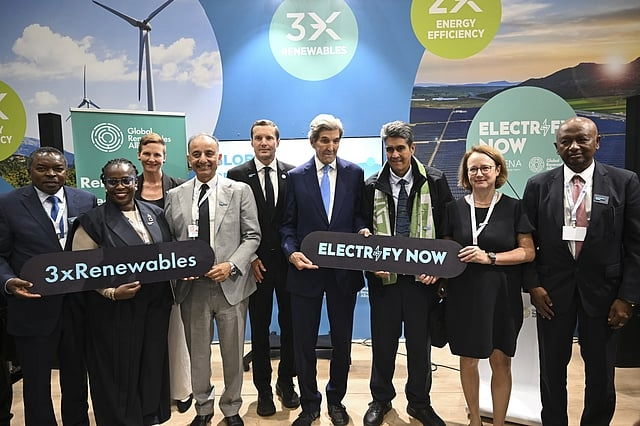

- COP31: Over 150 Countries And 260 Businesses Back Global Electrification Drive
A global push to accelerate the transition towards electricity-powered economies has gathered momentum at the COP31 climate summit in Antalya, Turkey, with more than 150 countries, the European Union, 37 cities and over 260 businesses participating in initiatives designed to expand clean energy investment, strengthen electricity grids and reduce dependence on fossil fuels.
The COP31 Global Climate Action Agenda Electrification Delivery Package, presented on November 19, brings together investment commitments, financing initiatives and infrastructure developments across six continents, reflecting growing recognition that the transition to cleaner energy systems is becoming as much an economic and industrial competitiveness issue as an environmental obligation.
The participating countries and the European Union represent more than two-thirds of global gross domestic product, while the businesses involved generate over US$4 trillion in combined annual revenue, illustrating the scale of economic activity increasingly associated with electrification.
At the centre of the package are investment plans by members of the Utilities for Net Zero Alliance (UNEZA), which have announced combined annual spending plans of at least US$156 billion across electricity networks, renewable energy generation and energy storage.
The planned investment represents an increase of 5.00% over the previous year and 35.00% compared with 2024, signalling growing financial commitments to infrastructure considered essential for the global energy transition.
The alliance reported that its members constructed more than 21,000 kilometres of electricity grids in 2025, an increase of 50.00% over the previous year. Yet the scale of the investment challenge remains substantial, particularly in developing countries where inadequate transmission and distribution infrastructure continues to constrain electricity access, industrialisation and economic growth.
The package comes as policymakers confront an increasingly important reality: expanding renewable electricity generation without simultaneously strengthening transmission networks, storage facilities and distribution systems risks creating bottlenecks that undermine the economic benefits of clean energy investment.
For African economies, where electricity reliability and affordability remain major constraints on industrial development, the emphasis on grids and financing could present opportunities to accelerate energy infrastructure development and attract investment into manufacturing and other productive sectors.
However, the critical question will be whether the emerging global investment commitments translate into affordable financing for countries facing fiscal pressures, high borrowing costs and significant infrastructure deficits.
International Renewable Energy Agency Director-General Francesco La Camera underscored the scale of the challenge, stating that global electricity grid investment would need to more than double, reaching a cumulative US$10 trillion by 2035.
“We cannot accelerate electrification without accelerating grids,” he said, noting that the agency would lead D-GRIDs, an initiative intended to strengthen electricity distribution systems and support investment in developing economies.
The initiative, launched by Turkey and the International Renewable Energy Agency, will focus on distribution-grid planning, digitalisation, resilience and investment, while the Green Grids Initiative’s technical assistance platform will connect governments and utilities with specialist organisations to address infrastructure challenges.
Electricity access remains another central priority of the package, with approximately 655 million people worldwide still lacking electricity, highlighting the unequal distribution of energy infrastructure despite decades of technological and economic advancement.
Sustainable Energy for All and its Universal Energy Facility reported that they had already achieved more than half of a target to deliver 25,000 new electricity connections by 2028.
In Sierra Leone, a separate off-grid renewable energy initiative has another 30,000 connections in development, with the potential to provide electricity access to more than 200,000 people by 2028.
The developments illustrate how decentralised electricity systems could help close energy access gaps in communities where extending national grids remains costly or commercially unattractive.
But expanding electricity access will require sustainable business models, predictable regulatory frameworks and financing arrangements that balance investor returns with household affordability.
Financing remains one of the most difficult barriers for emerging and developing economies seeking to undertake large-scale energy transitions.
Against this backdrop, the Climate Investment Funds announced that its AMPLIFi financing mechanism had become operational, supported by an initial £400 million contribution from the United Kingdom.
The mechanism aims to mobilise up to £5 billion for clean power, electricity grids, energy storage and electrification projects in emerging markets and developing economies.
The financing structure reflects growing efforts to use public and concessional resources to attract substantially larger volumes of private investment into markets where perceived risks often discourage commercial lenders.
The International Renewable Energy Agency has also reported more than US$4 billion in financing pledges through its Energy Transition Accelerator Financing platform, intended to support renewable energy deployment through 2030.
Meanwhile, the Electrify Now Finance Coalition, co-chaired by the World Bank, will work with governments, development finance institutions and private investors to develop commercially viable projects and address barriers that prevent investment commitments from reaching implementation.
The importance of these initiatives extends beyond climate policy.
For African economies, access to affordable energy financing could influence industrial competitiveness, export development and the ability to attract investment into energy-intensive sectors.
However, the benefits will depend on whether countries can develop bankable projects, strengthen electricity-sector governance and address payment risks that have historically discouraged private investment in energy infrastructure.
Commercial financial institutions are also increasing their exposure to electrification projects.
Allied Irish Banks announced that it would double its green and transition lending target for 2030 from €30 billion to €60 billion, following the deployment of €28 billion since 2019.
Octopus Energy launched an Asia Electrification Fund targeting US$600 million in investment, with US$50 million in initial backing. Its first investment supports a Philippine renewable energy developer planning 450 megawatts of solar generation capacity and 350 megawatt-hours of battery storage.
Spanish banking group BBVA reported that it had channelled nearly €60 billion into sustainable business activity associated with electrification between January 2025 and September 2026.
The growing involvement of commercial banks and investment institutions suggests that electrification is increasingly being treated as a mainstream investment opportunity rather than exclusively a climate financing obligation.
Transport is another sector experiencing significant change.
The Global Green Road Corridors Initiative reported that 13 zero-emission freight corridors are under development across six continents, covering more than 29,000 kilometres of roads.
The corridors are intended to support the electrification of commercial freight operations, a sector where dependence on diesel-powered vehicles remains substantial.
Electric vehicle sales in countries participating in the Zero Emission Vehicles Declaration reached 2.10 million during the first half of 2026, while six cities committed to introducing approximately 2,200 additional electric buses in 2027.
In Shenzhen, China, almost 1.80 million electric vehicles were operating by June 2026, with electric models accounting for 83.00% of new vehicle sales.
Commercial vehicle manufacturers are also raising investment.
TRATON Group, owner of Scania and MAN, secured €850 million in green financing through a bond and loan package intended to support battery-electric commercial vehicles.
In maritime transport, more than 30 supporters have backed an initiative targeting electricity to meet at least 20.00% of shipping’s final energy demand by 2035.
Beyond transport, heavy industry is emerging as another important frontier.
The Mission Possible Partnership reported that 36 commercial-scale industrial decarbonisation projects reached final investment decisions across 13 countries during the 12 months to November 2026.
The projects cover industries where reducing emissions remains particularly challenging because of high energy requirements and dependence on fossil-fuel-based production processes.
The United Nations Industrial Development Organization also launched the Global Green Industrialization Agenda at COP31, with the objective of coordinating industrial policies, investment, technology and workforce development.
UNIDO Director-General Gerd Mueller said electrification could become a major industrial development opportunity by improving factory efficiency, reducing fossil fuel dependence and generating demand for new technologies and skills.
“Electrification can become one of the great industrial development opportunities of this decade,” he said.
The broader transition is also attracting corporate support, with more than 185 companies generating combined annual revenue of US$1.73 trillion endorsing a statement calling for stronger electrification policies and improved investment conditions.
For developing economies, the emerging challenge is whether they can position themselves as participants in the new industrial supply chains or remain predominantly consumers of technologies manufactured elsewhere.
The distinction has particular significance for mineral-rich African economies, which supply several raw materials essential for batteries, electricity infrastructure and renewable energy technologies.
Without deliberate investment in processing, manufacturing capacity, technical skills and regional industrial integration, the expansion of global electrification could reproduce existing trade patterns in which developing countries export raw materials while importing higher-value finished technologies.
UN Climate Change Executive Secretary Simon Stiell described the package as evidence that climate ambitions were increasingly translating into economic activity.
“Electrification is a huge efficiency booster, helping bring down greenhouse gas pollution and energy costs, and tackle grave injustices in energy access,” he said.
Yet the announcement also acknowledges that existing initiatives remain insufficient to deliver electrification at the pace required to meet the Paris Agreement’s objectives.
The gap between investment announcements and completed infrastructure remains particularly important.
Grid construction, renewable energy projects and industrial transformation require permitting, long-term financing, skilled labour, reliable supply chains and regulatory certainty, meaning that announced investment plans cannot automatically be treated as delivered economic benefits.
For Ghana and other African economies, COP31’s electrification agenda provides an opportunity to reconsider how electricity infrastructure fits into broader national development strategies.
Rather than viewing the energy transition solely through the lens of emissions reduction, governments could increasingly assess its implications for industrial productivity, transport costs, energy security and export competitiveness.
Countries capable of combining affordable electricity with reliable infrastructure and supportive investment conditions may be better positioned to attract industries seeking to reduce both operating costs and carbon emissions.
But the transition will not be evenly distributed.
Economies with stronger institutions, better-developed financial markets and greater access to affordable capital could move faster, while countries facing persistent infrastructure deficits risk falling further behind.
The significance of COP31’s electrification package will therefore be measured not only by the number of governments and businesses supporting it, or the billions of dollars in investment plans, but by whether those commitments ultimately deliver reliable electricity, lower energy costs and productive economic opportunities.
For Africa, the defining question is whether the global electrification revolution will help transform the continent into a competitive industrial producer or reinforce its position as a supplier of raw materials to the world’s emerging clean energy economy.
That question, more than the scale of the announcements themselves, will determine whether the transition delivers genuinely inclusive economic development.

