

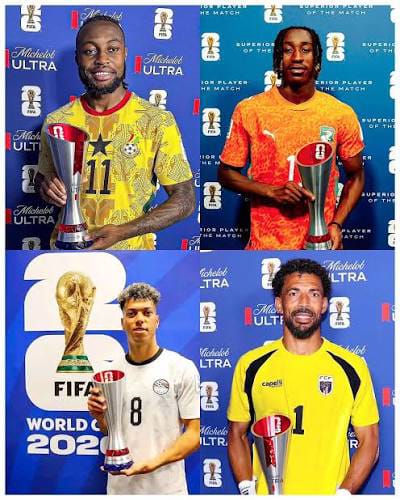

- Africa Roared, the World Took Notice: The Stars Who Lit Up the 2026 FIFA World Cup
As the curtain begins to fall on the 2026 FIFA World Cup, Africa can reflect on a tournament that once again showcased the continent’s immense football talent on the grandest stage.
Although the last African nation bowed out in the quarter-finals, players from across the continent left lasting impressions in the United States, Canada and Mexico, producing moments of brilliance that captivated supporters and strengthened Africa’s growing reputation in world football.
Ten African nations participated in the expanded 48-team tournament, with more than 260 players representing the continent. Some led unforgettable underdog stories, others announced themselves as future global superstars, while a few cemented their status among the world’s elite.
From Morocco’s impressive run to another quarter-final appearance to Cape Verde’s fairytale campaign and Ghana’s spirited showing, African football demonstrated once again that it belongs among the very best.
No African country produced more standout performers than Morocco.
Having reached the semi-finals in Qatar four years ago, the Atlas Lions proved their previous success was no fluke by advancing to the last eight once again.
Driving that remarkable campaign was Achraf Hakimi, who emerged as the tournament’s outstanding African player.
The Paris Saint-Germain full-back was exceptional at both ends of the pitch, combining defensive resilience with relentless attacking runs that constantly troubled opponents. His leadership, consistency and ability to influence matches from right-back made him one of the standout performers of the entire World Cup, not just among African players.
His performances have also strengthened his chances of retaining the CAF African Player of the Year award later this year.
Morocco’s success was also built on the emergence of teenage midfielder Ayyoub Bouaddi, whose energetic displays announced him as one of world football’s brightest young talents.
The 18-year-old impressed against top opposition throughout the tournament with his composure, relentless pressing and mature decision-making. Despite his age, he looked completely at home against some of football’s biggest names and played a crucial role in Morocco’s journey to the quarter-finals.
Another Moroccan who caught the eye was Ismael Saibari.
The attacking midfielder enjoyed an outstanding group stage, scoring in each of Morocco’s opening three matches before calmly converting the decisive penalty that eliminated the Netherlands in the Round of 32.
Although injury curtailed his tournament, Saibari’s performances were enough to convince Bayern Munich to complete his transfer from PSV Eindhoven during the World Cup itself, highlighting how quickly his reputation has grown.
Few stories captured football fans’ imagination like that of Cape Verde goalkeeper Vozinha.
At 40 years old, the experienced shot-stopper produced one inspirational performance after another as Cape Verde exceeded expectations and became one of the tournament’s surprise packages.
His remarkable reflex saves, leadership and calmness under pressure quickly turned him into an internet sensation.
The defining moment came after Cape Verde’s knockout defeat to Argentina, when Lionel Messi walked over to personally present the veteran goalkeeper with his match shirt in recognition of his outstanding display.
The gesture became one of the tournament’s most memorable images and further elevated Vozinha’s growing popularity, with reports now linking him to clubs in Brazil.
Egypt also enjoyed its finest World Cup campaign in history, and much of that success was inspired by Emam Ashour.
The industrious midfielder combined relentless work rate with attacking quality, scoring twice and consistently driving the Pharaohs forward.
His influence stretched beyond goals, as his pressing, energy and determination became central to Egypt’s impressive performances.
An unfortunate injury forced him off during the controversial defeat to Argentina, but his displays throughout the tournament have reportedly attracted interest from clubs outside Egypt.
For Ghana, one name stood above the rest.
Twenty-year-old Caleb Yirenkyi announced himself on football’s biggest stage with a series of mature performances that belied his age.
The midfielder became a national hero when he scored a dramatic late winner against Panama in Ghana’s opening match, a goal that set the tone for an impressive tournament.
He followed that unforgettable moment with consistently energetic displays throughout the Black Stars’ four matches, combining intelligence, composure and endless running in midfield.
Already regarded as one of Ghana’s brightest emerging talents, Yirenkyi’s performances are expected to accelerate his move from Danish football to one of Europe’s stronger leagues in the coming weeks.
Several established African stars also reminded the football world why they remain among the continent’s finest.
For Algeria, veteran captain Riyad Mahrez produced when his country needed him most, scoring twice in the decisive group-stage victory over Austria that secured qualification for the knockout rounds.
The former African Footballer of the Year later announced his retirement from international football, bringing an end to one of Algeria’s greatest careers.
Senegal’s Ismaila Sarr also enjoyed another memorable World Cup.
His four goals equalled Roger Milla’s long-standing record for the most goals scored by an African player in a single World Cup tournament—a record that has stood since Italia ’90.
While Senegal struggled to replicate previous successes as a team, Sarr’s finishing ensured he remained among the competition’s most dangerous forwards.
Several young players also used the tournament to announce themselves internationally.
DR Congo defender Aaron Wan-Bissaka impressed throughout the Leopards’ campaign despite their elimination to England, producing composed defensive displays that suggested brighter days lie ahead.
South Africa’s Mbekezeli Mbokazi quickly became one of the tournament’s breakout defenders. The 20-year-old repeatedly rescued Bafana Bafana with brave tackles, excellent positioning and remarkable composure, earning widespread praise from international observers unfamiliar with his talents before the competition.
Ivory Coast’s Amad Diallo endured a frustrating tournament after losing his starting place, but reminded everyone of his quality with a stunning individual goal after coming off the bench against Norway.
Beyond individual brilliance, the 2026 FIFA World Cup demonstrated the growing strength of African football.
Morocco confirmed its place among the world’s elite, Cape Verde inspired neutrals with one of the competition’s greatest underdog stories, Ghana unearthed another exciting generation, while emerging talents from Egypt, South Africa and DR Congo announced themselves to the global football audience.
Several players are now expected to secure major transfers following their impressive performances, while established stars further enhanced their reputations against the world’s best.
Although no African nation reached the semi-finals, the continent once again proved it possesses the talent, resilience and quality to compete with football’s traditional powers.
The World Cup may be approaching its conclusion, but for many of Africa’s brightest stars, this tournament feels less like an ending and more like the beginning of even greater journeys.

