


- South Africa’s anti-immigrant protests expose anger over jobs, services and governance failures
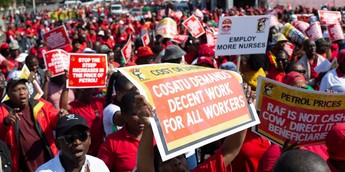
South Africa is facing renewed fears of xenophobic violence as anti-immigrant protesters demand that undocumented foreigners leave the country, in a crisis that has exposed deep public frustration over unemployment, failing services and distrust of African migrants.
According to Reuters, protesters have given undocumented foreigners until Tuesday to leave South Africa ahead of planned rallies, prompting thousands of foreign Africans to either return home or seek safety in camps. The group organising the demonstrations, March and March, has said its protest action is peaceful, but the climate has revived memories of previous attacks on migrants in Africa’s most industrialised economy.
The protests are being driven by claims that South Africa is overrun by illegal immigrants who are taking jobs from citizens, straining public services and contributing to crime. Musa Hlongwa, president of the anti-migrant civil group United South Africa, told journalists on June 24 that South Africans were tired of competing with foreign nationals for jobs, public school spaces and hospital services, while accusing some Nigerian nationals of selling drugs to young people.
The sentiment appears to have widened over the past year. Reuters cited three surveys from 2025 showing rising anti-immigrant feeling among South Africans. A Human Sciences Research Council poll found that only one in six adults said they would welcome all foreigners, while 42.00% said they would welcome none, up from about a third in 2021. An Afrobarometer survey found that seven out of 10 South Africans viewed immigrants’ economic impact negatively, while 85.00% said authorities should reduce the number of refugees entering the country or stop them altogether. Ipsos also found that nearly three-quarters of respondents did not trust immigrants from Africa at all.
But the data cited by Reuters challenges several of the claims driving the protests.
A 2023 survey by South Africa’s national statistics office showed that the country had about 3.10 million migrants, equivalent to around 4.10% of the population, down from 5.60% a decade earlier. Reuters noted that this is low by international standards, compared with 17.00% in Britain, 22.00% in Canada and 30.00% in Australia, based on 2024 United Nations data.
Anthony Kaziboni, senior researcher at the University of Johannesburg’s Centre for Social Development in Africa, told Reuters that while the public impression is that large numbers of people are entering the country, the data points in the opposite direction.
Claims that foreigners are responsible for South Africa’s high crime rate are also difficult to sustain from official evidence. Reuters reported that police do not release data on the nationalities of convicts, but justice department prison population figures from 2017 showed 11,842 foreigners in South African prisons, representing about 6.00% of the prison population. Of that number, 1,380 were imprisoned for entering the country illegally.
Loren B. Landau, Professor of Migration and Development at the University of Oxford, told Reuters that available evidence suggests immigrants are disproportionately law-abiding, with most offences linked to immigration violations.
The argument that migrants take jobs from South Africans is also contested. Reuters cited a 2018 World Bank report showing that for every migrant employed, about two jobs are created for South Africans through business activity. Migrants earn income and spend most of it locally, creating demand for goods and services produced by South Africans.
The pressure on public services is more complex. Economists quoted by Reuters argue that South Africa’s struggling health and education systems are mainly the result of chronic underinvestment and corruption, rather than migrant use. Undocumented migrants are also less likely to use public hospitals or schools because registration could expose them to authorities.
The deeper cause of the backlash appears to lie in South Africa’s wider social crisis. About a third of the population is unemployed, one of the highest rates in the world. Service delivery failures helped cost the African National Congress its parliamentary majority in the 2024 elections, while inequality remains among the highest globally. Local elections are also due by November this year, creating space for political actors to harden anti-migrant messaging.
That combination of economic hardship, weak services and electoral pressure has made migrants an easy target for public anger, even when evidence points more clearly to poor governance, corruption and structural unemployment.
South Africa has a long history of migrant labour, including under apartheid, when workers from across Africa were used in the mining economy. Today, that history sits uneasily alongside a society frustrated by slow growth, joblessness and deteriorating public services.
The immediate risk is that anti-immigrant mobilisation turns violent, particularly against African migrants who operate small businesses or live in vulnerable urban communities. For the wider region, the protests also carry diplomatic implications, given the number of migrants from neighbouring countries who live and work in South Africa.
The latest wave of protests therefore reflects more than hostility to undocumented migration. It is a warning sign about a society struggling to manage economic disappointment, public-sector failure and political distrust and increasingly directing that anger at foreign Africans rather than the institutions responsible for fixing the country’s underlying problems.

