

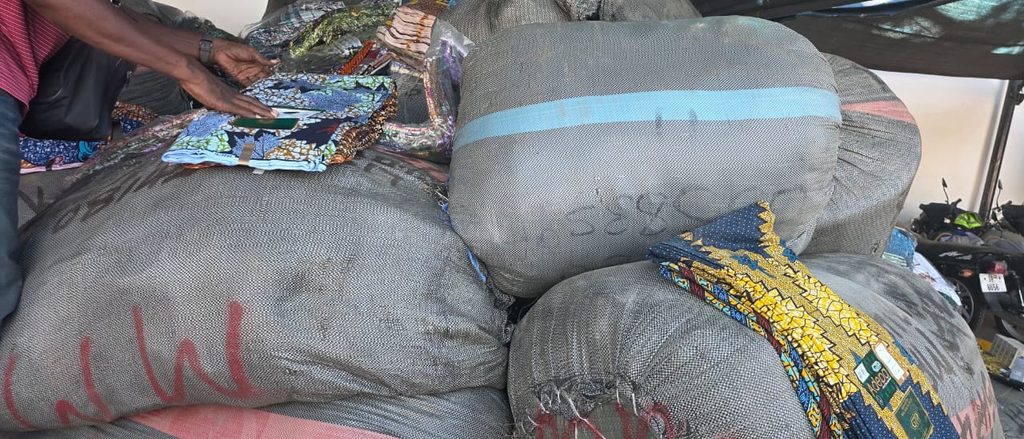

- GH¢20m Fake GTP Seizure Exposes the Cost of Counterfeit Trade
A police interception of imitation GTP wax prints estimated by the company at GH¢20 million has put renewed focus on the cost of counterfeit trade: lost tax revenue, pressure on local producers and the difficulty of protecting consumers once goods enter the market.
The Special Operations Team of the Inspector-General of Police seized the textiles after receiving a tip-off. The goods, described as wax prints from Nigeria bearing imitated Tex Styles Ghana designs, were reportedly smuggled into Ghana without the required taxes.
Tex Styles Ghana’s Environmental Sustainability Manager, Schandorf Nii Obodai, valued the seized material at “about GH¢20 million worth of cloth”. The police Intelligence Unit has taken over the investigation.
The seizure is significant, but its full meaning depends on what investigators establish next. The GH¢20 million figure is an estimate given by a company representative; the publicly available account does not specify the quantity seized, the valuation method or the amount of customs revenue allegedly lost.
Those details matter if the case is to move from an impressive interception to a measurable account of the scale and cost of the trade.
There are also separate questions to resolve. Investigators must establish how the goods entered the country, whether import duties and taxes were evaded, who imported and financed the consignment, and whether the fabrics infringed protected trademarks or designs.
These are related allegations, but each requires evidence. A seizure is an enforcement action, not a judicial finding of guilt.
That distinction is important for legitimate cross-border trade. Fabric made in another country is not automatically illegal.
The central issue is whether the goods falsely carry GTP branding or imitate protected designs and whether import rules were breached. Clear findings would help distinguish lawful imports and competition from counterfeiting and smuggling.
For Tex Styles Ghana, the commercial concern is direct. If products sold as GTP are not made by the company, buyers may be misled about their origin and quality. Counterfeit goods can also divert sales from a manufacturer that bears the costs of production, employment, taxes and compliance.
The company says imitation fabrics make it harder to sell locally produced cloth and can weaken production and jobs. Those claims describe the potential impact; the size of the losses from this particular consignment has not been independently quantified.
The episode also illustrates how counterfeit trade can affect public finances. If a shipment enters without required duties, the state loses revenue that would otherwise be collected at the border. But the scale of that loss cannot be inferred from the company’s estimate of the fabrics’ value. Establishing it requires the shipment’s declared or assessed value, the applicable tariff and taxes, and evidence of what was paid or avoided.
A successful raid is therefore only the first stage of enforcement. The investigation must identify the people behind the shipment and establish whether the goods were part of a wider distribution network. If the case ends with seized stock but no clear account of suppliers, importers and intended buyers, the route into the market may remain open for the next consignment.
The timing also matters. The company says counterfeit wax prints can remain on the market after the festive season, prolonging the pressure on legitimate sellers. That points to the importance of market surveillance and traceability, not just border checks. Once goods are dispersed among wholesalers and retailers, identifying and removing them becomes more difficult.
Tex Styles Ghana says it does not operate factories in Nigeria or elsewhere in Africa that produce GTP or Vlisco fabrics, and warns that claims of such production are used to sell imitations.
That statement is relevant to consumers and traders, but it also places a responsibility on the company and enforcement agencies to make verification straightforward. Buyers need reliable ways to identify genuine products, while customs and police need evidence they can use to distinguish authentic goods from imitations.
The broader challenge is that counterfeit goods compete on more than price. They exploit the value of an established name while avoiding the costs associated with building and protecting that brand. If consumers cannot tell what they are buying, trust in the label weakens.
If traders face uncertainty about authenticity, the risk extends beyond one manufacturer to the reputation of the wider textile market.
Public warnings alone may not be enough. Effective action requires coordination between police, customs authorities, trademark holders, market associations and retailers.
Investigators need to follow the transaction trail; customs authorities need to verify import records; and brand owners need to provide practical authentication information. Penalties must also be applied consistently where offences are proved.
The case raises a further question about the way Ghana measures enforcement success. The value of seized goods attracts attention, but meaningful assessment should include the number of investigations completed, prosecutions brought, convictions secured, revenue recovered and repeat routes disrupted.
Without those measures, large seizures may look decisive while the incentives for counterfeit trade remain intact.
For consumers, the immediate advice is to be cautious about claims that branded fabric was produced in a location where the company says it has no factory. For traders, checking suppliers and import documentation can reduce the risk of buying goods that may later be seized.
But responsibility cannot rest on buyers alone: regulators and brand owners must make verification accessible and enforcement predictable.
The GH¢20 million estimate makes this interception headline-grabbing. Its lasting significance will depend on whether the investigation establishes the facts, identifies the people responsible and closes the channels through which imitation goods reach the market.
Protecting a Ghanaian brand requires more than stopping one shipment; it requires a credible system that makes counterfeiting harder to import, distribute and sell.

