


- Ghana’s Oil Output Slump Deepens as Six-Year Production Decline Erodes State Revenues
Ghana’s upstream petroleum industry is facing its most serious structural test since the country began commercial oil production, with crude output falling for six consecutive years and petroleum revenues weakening sharply at a time when the state needs every source of foreign exchange and fiscal space.
A new report by the Institute for Energy Security has laid bare the scale of the decline. Ghana’s crude oil production fell from 71.44 million barrels in 2019 to 37.30 million barrels in 2025, representing a contraction of 47.79%. The Energy Commission projects output will fall further to 34.83 million barrels in 2026, extending the downturn into a seventh consecutive year.
The numbers tell a sobering story. Ghana is not simply producing less oil than it did at its peak. It is producing almost half of what it produced six years ago, even though petroleum remains one of the country’s most important sources of export earnings, fiscal revenue and energy security.
The revenue impact has been severe. Total petroleum receipts dropped by 43.30% to US$770.30 million in 2025, compared with US$1.36 billion in 2024, reflecting weaker production volumes and softer international crude prices.
For an economy still working through fiscal consolidation, debt restructuring and pressure on public finances, the sustained decline in oil receipts is more than a sectoral problem. It is a macroeconomic risk.
Petroleum revenues account for about 10.00% of government income and remain an important source of foreign exchange. When production falls, the impact is felt across the budget, the external sector and the broader economy. Government receives less from carried and participating interests, royalties, corporate taxes and surface rentals. The Ghana National Petroleum Corporation also receives less revenue to support its operations and investments.
The IES estimates that Ghana forfeited more than US$16.50 billion in potential gross petroleum revenues between 2019 and 2025 under a scenario where production had been sustained through continuous field development, new exploration licences and improved reservoir management.
That estimate is not merely a lost-revenue calculation. It is a warning about opportunity cost. The forgone revenues could have supported infrastructure, debt reduction, energy sector payments, education, healthcare, local content development and reserves accumulation.
The report argues that Ghana’s oil production losses are not cyclical, but structural. That distinction is important. A cyclical decline may be reversed by favourable prices, temporary field recovery or short-term operational adjustments. A structural decline requires deeper reform: new investment, new fields, better reservoir management, stronger regulation, faster approvals and a more competitive upstream fiscal framework.
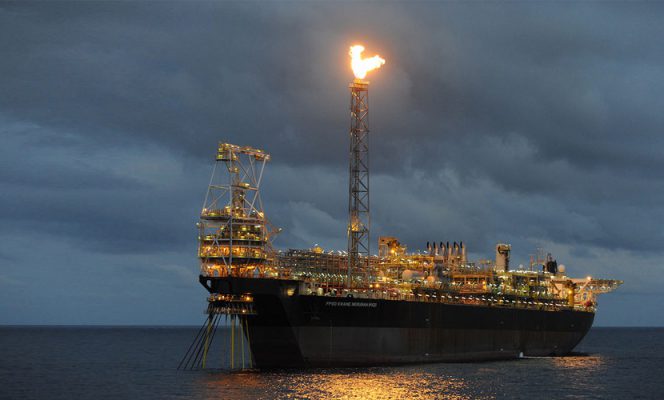
Ghana’s production remains heavily concentrated in three offshore fields — Jubilee, TEN and Sankofa Gye Nyame. These fields remain strategically important, but they are increasingly mature assets. Ageing reservoirs naturally lose pressure over time, and without sustained drilling, enhanced recovery and new discoveries, production decline becomes inevitable.
The Jubilee Field remained Ghana’s largest producer in 2025, but it also recorded the steepest annual decline following a scheduled maintenance shutdown and the natural depletion associated with mature oil fields. TEN and Sankofa Gye Nyame have also faced production challenges, reinforcing concerns that Ghana’s upstream base is too narrow for long-term security.
The deeper problem is that Ghana has not brought enough new reserves into production to replace declining output from existing fields. The IES attributes the downturn to declining reservoir productivity, limited replacement reserves, inadequate upstream investment and the absence of new petroleum agreements since 2018.
That absence of new petroleum agreements is one of the clearest warning signs in the report. Exploration is the lifeblood of any upstream petroleum industry. Without fresh licences, seismic work, appraisal drilling and new discoveries, a producing country eventually becomes dependent on ageing fields. Ghana appears to be approaching that point.
The consequences extend beyond crude oil exports.
Lower oil production also raises concerns about domestic gas supply, which is critical to Ghana’s power generation mix. Natural gas from domestic fields supports thermal power plants and reduces dependence on imported liquid fuels. If domestic gas availability weakens, Ghana could face higher fuel import requirements, greater exposure to exchange-rate volatility and increased pressure from global energy prices.
That would worsen an already difficult energy sector balance. Ghana is trying to reduce power sector arrears, improve utility finances and manage public transfers to the energy sector. A decline in domestic gas supply would make that task harder by raising generation costs and increasing vulnerability to external shocks.
The Ministry of Finance has acknowledged the production slowdown and says government has secured more than US$3.50 billion in investment commitments aimed at reversing the trend. These include a US$2.00 billion drilling programme covering 20 additional wells within the Jubilee and TEN fields, as well as a US$1.50 billion investment framework targeting the Offshore Cape Three Points block.
GNPC is also expected to commence exploratory drilling in the Voltaian Basin later this year, as authorities seek to diversify Ghana’s upstream resource base beyond the offshore producing fields that currently dominate national output.
These are important steps, but they will take time to translate into actual production. Wells must be drilled. Reservoirs must perform. Commercial discoveries must be made. Investors must commit capital. Regulatory approvals must be timely. Infrastructure must be available. In upstream oil and gas, policy announcements do not automatically become barrels.
Government has also started reviewing Ghana’s upstream fiscal and regulatory framework to improve investor competitiveness. Parliament has approved extensions to Tullow Oil’s petroleum agreements, allowing continued operations at the Jubilee and TEN fields until 2040.
The extensions provide continuity, but they do not remove the need for fresh exploration and new entrants. Ghana must now convince investors that the country remains attractive compared with other African upstream jurisdictions competing for the same capital.
That competition is intense. Global oil companies are becoming more selective. Capital is moving towards jurisdictions with clearer fiscal terms, faster decision-making, lower regulatory uncertainty and stronger production prospects. Ghana must therefore offer not only geological promise, but policy credibility.
Industry analysts argue that reversing the decline will require more than capital expenditure. Ghana must rebuild investor confidence through transparent licensing rounds, predictable fiscal policy, faster regulatory approvals, stronger institutional governance and better coordination among the Ministry of Energy, Petroleum Commission, GNPC and other sector agencies.
The IES recommends an immediate resumption of competitive petroleum licensing, accelerated field development programmes and reforms to strengthen GNPC’s operational capacity and oversight of petroleum revenues.
That recommendation goes to the heart of the issue. Ghana cannot manage its way out of a long-term production decline without new exploration and field development. Mature assets can be optimised, but they cannot carry the country indefinitely.
The oil sector’s decline should therefore force a broader national conversation. Ghana has often treated petroleum as a bonus revenue stream, but the current production slump shows that oil revenues are not guaranteed. They depend on investment, field management, regulation, geological success and long-term planning.
If Ghana fails to reverse the decline, the country risks losing fiscal revenue, foreign exchange earnings, domestic gas security and upstream investor relevance. If it succeeds, the sector can still support growth, power generation, industrialisation and public finances.
The stakes are high because the decline is no longer a short-term fluctuation. Six years of falling output point to a structural weakness that cannot be explained away by one maintenance shutdown or one bad production year.
Ghana’s oil story has reached a turning point.
The country must now decide whether it wants to remain a serious upstream producer or gradually become a declining petroleum province living off ageing fields.
The answer will depend on whether investment commitments become drilling activity, whether regulatory reforms become investor confidence, and whether Ghana can discover and develop new reserves before the old fields decline further.

