

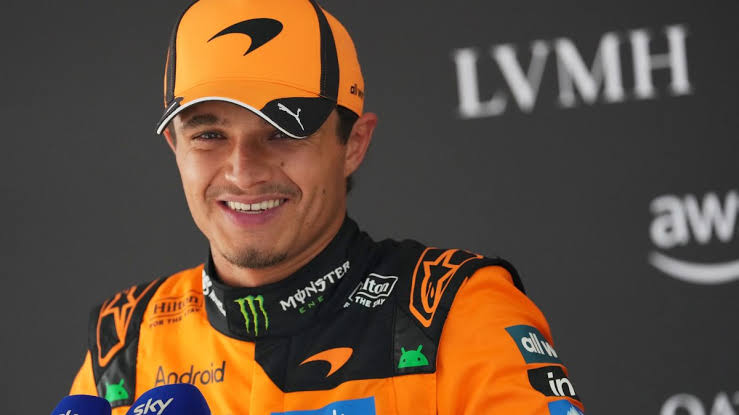

- Norris Warns Mclaren Still Lack a Title-Winning Package For 2027
Lando Norris’s victory in the rain-affected Sao Paulo Grand Prix gave McLaren a welcome return to the top step of the podium. His assessment afterwards was less celebratory: the team, he said, is still “not at the level we need to be to fight for a world championship”.
The warning matters because the result looked emphatic. Norris won by 14.602 seconds from Max Verstappen at Interlagos, converting pole position into his third victory of the season. But the margin did not tell the whole story.
Mercedes driver Kimi Antonelli spun while leading, George Russell lost time after a pit-lane spin, and changing weather made tyre calls and composure decisive. Norris acknowledged that McLaren’s upgrades helped, while also making clear that one strong weekend had not solved the team’s wider performance deficit.
“The upgrades we brought this weekend were great. They worked as they should have done,” Norris said. “But it’s still not enough.” He added that the new parts could not guarantee McLaren would “suddenly always be the quickest”.
The comments were a reminder that race wins are the product of more than car speed: strategy, pit stops, driver execution and rivals’ errors all shape the final result.
McLaren brought new wing and floor components to Brazil, and Norris said they had delivered an immediate step forward. Team principal Andrea Stella also credited the upgrades with helping the team return to contention, although conditions at Interlagos played a part.
The upgrades mattered, but they need to translate into consistent pace across different circuits and conditions before McLaren can make a credible championship claim.
That distinction is at the heart of Norris’s caution. A team may have enough pace to win a particular race without having the car, reliability and operational consistency required to sustain a title campaign.
Brazil demonstrated that McLaren can make improvements and execute under pressure. It did not prove that the team can regularly outpace Mercedes, Red Bull and Ferrari.
The result itself illustrated the difference between a strong car and a strong race weekend. Norris lost ground at the start from pole, then worked his way back into the lead as the track dried and later became wet again. McLaren timed his switch from intermediate tyres to slicks well.
Norris kept his composure through the changing conditions, while Antonelli’s spin opened the door for the McLaren driver to take the lead. The 71-lap race eventually returned to intermediate tyres as rain intensified.
Verstappen’s second-place finish also complicates any reading of the result as a simple demonstration of McLaren’s superiority. The Red Bull driver recovered from 21st on the grid to finish second, 14.6 seconds behind Norris. That recovery showed Red Bull’s capacity to remain competitive even after a difficult qualifying position.
Meanwhile, Mercedes secured the 2026 constructors’ championship with Russell fourth and Antonelli fifth, despite Norris winning the race. McLaren’s triumph therefore came alongside a clear reminder of the team’s season-long challenge: Mercedes had already done enough across the year to take the title.
Norris said McLaren had “not been good enough” during the season to mount a serious defence of its championship ambitions, and that he was not yet confident in the package. The wording is striking because it directs attention beyond the next race.
With two rounds remaining after Brazil, the team has limited time to change its standing in 2026; its more consequential task is to convert late-season development into a stronger foundation for 2027.
The next season will bring some refinements to the technical and sporting rules, but the FIA’s September statement described the planned technical changes as minor. It also approved a reduction in standard race distance from 305km to 290km, changes to race time limits for disrupted events and the removal of gearbox homologation.
That suggests McLaren will not be starting from a completely new technical framework in 2027. Its ability to build on the current car’s development may therefore matter, although the regulations and competitive order will continue to evolve.
The São Paulo upgrades may be a useful test of that development direction. But their value will be judged not only by a single victory, but by whether they perform consistently and whether the team can close the gap in outright pace.
Norris said McLaren had still been a tenth or two behind in practice, according to team principal Stella’s assessment, despite the improved race result. That is a small margin in lap-time terms, but across a season it can determine qualifying positions, tyre degradation and whether a driver can control a race rather than rely on events unfolding favourably.
There is also an operational question. Championship-winning teams need to make fewer costly mistakes over the course of a season. In Brazil, McLaren’s decisions helped Norris capitalise, while mistakes from Antonelli and Russell altered the race.
Norris himself pointed to “good strategy, good pit stops, driving well and not making mistakes” as important ingredients in winning. McLaren’s challenge is to combine that execution with a car fast enough to put both drivers in contention more often.
For Norris, the victory offered something tangible to the team after a difficult run. He said he was proud of the work behind the upgrades and grateful to be able to reward the team’s effort.
But his caution also sets a demanding standard for the months ahead: development must continue, and confidence in the car has to be earned through repeatable performance.
The Brazil result is encouraging evidence that McLaren can respond when it identifies weaknesses. It is not yet evidence that the team is ready to fight for a championship.
Norris’s message is that the distance between those two claims remains real and that the work to close it has to continue long after the celebrations at Interlagos.

