

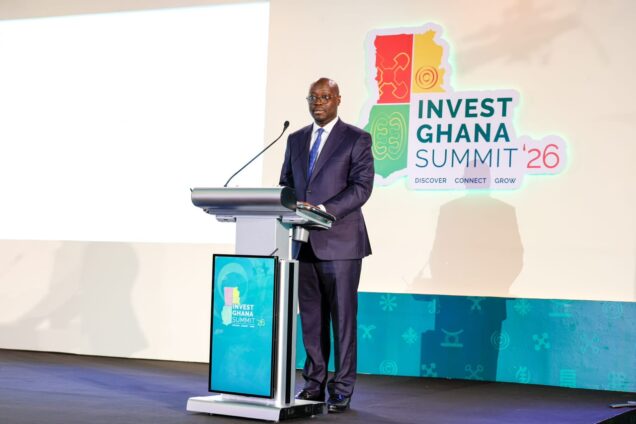

- Ato Forson Urges Investors to Build Businesses and Expand Production in Ghana
Finance Minister Cassiel Ato Forson has invited local and international businesses to invest in Ghana, produce locally and use the country as a base for reaching wider African markets.
His pitch is backed by a four-year public investment plan equivalent to US$10 billion under the New Economy programme.
The challenge now is to turn that headline commitment into projects that attract private money, create jobs and build lasting productive capacity.
Speaking at the Invest Ghana Summit in Accra, Dr Forson said the 2027 Budget provides for more than US$2.5 billion of the planned investment in its first year.
Government intends to direct spending towards areas including power, irrigation and transport services that can determine whether a factory can expand, a farm can reach buyers or a manufacturer can produce at a competitive cost.
“Ghana is ready to produce more at home and sell more to the world,” he said, urging businesses to identify where they could invest and create jobs. The appeal is direct, but an investment invitation is only the beginning of a commercial decision.
Investors will need to assess whether projects have reliable infrastructure, clear rules, viable markets and financing that matches the time it takes to earn a return.
The sectors identified by the Finance Minister show the breadth of the government’s ambition. In agriculture, planned rice hubs could create opportunities in irrigation, storage, milling and packaging.
Government is also proposing that public institutions buy Ghana-grown rice and other staples, potentially creating demand for local producers and processors able to supply consistent volumes and meet quality standards.
That proposal highlights a condition for the wider production strategy: supply must connect to dependable demand. A farmer or miller will invest more confidently if there is a clear buyer, a workable price and a payment system that allows the next production cycle to begin.
Public procurement could help establish that market, but its credibility will depend on the government’s ability to follow through on purchases and payments.
Energy is another key part of the pitch. Dr Forson argued that reliable electricity could help factories get more from existing machinery and add shifts.
He also pointed to opportunities in solar and battery storage, equipment supply and the servicing of industrial power systems. The potential is not limited to building new facilities; it includes enabling businesses to use their existing capacity more fully.
The case for minerals processing is similarly about retaining more value within Ghana. The Minister said government was establishing a critical minerals processing enclave in the Western Region, where investors could develop plants to process manganese and bauxite into higher-value products.
The economic case will depend on whether local processing can operate competitively, secure reliable inputs and reach customers for its output.
Other opportunities include garments and medicines, tourism and the creative arts, and technology services that help businesses reach customers, receive payments and move goods across borders.
The range gives investors several possible entry points, but it also raises a practical question: how will government prioritise and coordinate projects so that investment in one area supports others? A processing plant, for instance, also needs power, transport, skilled workers and access to finance.
The Finance Minister named macroeconomic stability and affordable finance as foundations for the New Economy. He also argued that fiscal discipline protects the conditions businesses need to price contracts, finance factories and invest for the long term.
That emphasis recognises the tension at the heart of the plan: public investment is meant to unlock growth, but it must be financed without undermining the stability that makes long-term investment possible.
The proposed US$10 billion public investment could help create opportunities, but it cannot substitute for private capital. Dr Forson urged Ghanaian businesses to present expansion plans they had been waiting to finance, asked international investors to partner local firms and called on banks and development finance institutions to work with both sides on viable projects.
This shifts attention from the amount government plans to spend to the mechanisms that will help businesses obtain suitable finance.
Those mechanisms matter because different investments need different kinds of funding. A short-term loan may help a processor buy inputs, but it may be poorly suited to financing irrigation or a plant that takes years to reach full production.
Investors and lenders will need to match financing terms to the risks and cash flows of each project. The summit’s value will therefore be measured partly by whether conversations between firms, banks and government continue after the event.
Dr Forson urged participants to leave with a partner, a project to examine and a follow-up meeting scheduled.
It is a useful benchmark for an investment summit: announcements and networking are indicators of interest, not proof that money has been committed or facilities built.
The stronger evidence will come from projects that reach financial close, begin construction, source inputs locally and deliver goods to paying customers.
The AfCFTA gives the investment pitch a continental frame. Dr Forson urged businesses to consider the size of the African market when deciding how much production capacity to establish in Ghana.
A local customer could provide a starting point, but regional sales could justify larger facilities and more specialised production. That opportunity will require firms to compete on price, quality and reliable delivery, not simply locate themselves in Ghana.
Ghana’s message to investors is that public investment will help lower the barriers to production while private businesses supply capital, expertise and commercial execution. Its credibility will depend on the relationship between those two parts.
If government spending improves infrastructure and creates reliable markets, it can make private projects more attractive. If the public investment plan remains a large number without clear projects, timelines and financing arrangements, the call to invest may struggle to move beyond the summit stage.
The invitation to “produce here and grow with us” is therefore both a sales pitch and a test for government. Investors will look for proof that policy commitments endure and that projects can operate profitably.
Ghanaians, in turn, will want to see whether the investment brings more than construction activity: whether it creates durable jobs, strengthens local firms and leaves the economy better able to produce and export.
The New Economy’s success will not be determined by the size of its ambition alone. It will be determined by what is financed, built and sustained and by whether Ghanaian businesses can grow alongside the investors it hopes to attract.

