
- NPA Rejects GH¢600 million Fuel Revenue Loss Claims, Cites ICUMS and GRA Records to Challenge Allegations
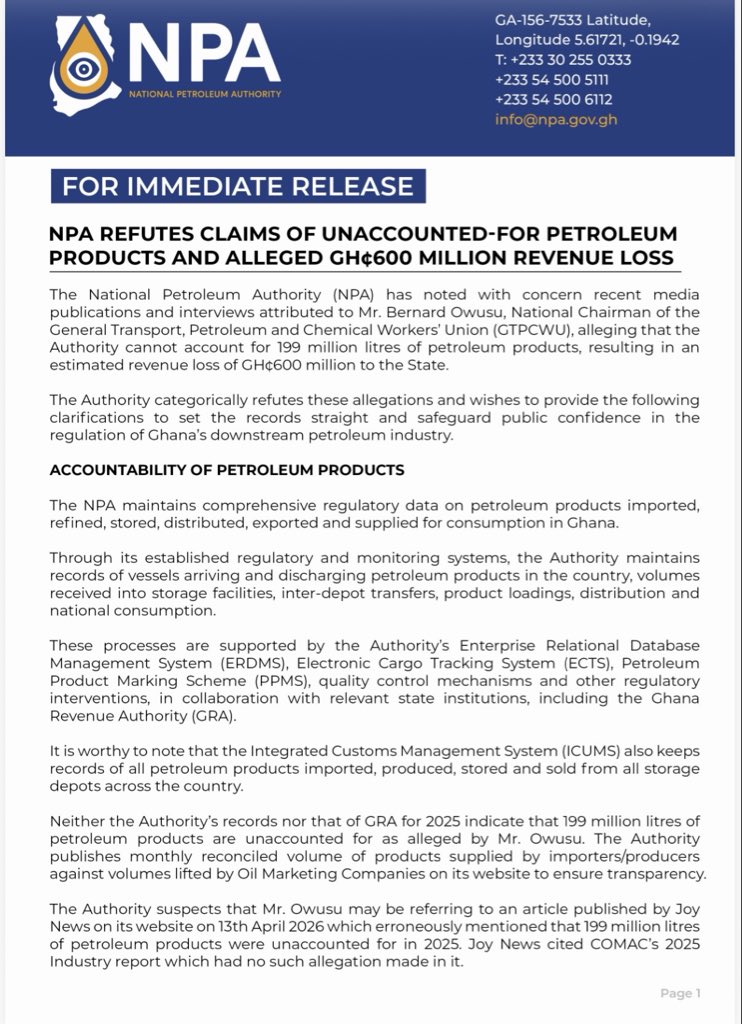
The National Petroleum Authority (NPA) has categorically rejected allegations that Ghana failed to account for 199 million litres of petroleum products in 2025, resulting in an estimated GH¢600 million loss in state revenue, insisting that its regulatory records and those maintained by the Ghana Revenue Authority (GRA) do not support the claims.
In a statement issued on Sunday, November 29, 2026, the downstream petroleum regulator challenged Bernard Owusu, National Chairman of the General Transport, Petroleum and Chemical Workers’ Union (GTPCWU), to provide verifiable evidence and the methodology underlying statements attributed to him concerning discrepancies in petroleum product volumes.
The Authority maintained that Ghana’s petroleum supply chain is monitored through multiple regulatory and customs systems, including the Integrated Customs Management System (ICUMS), which maintains records of petroleum products imported, produced, stored and sold from storage depots across the country.
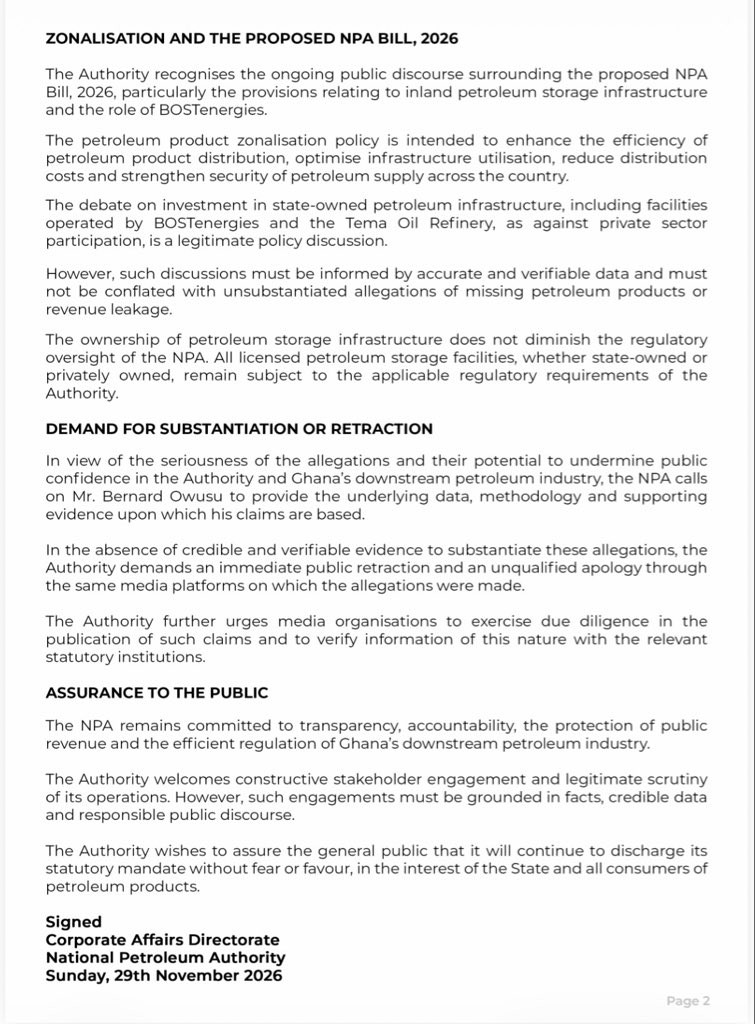
The rebuttal comes amid growing disagreement over the proposed National Petroleum Authority Bill, 2026, particularly provisions concerning the operation of inland petroleum storage infrastructure and the future commercial role of state-owned BOSTenergies.
However, the controversy has acquired an additional dimension following a separate clarification by Mr Owusu, who has denied accusing the NPA of stealing petroleum products or claiming that the Authority itself had lost 199 million litres of fuel.
The competing statements expose an important distinction between discrepancies in petroleum accounting, allegations of missing physical products and claims about potential tax revenue losses.
They also raise broader questions about how regulatory institutions, industry associations and labour unions communicate petroleum-sector data and whether publicly disputed figures can be independently reconciled.
The NPA’s statement, signed by its Corporate Affairs Directorate, said, “the Authority categorically refutes these allegations.”
It explained that its records cover petroleum products imported into Ghana, refined domestically, stored in petroleum depots, transferred between facilities, exported and supplied for consumption.
The Authority indicated that its monitoring arrangements allow it to track the movement of petroleum products across different stages of the downstream value chain, providing a basis for reconciling reported imports and production with distribution and consumption.
According to the statement, neither its regulatory records nor GRA’s corresponding data for 2025 establish that 199 million litres of petroleum products remain unaccounted for.
The NPA further disclosed that it publishes monthly reconciled volumes of petroleum products supplied by importers and producers against quantities lifted by Oil Marketing Companies.
These publications, it argued, form part of efforts to maintain transparency and strengthen public confidence in petroleum-sector regulation.
The Authority identified several technology-based systems supporting its oversight responsibilities.
These include the Enterprise Relational Database Management System (ERDMS), Electronic Cargo Tracking System (ECTS) and Petroleum Product Marking Scheme (PPMS).
Together with quality-control arrangements and other regulatory interventions, these systems are intended to provide visibility over product movements and help detect discrepancies within the petroleum distribution network.
Significantly, the statement also made specific reference to ICUMS, which operates under the Ghana Revenue Authority’s customs administration framework.
The NPA stated, “It is worthy to note that the Integrated Customs Management System (ICUMS) also keeps records of all petroleum products imported, produced, stored and sold from all storage depots across the country.”
The reference is important because petroleum accountability involves more than establishing the quantity of fuel entering Ghana.
It also requires credible documentation of how petroleum products move through storage facilities, distribution networks and sales channels, and how the corresponding fiscal obligations are assessed and collected.
Accurate customs and regulatory records can support the identification of irregularities, improve revenue assurance and strengthen the reconciliation of transactions across participating institutions.
However, the existence of multiple monitoring systems does not, by itself, establish that every petroleum transaction has been accurately recorded or that no revenue leakage can occur.
The effectiveness of those systems ultimately depends on the quality of data entered, the consistency of reconciliation procedures and the ability of responsible institutions to investigate discrepancies.
The NPA’s statement establishes the regulator’s position that the specific 199 million-litre allegation is unsupported by its records.
It does not publish a detailed transaction-by-transaction reconciliation demonstrating how the disputed figure arose or was ruled out.
Such a reconciliation could provide greater clarity, particularly given the public interest surrounding the reported GH¢600 million revenue figure.
The NPA also questioned the origin of the allegation.
It suggested that the figure may have emerged from an April 13, 2026 publication concerning petroleum product volumes, which it said incorrectly attributed a claim about 199 million litres of unaccounted-for products to the Chamber of Oil Marketing Companies’ 2025 industry report.
The Authority maintained that the industry report did not contain the allegation presented in that publication.
This aspect of the dispute is particularly important because it concerns whether an industry dataset was interpreted correctly before being introduced into public debate.
The figures have been presented in different accounts as missing petroleum products, unaccounted-for volumes and lost tax revenue.
These descriptions are not interchangeable.
A discrepancy between reported quantities may arise from accounting definitions, reporting periods or other reconciliation issues. It does not automatically establish that physical products have disappeared.
Similarly, an estimate of tax revenue potentially lost through unaccounted-for transactions does not necessarily represent the market value of the petroleum products concerned.
An independent examination of the underlying industry report, including its methodology and definitions, would therefore help resolve whether the public controversy arose from conflicting datasets or incorrect interpretations.
The need for clarification has become more pressing following Mr Owusu’s response to allegations attributed to him.
In a statement dated November 28, the union chairman denied having made the specific accusation that 199 million litres of petroleum products had disappeared from the NPA.
He also denied granting an interview to Ghana Today, the publication he identified as having attributed the disputed allegation to him.
Mr Owusu explained that his remarks during a November 27 television interview referred to the 2025 Petroleum Product Analysis Report associated with the Chamber of Oil Marketing Companies and the Ghana Energy Chamber.
He maintained that discussing unaccounted-for petroleum volumes within an industry report was different from accusing the NPA of theft.
His clarification therefore predates the Authority’s November 29 rebuttal and introduces a material distinction into the controversy.
The original report and the precise calculation behind the GH¢600 million estimate would need to be independently examined before determining which interpretation is supported by the underlying evidence.
The disagreement is unfolding against the backdrop of an increasingly contentious debate over Ghana’s proposed petroleum-sector regulatory reforms.
The NPA Bill, 2026, has attracted opposition from the GTPCWU over provisions concerning private-sector participation in inland petroleum storage and distribution infrastructure.
The union has argued that changes to the existing framework could weaken the commercial position of BOSTenergies and potentially undermine the financial sustainability of strategic petroleum infrastructure developed with public investment.
At a press conference on November 23, Mr Owusu raised concerns about Clause 103 of the proposed legislation, which the union believes could open inland depot operations more broadly to private companies.
The union maintains that BOSTenergies should retain its strategic role and that private investment should be pursued through structured partnerships.
Its concerns extend to potential reductions in throughput at state-owned facilities, employment implications and the costs of maintaining petroleum pipelines and storage infrastructure.
The union has threatened industrial action if its concerns are not addressed before the proposed legislation is passed.
Those arguments represent a separate policy dispute from the allegation concerning unaccounted-for petroleum products.
The NPA acknowledged that questions about investment in state-owned facilities, including infrastructure operated by BOSTenergies and the Tema Oil Refinery, and the appropriate role of private companies are legitimate matters for public discussion.
Nevertheless, it warned against combining the debate over regulatory reforms with allegations about missing petroleum products or revenue losses that have not been substantiated.
The Authority explained that the petroleum product zonalisation policy is intended to improve distribution efficiency, optimise infrastructure utilisation, reduce transportation costs and strengthen the security of petroleum supplies nationwide.
Under such an arrangement, efficient use of storage depots, pipelines and regional distribution networks can potentially reduce the distance petroleum products travel and lower associated logistics expenses.
For consumers and businesses, those efficiencies could contribute to more reliable fuel distribution and help contain transportation-related costs.
However, the commercial implications depend on how the policy is implemented, the ownership and location of available infrastructure, the pricing of distribution services and the treatment of existing investments.
The debate therefore presents a legitimate policy choice involving the balance between state infrastructure, private capital and national energy security.
The NPA maintained that petroleum storage facilities remain subject to its regulatory oversight irrespective of ownership.
This distinction is important because allowing greater private participation does not necessarily mean removing regulatory obligations relating to safety, product quality, reporting and licensing.
At the same time, the continued existence of regulatory oversight does not, by itself, resolve the union’s concerns about the commercial viability of state-owned infrastructure.
Those concerns require a separate assessment of investment, competition, infrastructure utilisation and the potential fiscal consequences of changes to the regulatory framework.
The central issue is that Ghana must avoid allowing disagreement over petroleum-sector reform to obscure the need for credible, independently verifiable information about product volumes and public revenue.
The NPA has demanded that Mr Owusu provide the data, methodology and evidence supporting the allegations attributed to him.
In the absence of credible substantiation, the Authority has called for an immediate public retraction and an unqualified apology.
However, Mr Owusu’s earlier denial of the specific allegation means that the dispute now involves not only the accuracy of petroleum accounting figures but also whether his original remarks were correctly reported and attributed.
A resolution would benefit from the publication and examination of the relevant portions of the 2025 petroleum industry report, together with the NPA’s corresponding reconciled figures and the applicable GRA records.
For the Authority, such transparency could strengthen confidence in its regulatory systems and demonstrate how discrepancies are identified and addressed.
For the union and other stakeholders, verifiable data would provide a firmer foundation for discussing revenue protection and the future structure of Ghana’s downstream petroleum industry.
The broader economic implications are substantial.
Petroleum products are critical to transportation, manufacturing, agriculture, mining and household consumption.
Their movement through the supply chain also generates fiscal obligations that contribute to government revenue.
Consequently, weaknesses in petroleum accounting and revenue assurance, where established, can affect public finances and confidence in sector regulation.
Equally, unsupported allegations of substantial losses can damage institutional credibility and create uncertainty about the integrity of the market.
The appropriate response is therefore rigorous reconciliation rather than speculation.
Ghana’s petroleum industry requires a regulatory framework capable of encouraging investment, protecting public revenue and ensuring the efficient operation of strategic infrastructure.
That objective depends on accurate information, transparent institutions and a clear separation between commercial policy disagreements and allegations of financial misconduct.
The November 29 rebuttal establishes the NPA’s firm rejection of the specific 199 million-litre allegation.
But with Mr Owusu disputing the interpretation of his remarks, the most constructive next step is to examine the original figures rather than assume either account has resolved the underlying data question.
For consumers, businesses and taxpayers, the concern is ultimately straightforward: Ghana must be able to account for petroleum products moving through its economy and demonstrate that the taxes and levies legally due are properly assessed and collected.
The credibility of that assurance rests not merely on institutional declarations, but on the transparency, consistency and verifiability of the records supporting them.