


New Skills and AI Are Reshaping the Future of Work
Technological change has reshaped job markets for centuries. But the benefits have not always been widely shared. As AI and digital technologies transform today’s workplace, even those at the forefront of innovation are not immune to disruption, as recent job cuts at major technology companies show.
Yet new roles are also emerging, as others disappear. New skills, new tasks, and entirely new occupations are being created alongside automation, offering alternative pathways for prosperity.
For workers, finding or keeping a job will increasingly depend on the ability to update skills or learn new ones. Our latest analysis of millions of online vacancies reveals the scale of the demand for new skills: one in 10 job postings in advanced economies and one in 20 in emerging market economies now require at least one new skill.
Professional, technical, and managerial roles are seeing the most demand for new skills, particularly in IT, which accounts for more than half of this demand. Sector-specific capabilities are also trending. Healthcare, for instance, is seeing a surge in telecare and digital health skills, while marketing increasingly demands expertise in social media.
The changing face of the labor market is, understandably, creating anxiety among workers. With nearly 40 percent of global jobs exposed to AI-driven change, concerns about job displacement and declining opportunities for some groups are becoming more acute. This underscores the need for proactive and comprehensive policymaking that prepares the labor force for the future of work and ensures the gains from AI are broadly shared.
Higher Wages, Mixed Job Effects
Employers pay more for workers who acquire emerging skills. In the United Kingdom and the United States, job postings that include a new skill tend to pay about 3 percent more. There’s an even greater premium for openings with four or more new skills. These roles can pay up to 15 percent more in the United Kingdom and 8.5 percent more in the United States.
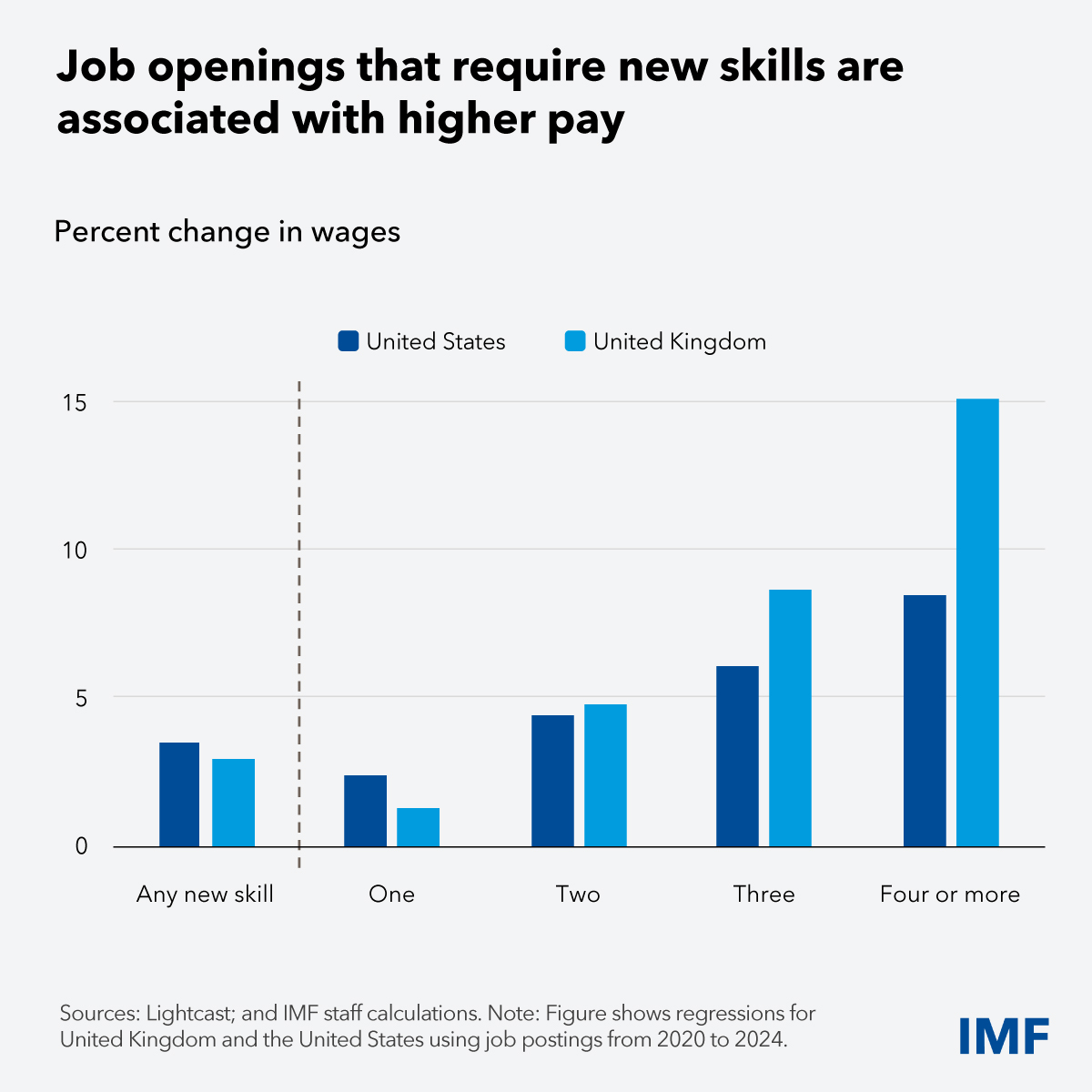
This wage bump can boost the local economy, our research shows. Workers with more money in their pockets spend more at local businesses, which in turn hire more staff to meet demand. In the US, for example, regions with higher adoption of new skills saw employment rise by 1.3 percent for each 1 percentage point increase in the share of job postings that require new skills over the past decade.
However, high-skill and low-skill workers tend to gain the most, while middle-skill roles, like routine office jobs, are being squeezed.
The picture for AI-related skills is even more complex. While these skills command wage premiums, they have not contributed to employment growth so far, like other new skills have. In fact, employment levels in AI-vulnerable occupations are lower in regions with high demand for AI skills—3.6 percent lower after five years than in regions with less demand for these skills. That’s a challenge for young people starting their careers, as entry-level jobs have higher exposure to AI. These findings align with emerging evidence from the US that generative AI adoption reduces entry-level hiring—especially when tasks can be automated.
Global readiness
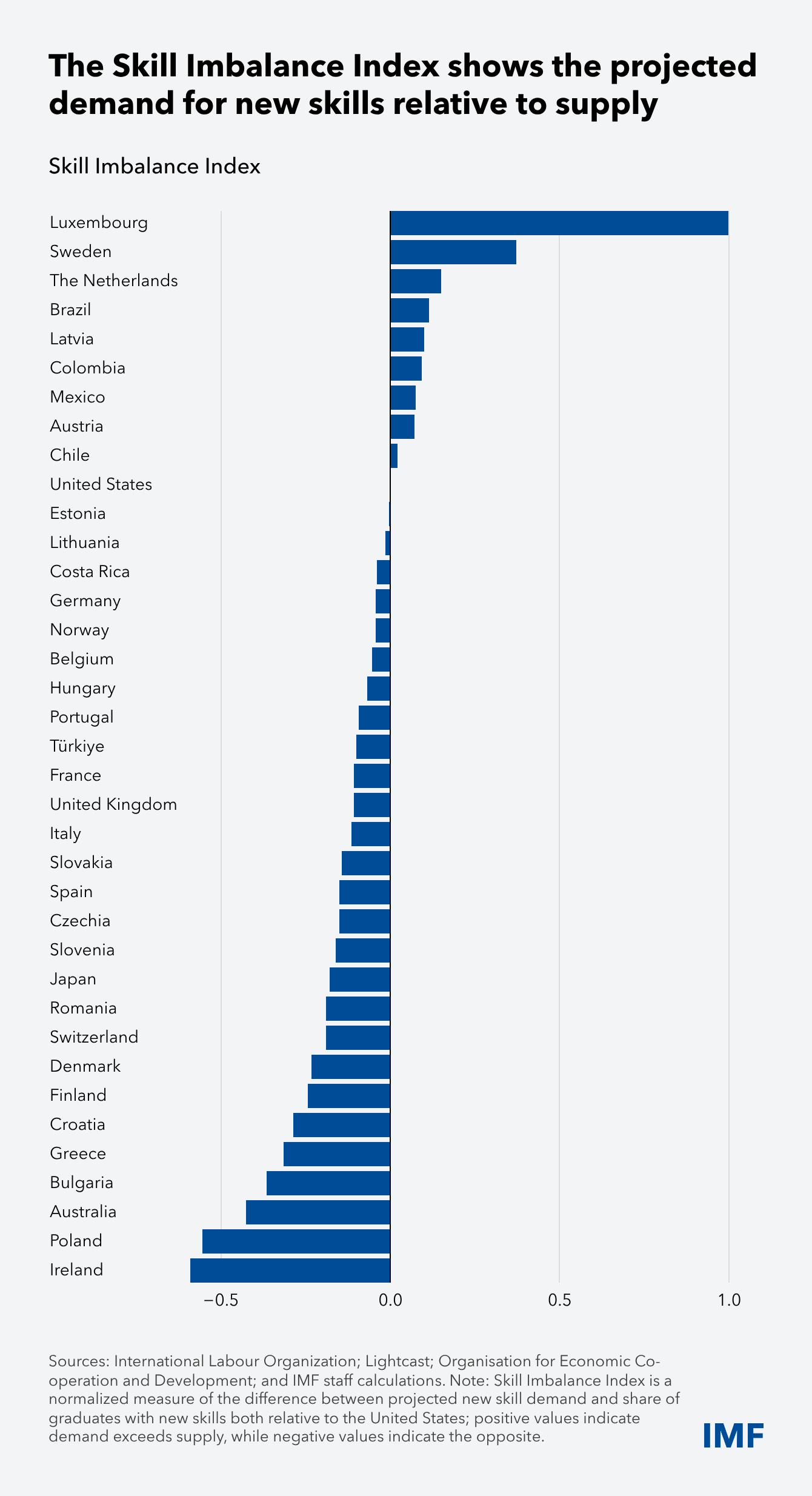
These trends are not inevitable. Policy choices made today can turn disruption into opportunity. The big question for policymakers is how? To help answer that, we developed a Skill Imbalance Index using employment data from several countries. The measure reflects the relative weight of potential future new skill demand versus supply, using the US as a benchmark. It complements the existing IMF AI Preparedness Index, which focuses on the preparedness of countries in four areas relevant to the smooth adoption of AI.
Countries broadly fall into two categories in the Skill Imbalance Index. Those with high demand for new skills but relatively low supply—like Brazil, Mexico, and Sweden—need to invest in training and ensuring better education in science, technology, engineering, and mathematics. They may also need to outsource or rely on foreign-born workers with skills.
Other countries, such as Australia, Ireland and Poland have abundant talent but more modest demand. Their challenge is to stimulate innovation and help companies absorb available talent. Reforms that foster innovation and the creation of new firms and improve business access to finance would help.
Emerging economies and low-income countries, where both demand and supply remain relatively limited, will need both sets of policies.
 More broadly, countries should deploy policies to help workers adapt and acquire new skills and remain engaged in the workforce, and enhance their mobility through affordable housing and flexible work arrangements. This would help connect workers with new opportunities and help to spread new skills more quickly. Competition policy matters too, as does facilitating the entry of new firms. As businesses acquire rivals to capture scarce talent, market power can concentrate in ways that ultimately limit innovation and opportunities. Social protection also should be improved to better support those facing difficult job transitions, and facilitate their reintegration into the workforce.
Finally, governments need to redesign education systems for an AI-driven economy. The high demand for new IT skills may not necessarily translate into a one-for-one rise in demand for IT and AI specialists, especially as many IT tasks may progressively be automated by AI. So, today’s students need cognitive, creative, and technical skills that complement AI and help them use it rather than compete with it. At the same time, workers at risk of displacement need access to retraining to keep pace with rapid changes in the job market.
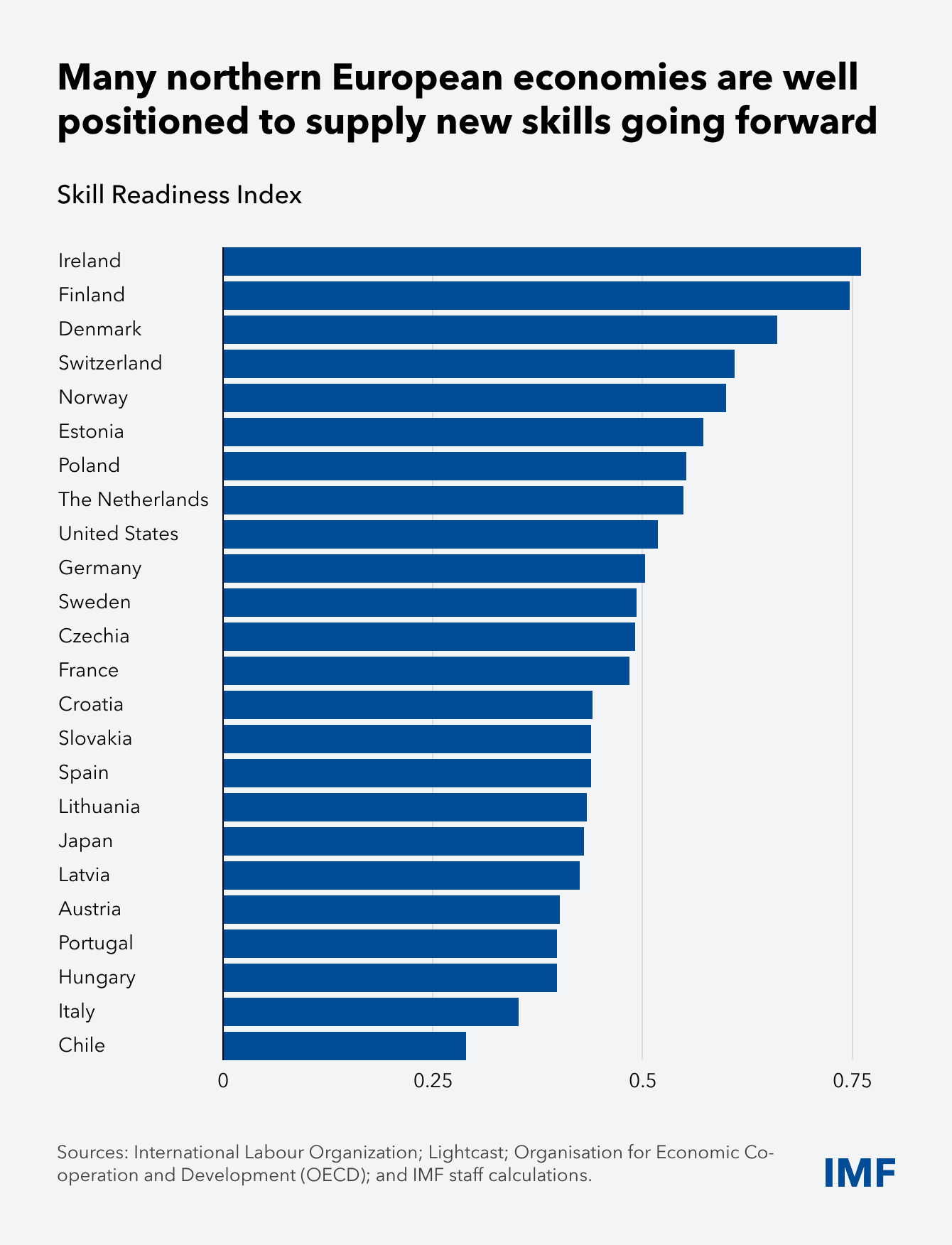
Some countries are already leading the way. Our Skill Readiness Index ranks Finland, Ireland, and Denmark among those best positioned to equip their workforces with the skills and agility needed for the future. What sets them apart? Robust investment in tertiary education and lifelong learning programs that help workers adapt as technology evolves.
Preparation and action
The extent to which AI strengthens economies will depend on how well we prepare workers and firms for the transition. But the stakes go beyond economics. Work brings dignity and purpose to people’s lives. That’s what makes the AI transformation so consequential.
Success will hinge on bold steps taken now: investing in skills, supporting workers through job transitions, and keeping markets competitive so innovation benefits everyone.
