


- Governor Johnson Asiama Sets New Growth Ambition for Ghana International Bank
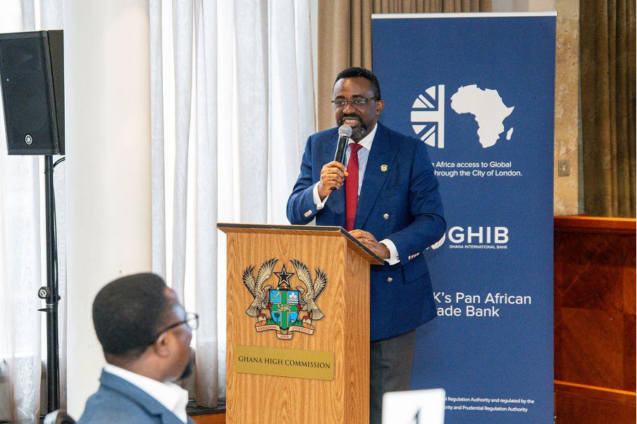
Bank of Ghana Governor and Board Chairman of Ghana International Bank, Dr Johnson Asiama, says the institution is being positioned to become a leading financial bridge between Africa and international capital markets.
Speaking at a town hall meeting in London, where he introduced the incoming Chief Executive Officer of the Bank, Ian Greenstreet, Dr Asiama said GHIB must build on its recent transformation and strengthen its role as a platform connecting African trade, finance and global capital.
“I want us to be a larger, more innovative, faster institution for our clients, and a place where talented people see a long-term future for themselves,” he said.
The Governor urged staff of the Bank to remain focused during the leadership transition, stressing that clients and shareholders would continue to depend on the institution’s performance.
“Do not let this transition distract you from the work that makes this bank what it is,” he told staff. “Our clients, our shareholders depend on you. So, let’s keep moving.”
The Board of Ghana International Bank has announced the appointment of Chartered Accountant and Banker Ian Greenstreet as the new Chief Executive Officer, subject to the necessary regulatory approval.
Mr Greenstreet will take over from Dean Adansi, who has led the bank for the past eight years and is credited with helping turn the institution around during his tenure.
According to the Board, Mr Greenstreet brings more than four decades of experience across international banking, investment management, risk management, corporate governance and business transformation.
His appointment comes at a time when GHIB is seeking to deepen its trade finance role and expand its relevance in international capital markets.
Dr Asiama said the Bank has gone through significant transformation over the years and now occupies a strong position in West African trade finance.
“We are the leading trade finance bank in Anglophone West Africa outside Nigeria, with over US$14 billion in trade flows over the past five years,” he said.
He added that the Bank’s balance sheet remains strong, with capital and liquidity levels well above regulatory requirements and a record of near-zero non-performing loans.
The Governor also noted that GHIB received a standalone credit rating of B+ from Fitch last year, which he said pierced Ghana’s own sovereign ceiling.
That rating, according to market watchers, is important because it can improve confidence among international counterparties, correspondent banks and trade finance partners.
For Ghana, GHIB’s repositioning has wider strategic significance.
The Bank has historically served as an important international banking link for Ghana and parts of West Africa, particularly in trade finance, correspondent banking and financial intermediation between African institutions and global markets.
At a time when many African banks face correspondent banking constraints, tighter global compliance requirements and rising funding costs, a stronger GHIB could provide an important platform for regional financial connectivity.
The ambition to make the Bank a bridge between Africa and international capital markets also aligns with Ghana’s broader efforts to rebuild investor confidence, deepen financial sector credibility and attract long-term capital.
It comes as Ghana continues to navigate post-debt restructuring recovery, fiscal consolidation and efforts to restore full market access.
For African businesses, particularly exporters and importers, access to reliable trade finance remains critical.
Trade finance gaps continue to affect companies across the continent, especially small and medium-sized enterprises that struggle to obtain affordable financing for cross-border commerce.
If GHIB can strengthen its balance sheet, expand partnerships and improve product innovation, it could play a larger role in supporting trade flows, capital mobilisation and financial intermediation across Ghana and the wider sub-region.
Dr Asiama’s message also reflects a broader shift in how African financial institutions are being expected to operate.
They are no longer being judged only by domestic banking performance, but also by their ability to connect African businesses to global liquidity, investment and trade networks.
For GHIB, the leadership change therefore comes with both opportunity and responsibility.
Mr Greenstreet will be expected to sustain the Bank’s recent turnaround, deepen client relationships, improve operational speed, strengthen innovation and position the institution for long-term growth.
The Governor’s comments suggest that GHIB’s next phase will focus on scale, agility and relevance to clients operating across African and international markets.
The key test will be execution.
If GHIB can convert its strong trade finance base, balance sheet stability and international presence into broader capital market connectivity, it could become a more important financial bridge for African businesses seeking global capital.
For now, Dr Asiama’s message is clear: GHIB must not settle for recovery alone.
It must use its renewed strength to become a bigger, faster and more innovative institution capable of linking Africa more effectively to international finance.

