

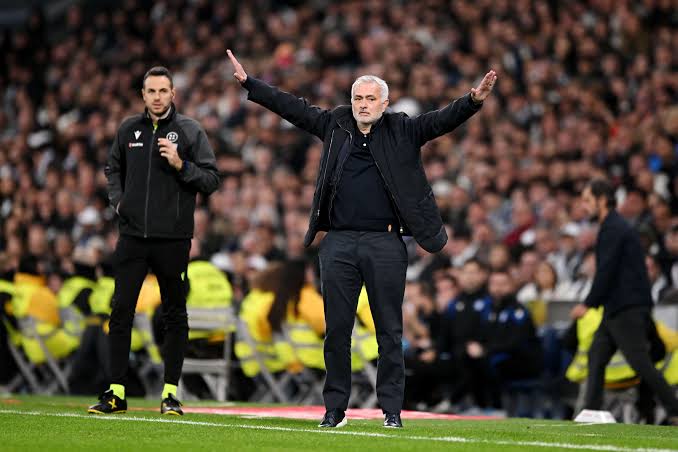

- Mourinho Takes Responsibility After Real Madrid’s Shock Defeat to Alavés
José Mourinho has refused to make Vinícius Júnior the scapegoat for Real Madrid’s 2-1 home defeat to Deportivo Alavés, insisting the responsibility for the result rests with the team and ultimately with him.
The loss ended Madrid’s 10-match winning run and dropped them from second to third in the league standings. It also brought a difficult evening at the Bernabéu into sharper focus: the home crowd booed Vinícius after a poor outing, while Mourinho was also criticised following his decision to substitute Arda Güler in the 60th minute.
The result was damaging, but the reaction to it may prove just as consequential. When a team’s winning streak ends, the impulse is often to find one decisive error or one player to blame. Mourinho’s response pushed against that instinct.
He argued that Vinícius had been no worse than the rest of the side, and that the performance should be assessed collectively.
“There’s no need for stories,” Mourinho said, rejecting speculation about Güler’s reaction to being taken off, the crowd’s treatment of Vinícius and the decision not to substitute the Brazilian. He urged attention to the defeat itself. “The coach is responsible,” he added.
That intervention matters because Vinícius has often been central to the emotional temperature around Madrid.
When he struggles, criticism can quickly become personalised; when he excels, he is celebrated as a decisive force.
Mourinho’s message was that one player should not carry the weight of a collective failure. It was also an acknowledgement that the manager cannot escape scrutiny by redirecting attention towards the crowd, refereeing or an individual’s form.
The coach’s decision to replace Güler with Carlos Espi became one of the evening’s flashpoints.
The substitution drew boos from sections of the home support, with Vinícius also targeted after a frustrating performance.
In a tense game, the change became a symbol for the supporters: a visible decision they could contest, even if it did not explain the broader defeat.
That is the risk of a highly charged stadium response. It can flatten a complex performance into a verdict on one player or one substitution. Yet Mourinho’s refusal to enter that debate does not mean the decision was beyond question.
Substitutions are part of a manager’s responsibility, and supporters are entitled to challenge them. His point was that revisiting the reaction around the change would not explain why Madrid lost.
The defeat also poses a more structural question for a team that had won 10 games in a row: what did the run conceal, and what did Alavés expose?
A winning streak can reflect quality and consistency, but it can also create the impression that a team is more secure than it is. One loss does not invalidate the preceding results. It does, however, test whether a team can respond without allowing one setback to become a crisis.
Madrid’s drop from second to third underlines the immediate cost. The standings can shift quickly, and a club with title ambitions cannot treat lost points as an isolated disappointment.
Mourinho will be judged not only on the defeat but on the team’s capacity to recover particularly after a game that ended amid controversy and frustration.
Jude Bellingham’s late sending-off and Mourinho’s criticism of referee Soto Gardo added another layer to the post-match fallout. Refereeing decisions can shape a contest, and a manager may reasonably contest them.
But when the conversation is dominated by the dismissal, the boos and the substitution, it can become harder to examine the football that preceded those moments. Mourinho’s insistence on collective responsibility may be an attempt to keep the analysis from narrowing to a single incident.
For Vinícius, the manager’s defence is significant, but it does not remove the need for a response on the pitch.
A player who is booed at home faces a difficult balance: ignore the noise, remain influential and avoid letting frustration take over. Mourinho has made clear that he will not assign the defeat to the Brazilian alone.
The next performances will determine whether that support helps restore confidence or merely prolongs scrutiny.
For Güler, meanwhile, the substitution raises questions about how Mourinho manages the expectations of a squad containing high-profile attacking talent.
The available account does not establish how the player reacted privately, and Mourinho explicitly cautioned against inventing a story around it.
The football question is simpler: how will Madrid use their creative options to regain control of matches when opponents disrupt their rhythm?
The manager’s choice of language placing responsibility on himself can be read as leadership, but it also sets a standard. If the coach accepts accountability, the next step is to show what that accountability produces: a clearer plan, improved execution and a team that can absorb pressure without losing its shape. Responsibility becomes meaningful when it leads to correction.
Madrid have enough experience and quality to respond to a single defeat. The danger lies in allowing an abrupt end to a winning run to trigger a blame cycle that distracts from the work required.
Booing may express supporter frustration, but it cannot organise a defence or improve the team’s decisions in possession.
A manager’s public defence of a player may calm the immediate debate, but it will only hold if the team’s performances improve.
Mourinho has drawn a line: Vinícius should not be made the explanation for a defeat in which, he says, no player stood above the rest. That is a reasonable distinction between individual accountability and collective responsibility.
It is also a test of the coach’s own authority. Madrid’s response will show whether his words become a reset or simply the opening statement in a longer argument about who is responsible when the winning stops.

