


- England’s World Cup Discipline Problem Could Become Norway’s Biggest Advantage
England have reached the World Cup quarter-finals, but they arrive there with a problem that is as tactical as it is disciplinary: no team left in the tournament is being punished more often for the fouls it commits.
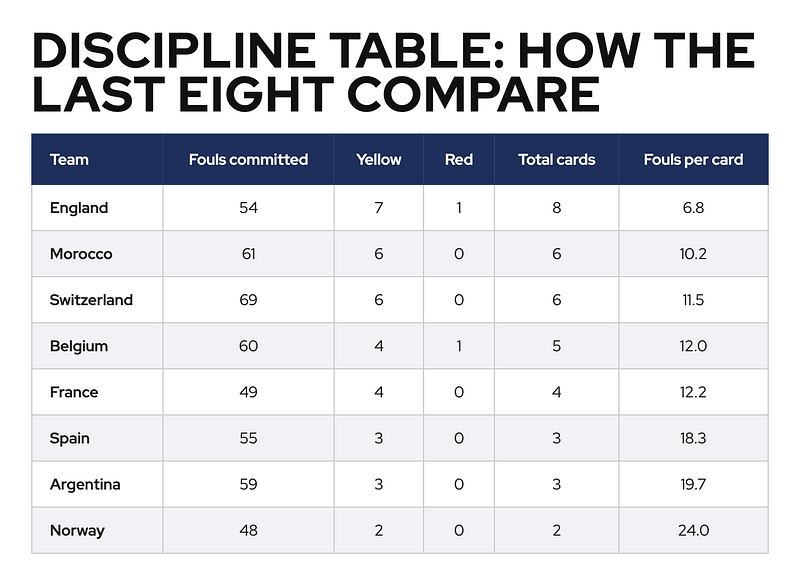
New data from BetBuilderAI, Gambling.com’s AI-powered World Cup hub, shows that England have been shown a card once every 6.80 fouls, the worst ratio of any quarter-finalist. Their next opponents, Norway, sit at the other end of the table, receiving one card every 24.00 fouls.
That contrast gives Saturday’s quarter-final a sharp edge. England are not merely facing one of the cleanest sides left in the competition; they are doing so with the heaviest disciplinary burden among the last eight.
According to the data, England have committed 54 fouls and received eight cards, made up of seven yellow cards and one red. Argentina, by comparison, have committed more fouls, 59 in total, but have collected only three yellow cards.
The numbers raise an awkward question for England: are they genuinely more reckless than their rivals, or are they being punished more severely for comparable offences?
At this stage of a World Cup, discipline becomes more than a behavioural issue. It affects pressing intensity, defensive aggression, midfield duels, substitution planning and the willingness of players to take tactical risks. One early yellow card can change how a full-back defends. One mistimed challenge can force a coach to rethink the midfield. One red card can destroy a tournament.
England know that danger well. In their last-16 win over Mexico, referee Alireza Faghani showed five cards from only seven England fouls, including Jarell Quansah’s second-half red card. That single match sharply worsened England’s disciplinary profile and offered Norway a clear area to exploit.
The data from Gambling.com puts it bluntly: “Figures show no side left in the tournament is carded more often relative to fouls committed than England.”
For a team chasing a semi-final place, that is not a minor statistical footnote. It is a warning.
Norway enter the match with a very different profile. Their card rate of one every 24.00 fouls suggests a side that either tackles with greater timing, manages referees more effectively, or avoids the kind of emotional moments that turn ordinary fouls into disciplinary incidents.
That may be invaluable in a quarter-final where margins are likely to be narrow.
The danger for England is not simply that they may concede fouls. Every team does. The danger is that their fouls are becoming expensive. When a team is shown cards at such a high rate, it begins to play under constraint. Players pull out of challenges. Defenders hesitate. Midfielders stop tactical fouls. Wingers are allowed to run. The opponent senses fear.
Norway will know this. A smart opponent does not merely attack weaknesses in formation; it attacks weaknesses in temperament. If England have become vulnerable to referee decisions, Norway can increase pressure through direct running, quick transitions and repeated one-on-one situations that invite tackles.
England’s coaching staff must therefore manage two matches at once. The first is the visible contest against Norway. The second is the invisible contest against impatience, frustration and emotional overload.
There is also a refereeing dimension. The data shows that knockout-stage carding is running above the group-stage average of 2.50 yellow cards per match. That suggests the tournament has become more tightly controlled as the stakes have increased. Referees may be less willing to let physical contact go unpunished, especially in matches where tension rises quickly.
England cannot afford to behave as if the threshold remains the same as in the group stage.
This is where tournament intelligence becomes critical. Successful knockout teams understand referees early. They identify what is being punished, which duels are risky, whether dissent is being tolerated, and how physical the match can become. England must learn that lesson quickly, because another refereeing mismatch could be costly.
The comparison with Argentina is instructive. Argentina have committed more fouls than England but collected far fewer cards. In their win over Egypt, referee Francois Letexier showed no cards from 13 fouls.
That does not prove unfair treatment. Different matches have different rhythms, fouls and contexts. But it does show that foul count alone does not explain England’s card problem. The nature of the fouls, match management, referee interpretation and player reactions all matter.
For England, the answer cannot be to complain. It must be to adapt. There is a long history of technically gifted teams losing control in knockout football because they mistook emotional intensity for competitive edge. England must avoid that trap. Discipline is not softness. It is control. It is knowing when to press and when to delay. It is knowing when to make a tactical foul and when to trust defensive cover. It is knowing that a quarter-final can be lost in one unnecessary lunge.
Saturday’s match therefore becomes a test of maturity as much as quality. England still have enough talent to reach the semi-finals. Their attack carries threat, their midfield has control, and their tournament momentum survived a difficult last-16 tie. But the disciplinary data suggests that talent alone may not be enough.
Norway, meanwhile, will see opportunity. A clean disciplinary profile gives them freedom. Their players can compete without the same burden of accumulated pressure. They can challenge confidently, defend aggressively and stretch England emotionally.
The irony is that England’s biggest risk may not be Norway’s best player. It may be England’s own inability to manage the moments between tackles.
The Gambling.com data should therefore be read as more than betting intelligence. It is a tactical clue. It shows where the quarter-final could turn: not only in the penalty area, but in the referee’s notebook.
For England, the challenge is clear. They must match Norway’s discipline before they can beat their football.
If they do not, the story of their World Cup may not be written by a goal scorer, but by a card.

