

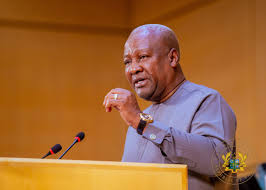

- Prez Mahama Targets Fresh Investment Wave as Ghana Shifts from Stabilisation To Industrial Growth
Ghana is seeking to convert improving macroeconomic conditions into a new wave of private investment, with President John Dramani Mahama’s administration positioning the country as both an investment destination and a gateway to the wider African market. The message from the Africa Business Investment Summit was deliberately expansive: “Invest in Ghana. Invest in Africa.”
Behind the slogan is a more consequential economic objective. The government wants to move the national conversation beyond stabilisation and towards productive investment, industrialisation and job creation.
The administration says Ghana recorded real GDP growth of 6.00% in 2025, with non-oil GDP expanding by 7.60%, while first-quarter growth in 2026 reached 6.40%.
Those numbers provide a stronger backdrop for an international investment campaign than the period of debt distress, high inflation and economic uncertainty that preceded them.
But the harder test is whether stronger headline growth can be converted into long-term capital capable of building factories, expanding productive capacity, deepening exports and creating internationally competitive Ghanaian businesses.
That is the economic wager behind the Mahama administration’s investment pitch.
The government is presenting its agenda as something larger than a return to macroeconomic stability. Its stated objective is to use improved conditions as the foundation for structural transformation by increasing domestic production, expanding value addition, strengthening manufacturing and creating employment.
At the summit, investors were directed towards opportunities in energy, technology, agriculture, mining, tourism, maritime development, infrastructure and manufacturing. Two policy initiatives sit prominently within that proposition: the 24-Hour Economy Programme and the Investment Opportunities Mapping Project.
Ghana cannot sustainably transform its economy if growth continues to depend heavily on consumption, imports and the export of relatively unprocessed commodities. It needs capital that expands what the economy can actually produce.
That means investment in machinery, processing plants, logistics, power, technology and human capital. The 24-Hour Economy Programme therefore matters more as an investment and productivity strategy than as a political slogan.
Its real test will be whether it can reduce production bottlenecks, increase utilisation of existing industrial assets and make Ghanaian businesses more competitive.
If implemented effectively, higher productive capacity could generate employment, strengthen exports, broaden the tax base and reduce pressure on foreign exchange. If execution falls short, however, the programme risks becoming another ambitious policy framework whose results fail to match its rhetoric.
Ghana’s strongest investment selling point may not be the size of its domestic market. It is the African Continental Free Trade Area.
As host of the AfCFTA Secretariat, Ghana occupies a strategically important position in Africa’s emerging continental trade architecture. The government is presenting the agreement as access to a market of more than 1.30 billion people with combined economic output exceeding US$3.50 trillion.
A multinational company assessing Ghana solely as a domestic market may see limited scale compared with larger African economies.
But a company able to manufacture in Ghana and sell competitively into multiple African markets has a very different proposition. The ambition is therefore to turn Ghana into a platform to produce in Ghana, process in Ghana and export from Ghana.
Ghana has long possessed the resources required to support industrial development. Its challenge has been converting those resources into higher-value economic activity at sufficient scale.
The government’s Feed Ghana Programme seeks to address part of that problem by increasing agricultural production, reducing food imports and building more reliable domestic supplies of raw materials for industry.
But the investment opportunity extends considerably beyond farming. It includes irrigation, storage, transport, cold-chain infrastructure, processing, packaging, logistics and food manufacturing.
Ghana is already one of Africa’s major gold producers. The long-term development opportunity lies not simply in extracting more minerals, but in capturing a larger share of the value chain before those resources leave the country.
Industrialisation therefore sits at the centre of the investment proposition. The government has highlighted industrial parks and special economic zones including the Greater Kumasi Industrial City and Special Economic Zone, Dawa Industrial Zone and Tema Integrated Industrial Park as potential platforms for manufacturing expansion.
These projects will matter only if they solve the practical problems investors encounter. Large capital commitments are rarely made simply because a government announces an industrial policy.
Investors require access to serviced land, reliable power, transport links, finance, skilled labour, efficient regulation and credible access to markets. That is where Ghana’s international investment pitch meets its most demanding test.
Investors comparing Ghana with other markets across Africa, Asia and Latin America will ultimately assess expected returns against political, regulatory, currency, infrastructure and execution risks.
Ghana therefore has to offer more than opportunity. It must offer a sufficiently attractive risk-adjusted return. That requires predictable taxation, reliable electricity, efficient ports, functioning infrastructure, reasonable access to foreign exchange, credible regulators and confidence that contracts will be respected.
The intervention by Asantehene Otumfuo Osei Tutu II at the summit was therefore economically significant.
He urged African governments to treat good governance as an economic asset, arguing that stronger governance can strengthen investor confidence and accelerate development. That observation goes directly to the heart of Ghana’s challenge.
Macroeconomic stability may attract investor attention. Institutional credibility is what can convert that attention into committed capital.
An investor deciding whether to establish a factory for 20 years will be concerned not only about today’s growth rate, but also about whether tax rules can change unexpectedly, permits can be obtained efficiently, electricity will remain available and commercial disputes can be resolved predictably.
Ghana’s investment proposition consequently depends as much on state capability as it does on macroeconomic recovery.
Ghana has a young population entering the labour market faster than the formal economy is creating high-productivity jobs.
That raises the standard by which any investment drive should ultimately be judged.
Ghana’s Ambassador to the United States, Victor Smith, argued that investment partnerships should help build an Africa in which young people can realise their aspirations without feeling compelled to leave the continent in search of opportunity.
That means the country cannot measure investment success solely by the number of dollars announced.
The more important questions are how many factories are built, how many workers are employed, how much technology is transferred, how much production is exported and how much economic value remains within Ghana.
Those are the metrics that determine whether foreign investment generates structural transformation rather than merely financial inflows.
For the Mahama administration, the summit therefore represents only the beginning of the investment cycle. The rhetoric was confident.
“Let history record that we did not only gather to speak about Africa’s future. We gathered to invest in it, and to build it,” the government said.
Ghana must convert investor interest into bankable projects, financial close, construction and production.
That requires coordination across ministries, investment agencies, regulators, local authorities, utilities and financial institutions. Delays at any one point can undermine an otherwise viable investment.
It sits at the intersection of AfCFTA’s continental market, an expanding domestic consumer base, significant natural-resource endowments and a renewed policy emphasis on industrialisation.
If the country can combine those advantages with macroeconomic discipline, predictable governance and reliable infrastructure, it could strengthen its position as a regional investment platform. The Mahama administration is effectively asking global capital to take a long-term position on Ghana.
For that wager to succeed, the economic reset must prove to be more than another recovery cycle.
It must become the foundation for a more productive economy. The potential reward is considerable: stronger exports, more factories, higher-value agriculture, better jobs and a deeper role in African trade.
But investors will ultimately judge Ghana not by the ambition of speeches delivered at international summits.
They will judge it by whether projects can move from conference rooms to construction sites, farms, factories, ports and technology hubs. That is where “Invest in Ghana. Invest in Africa” will either become an investable proposition or remain a slogan.

