

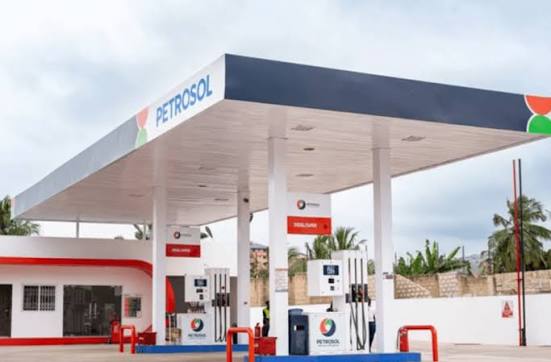

- PETROSOL Profit Nearly Quadruples to GH¢13.17 million as Revenue Crosses GH¢1 billion
PETROSOL Platinum Energy PLC delivered a sharp improvement in profitability during the nine months ended September 2026, lifting revenue above GH¢1 billion and almost quadrupling profit after tax. Yet the company’s results also reveal a less comfortable story beneath the income statement: rapid growth absorbed substantial cash, pushed receivables higher and required a significant increase in borrowing.
The Ghanaian energy company recorded revenue of GH¢1.11 billion, up 19.84 per cent from GH¢925.46 million in the corresponding period of 2025. Profit after tax climbed 288.65 per cent to GH¢13.17 million from GH¢3.39 million, while profit before tax increased more than fivefold to GH¢18.82 million.
For a fuel-marketing business operating with thin margins, the improvement is meaningful. The more important question for investors, however, is whether PETROSOL can translate its stronger accounting earnings into sustainable operating cash flow without allowing working-capital requirements and debt costs to consume the gains.
Cost of sales rose by 19.20 per cent to GH¢1.05 billion, slightly slower than revenue. That difference lifted gross profit by 33.14 per cent to GH¢57.13 million from GH¢42.91 million. Gross margin consequently improved to approximately 5.15 per cent from 4.64 per cent.
The movement may appear modest, but a half-percentage-point improvement matters in a business where product costs absorb nearly 95 pesewas of every cedi earned. It indicates that PETROSOL extracted more value from each unit of sales, whether through pricing, product mix, procurement efficiency or improved inventory management. The unaudited statements do not provide a breakdown allowing investors to identify the precise driver.
Operating leverage strengthened the effect. General and administrative expenses increased by only 3.97 per cent to GH¢40.75 million, far below the growth in revenue and gross profit. This helped operating profit reach GH¢24.94 million, more than three-and-a-half times the GH¢7.10 million recorded a year earlier. The operating margin rose to 2.25 per cent from 0.77 per cent.
Other income also made a material contribution, rising to GH¢9.86 million from GH¢3.53 million. Without that increase, the operating recovery would have been less dramatic. Future disclosures would therefore benefit from explaining the source and recurrence of this income, allowing investors to distinguish core trading performance from gains that may not repeat.
Credit risk moved in the opposite direction. Impairment losses on trade receivables increased to GH¢1.30 million from GH¢150,000. Although still small relative to revenue, the rise is relevant because trade and other receivables expanded rapidly during the period.
Finance costs increased by 53.18 per cent to GH¢6.73 million, while finance income declined to GH¢608,885 from GH¢866,758. PETROSOL nevertheless produced a substantial increase in profit before tax because the improvement in operating earnings outweighed the heavier financing charge.
Its effective tax burden also normalised sharply. Income-tax expense rose to GH¢5.64 million from GH¢178,369, representing about 30 per cent of profit before tax, compared with approximately 5 per cent in the previous period. Even after this larger charge, net profit margin improved to 1.19 per cent from 0.37 per cent.
The profit lifted retained earnings to a positive GH¢609,001 from an accumulated loss of GH¢12.56 million at the beginning of 2026. Total equity consequently increased to GH¢33.88 million. Crossing from accumulated losses into positive retained earnings represents an important symbolic and financial milestone, but the narrow balance means future losses could quickly reverse it.
PETROSOL’s balance sheet expanded substantially. Total assets reached GH¢331.47 million at September 2026, an increase of 58.93 per cent from GH¢208.56 million a year earlier. Property and equipment rose to GH¢76.90 million from GH¢55.97 million, supported by GH¢25.57 million of capital expenditure during the nine-month period.
The most striking expansion occurred in working capital. Trade and other receivables more than doubled to GH¢142.65 million from GH¢55.59 million, an increase of GH¢87.06 million. Inventory rose by 74.21 per cent to GH¢50.95 million from GH¢29.24 million.
Combined, inventory and trade receivables amounted to GH¢193.60 million, equivalent to 58.41 per cent of total assets. This concentration means the quality and collection speed of receivables, together with the ability to sell inventory efficiently, will be central to the company’s liquidity and future returns.
The cash-flow statement demonstrates the pressure. PETROSOL reported net cash used in operating activities of GH¢91.47 million, compared with an outflow of GH¢9.82 million in the same period of 2025. The principal cause was a GH¢76.23 million increase in receivables, accompanied by GH¢20.38 million absorbed by inventory and a GH¢17.77 million reduction in payables.
This creates a pronounced gap between earnings and cash generation. PETROSOL earned GH¢13.17 million after tax but consumed more than seven times that amount in operating cash. Such a divergence can occur during rapid expansion, especially when a company extends credit to grow sales or stocks more products. It becomes a risk if customer payments slow or inventory does not convert into cash as planned.
The company financed that gap primarily through debt. Loan proceeds reached GH¢1.67 billion, while repayments totalled GH¢1.55 billion, producing net financing cash of GH¢116.45 million. Total loans and borrowings on the balance sheet rose to GH¢146.59 million from GH¢28.91 million a year earlier.
Most of the increase sits in non-current borrowings, which climbed to GH¢112.51 million from GH¢2.31 million. Moving funding towards longer maturities may reduce immediate refinancing pressure, but total borrowings were equivalent to more than four times shareholders’ equity at September 2026. That leverage increases exposure to interest rates, lender conditions and fluctuations in operating cash.
Liquidity nevertheless improved on a conventional balance-sheet measure. Current assets rose to GH¢232.88 million against current liabilities of GH¢184.72 million, producing a current ratio of about 1.26. A year earlier, current assets of GH¢127.99 million covered only 69 per cent of current liabilities.
The improvement should be interpreted carefully because much of the liquidity rests in receivables and inventory rather than cash. Cash and cash equivalents declined to GH¢29.60 million from GH¢32.18 million, despite the large financing inflow. The company also invested GH¢24.91 million net in property, equipment and other investing activities.
PETROSOL’s results therefore contain two credible narratives. The first is a recovery story: rising sales, better gross margins, controlled administrative expenses, stronger operating profit and a return to positive retained earnings. The second is an execution challenge: earnings growth is being accompanied by heavier credit exposure, negative operating cash flow and considerably greater leverage.
The company’s 55 per cent investment in Dahai New Energy Technology also offers a route into solar and renewable-energy installations. PETROSOL said the acquisition supports diversification and Ghana’s transition towards cleaner energy. The subsidiary was not consolidated because its effect was considered immaterial, leaving investors with limited visibility over its contribution and development.
For the final quarter and beyond, the decisive indicators will not be revenue alone. Investors should watch receivables collection, inventory conversion, operating cash flow, finance costs and the return generated from newly acquired assets. Any expansion that converts sales into cash could validate the additional borrowing; continued cash absorption would make the balance-sheet growth more difficult to sustain.
PETROSOL has shown that it can grow turnover and rebuild profitability. Its next test is more demanding: proving that the GH¢13.17 million profit is not merely an accounting high point, but the beginning of a cash-generative, financially disciplined growth cycle.

