

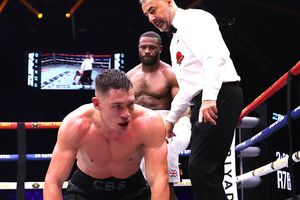

- Two Knockdowns End Billam-Smith’s Fight as White Says Referee Acted Early
Cheavon Clarke ended Chris Billam-Smith’s unbeaten record against stoppages with a seventh-round victory in London, but the upset was followed by a debate over whether referee Lee Every intervened too early.
Clarke knocked the former world cruiserweight champion down twice in the round before the referee stopped the fight at the Copper Box Arena. Billam-Smith was back on his feet when the bout was waved off and immediately shook his head in protest.
Zuffa Boxing promoter Dana White also questioned the timing, saying: “I thought it was early.”
The result was a major breakthrough for Clarke, who came into the fight seeking a high-profile win to elevate his standing in the cruiserweight division.
He not only defeated a former world champion but did so against an opponent he had beaten twice as an amateur, including in the 2016 national championship final.
Billam-Smith had never previously been dropped as a professional, let alone stopped. Clarke’s right hand changed that in the seventh round, landing cleanly as Billam-Smith leaned forward.
The Bournemouth fighter went down, rose and attempted to move away, but Clarke pressed him towards the ropes and knocked him down again. The referee intervened as Clarke continued to land punches.
The decision divided opinion because Billam-Smith was upright and appeared willing to continue. He later said he had felt in control of the fight before the decisive exchange, while accepting that Clarke’s shot had hurt him.
“I made a mistake, but I felt like I was winning the fight,” Billam-Smith said. He congratulated Clarke and said he would welcome another chance to face him.
Clarke defended the stoppage, arguing the referee had to judge whether Billam-Smith was protecting himself effectively, not simply whether he could stand. “If he was blocking the shots he wouldn’t have been dancing,” Clarke said.
He added that the referee could also have faced criticism had he allowed the fight to continue and Billam-Smith been hurt again.
That distinction sits at the heart of the controversy. A boxer’s ability to rise after a knockdown does not by itself establish that it is safe to continue. The referee must assess the fighter’s balance, awareness, ability to defend and the danger of the punches still coming.
In this case, Billam-Smith had been dropped twice in quick succession and was under sustained attack near the ropes. Those circumstances support the case for intervention, even if the fighter believed he could recover.
The stoppage also came after a competitive fight in which Clarke’s movement and timing repeatedly troubled Billam-Smith. The former champion pressed forward and worked at close range, but Clarke found openings with his right hand and uppercuts.
In the third round, he landed an uppercut between Billam-Smith’s elbows and followed with a left hook. Billam-Smith’s pressure brought him into the contest, but it also gave Clarke opportunities to counter as he advanced.
Billam-Smith had a stronger spell in the sixth round, landing with more force and briefly making Clarke give ground. That phase may help explain why he believed he was ahead. But it could not offset the sudden shift in the seventh, when Clarke’s power and accuracy produced the first knockdown of Billam-Smith’s professional career and then the second.
For Clarke, the victory carries a significance beyond the rivalry. He had stopped Jack Massey in his previous fight, and the win over Billam-Smith gives him consecutive high-profile results.
At 35, he has used the opportunity to make a strong case for a place among the division’s leading contenders. The performance showed that his speed, power and ability to exploit an opponent’s forward movement can trouble elite opposition.
Billam-Smith, 36, leaves the fight with questions about his route back to a world-title opportunity. He had been a WBO cruiserweight champion and entered the contest aiming to rebuild his position in the division.
A first stoppage defeat is a serious setback, but the manner of the ending and the dispute over the referee’s intervention makes an immediate rematch an obvious possibility. Billam-Smith has said he wants one; Clarke’s victory gives him control over whether to accept it.
The rivalry is already unusually personal in sporting terms. Clarke beat Billam-Smith in amateur competition a decade ago, and this professional victory makes it three defeats for Billam-Smith across their meetings.
For Clarke, the win confirms that their history was not simply an amateur footnote. For Billam-Smith, it leaves the prospect of a fourth encounter as a chance to settle a score that has followed both men into the professional ranks.
The wider question is how the result should be remembered: as a decisive win for Clarke or as a contest cut short before Billam-Smith could prove he had recovered. The footage will continue to fuel discussion, but the most important sequence is clear.
Clarke landed the cleaner power shot, scored two knockdowns and forced the referee to make a safety judgment under pressure.
White’s view that the stoppage came early reflects the immediate reaction of a promoter who saw Billam-Smith standing and protesting. Clarke’s defence reflects the danger of allowing a fighter to absorb further unanswered punches.
The disagreement does not erase the result; it underscores the difficult balance referees face between preserving a contest and preventing avoidable damage.
Clarke leaves the Copper Box with the biggest win of his professional career and renewed momentum in the cruiserweight division. Billam-Smith leaves with his first stoppage defeat, but also with a possible route back through a rematch.
Whether that fight happens, and whether the stoppage is judged differently after review, will shape the next chapter of a rivalry that has now swung decisively in Clarke’s favour.

