


- Ghana’s Extractive Sector Challenge Is Implementation, Not Lack of Laws — NRGI
Ghana must move beyond the publication of extractive sector data and ensure that mineral revenues translate into measurable development outcomes in mining communities, the Natural Resource Governance Institute has urged.
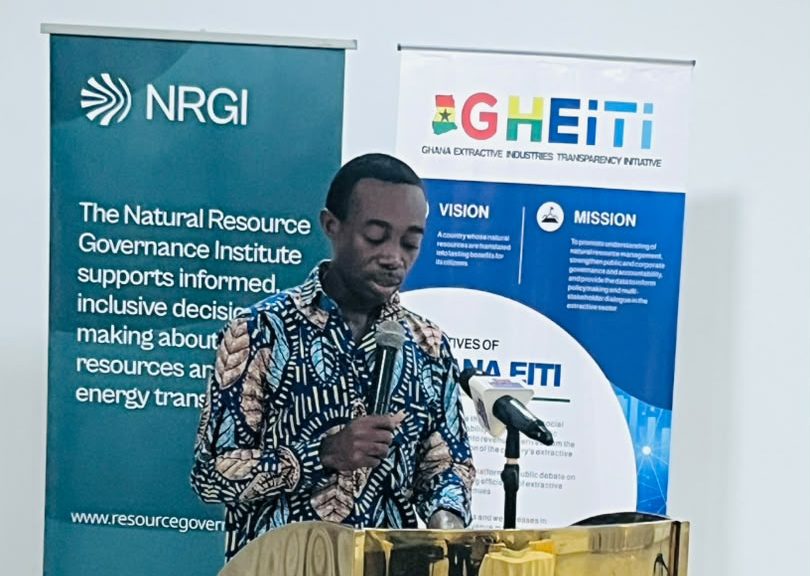
Speaking at the GHEITI Partners Roundtable on Subnational Extractive Governance in Accra, David Adjei, delivering remarks on behalf of NRGI’s Country Manager, said Ghana’s progress under the Extractive Industries Transparency Initiative has strengthened the country’s reputation as a leader in transparency.
He warned, however, that disclosure alone is no longer enough if mineral revenues do not improve livelihoods, infrastructure and economic opportunities in host communities.
“The central question before us is no longer about disclosure alone, but about what is done with that information,” he said.
“How is data being used to improve accountability, influence decisions and ultimately deliver development outcomes in resource-producing areas?”
The comments come amid growing debate over whether Ghana’s mineral wealth is delivering sufficient benefits to the communities that bear the environmental, social and economic costs of extraction.
Although Ghana has developed legal and institutional frameworks for managing mineral revenues, including the Minerals Development Fund Act, implementation gaps continue to weaken the link between resource extraction and local development.
Mr Adjei said Ghana’s challenge is now less about the absence of rules and more about the discipline to implement existing laws consistently.
According to NRGI’s research and stakeholder engagements, only about 50.60% of expected Minerals Development Fund transfers between 2017 and 2021 reached intended beneficiaries.
The shortfall, he said, reflects persistent delays, partial disbursements and weak compliance with statutory transfer obligations.
For NRGI, this is not merely a technical problem. It is a governance failure rooted in weak accountability, poor institutional coordination and limited enforcement.
“The challenge is no longer the absence of rules but the discipline to implement them consistently,” Mr Adjei said.
The Minerals Development Fund was designed to ensure that part of Ghana’s mineral revenues is returned to mining communities and used to support development in areas affected by extraction.
But delays and partial transfers have often left local authorities and communities unable to plan effectively or implement projects that respond to local priorities.
Mr Adjei said the situation has deepened the disconnect between the scale of mineral extraction and the visible development outcomes in many resource-producing areas.
He also raised concern about weak transparency in how mineral revenues are spent at the local level.
Drawing on NRGI’s work in mining districts such as Obuasi and Tarkwa, he said communities often struggle to track multiple revenue streams, including royalties, ground rents and MDF allocations.
Without clear and accessible information on how much money is received, how it is allocated and which projects are funded, citizens are unable to hold local authorities and institutions accountable.
This weak oversight, he said, makes it difficult to determine whether mineral revenues are being used to address the most urgent development needs of host communities.
The result is that communities may see extraction taking place around them while roads, schools, health facilities, water systems, jobs and alternative livelihoods remain inadequate.
Mr Adjei said the gap between transparency and development is one of the most important governance questions facing Ghana’s extractive sector.
Over the years, Ghana has made significant progress in publishing extractive sector data through GHEITI reports and related accountability platforms. These disclosures have improved public access to information on revenues, payments and institutional flows.
But NRGI’s position is that the next phase of reform must focus on whether the data is being used to improve decision-making and development outcomes.
Transparency, by itself, does not build roads, improve schools or restore degraded land. It only becomes useful when citizens, institutions and policymakers use the information to demand accountability, correct leakages and ensure revenues reach their intended destinations.
Mr Adjei also identified limited community participation as a major weakness in subnational extractive governance.
He said mining communities should not be passive recipients of projects determined elsewhere, but active participants in deciding how mineral revenues are used.
Community participation, he argued, must be institutionalised within local development planning processes to ensure that spending reflects the priorities of those directly affected by mining.
This is particularly important in new and emerging mining areas.
Referring to stakeholder engagements in the Oti Region, Mr Adjei said Ghana has an opportunity to establish strong governance systems before significant mineral revenues begin to flow into emerging mining districts.
He said doing so would help the country avoid repeating governance failures seen in older mining areas, where weak oversight, poor planning and inadequate community participation have undermined the developmental value of mineral revenues.
As Ghana positions itself to benefit from rising global demand for energy transition minerals, NRGI said proactive governance reforms will become even more important.
The global shift towards clean energy technologies is increasing demand for minerals used in batteries, renewable energy systems, electric vehicles and related infrastructure.
For mineral-rich countries such as Ghana, this creates new economic opportunities. But without strong governance systems, new mineral revenues could reproduce old patterns of extraction without sufficient local benefit.
Mr Adjei outlined four priorities for strengthening subnational extractive governance.
First, he said Ghana must improve the accessibility and practical use of extractive sector data. Information should not only be published in technical reports, but presented in ways that communities, local officials, civil society groups and journalists can understand and use.
Second, the country must establish systems that track mineral revenues from collection through to project implementation. Such systems would make it easier to know whether funds due to communities have been transferred, how they have been used and whether projects have been completed.
Third, community participation must be institutionalised in local development planning. Host communities should have a structured role in identifying priorities, monitoring projects and evaluating whether mineral revenues are addressing their needs.
Fourth, Ghana must enforce existing legal and institutional frameworks. For NRGI, passing laws is not enough if institutions fail to comply with transfer obligations, reporting requirements and accountability mechanisms.
Mr Adjei also called for stronger collaboration among government institutions, civil society organisations, development partners and host communities.
He said no single institution can fix the governance challenges in the extractive sector alone, making coordinated action essential.
The call reflects the complex nature of mineral revenue governance, which involves central government agencies, local authorities, traditional leaders, mining companies, civil society groups and community representatives.
Weak coordination among these actors can result in delayed transfers, poor project selection, inadequate monitoring and reduced public trust.
NRGI reaffirmed its commitment to supporting Ghana through research, policy analysis and advocacy aimed at strengthening accountability in mineral revenue management.
The institute said its work would continue to focus on helping citizens and institutions use extractive sector information to improve governance and development outcomes.
Mr Adjei closed with a reminder that mineral revenues are not gifts to mining communities.
“Mineral revenues are not discretionary transfers to communities. They are public entitlements, grounded in law and justified by the environmental, social and economic costs that host communities bear,” he said.
The statement captures the central issue in Ghana’s mining governance debate.
Communities that host mining operations often endure land disturbance, environmental pressure, social disruption and economic displacement. The revenues assigned to them are therefore not acts of generosity, but compensation linked to legal rights and development obligations.
The next stage of extractive sector reform will be judged not by how much data is published, but by how effectively mineral revenues are transferred, tracked and converted into visible improvements in the lives of mining communities.

