

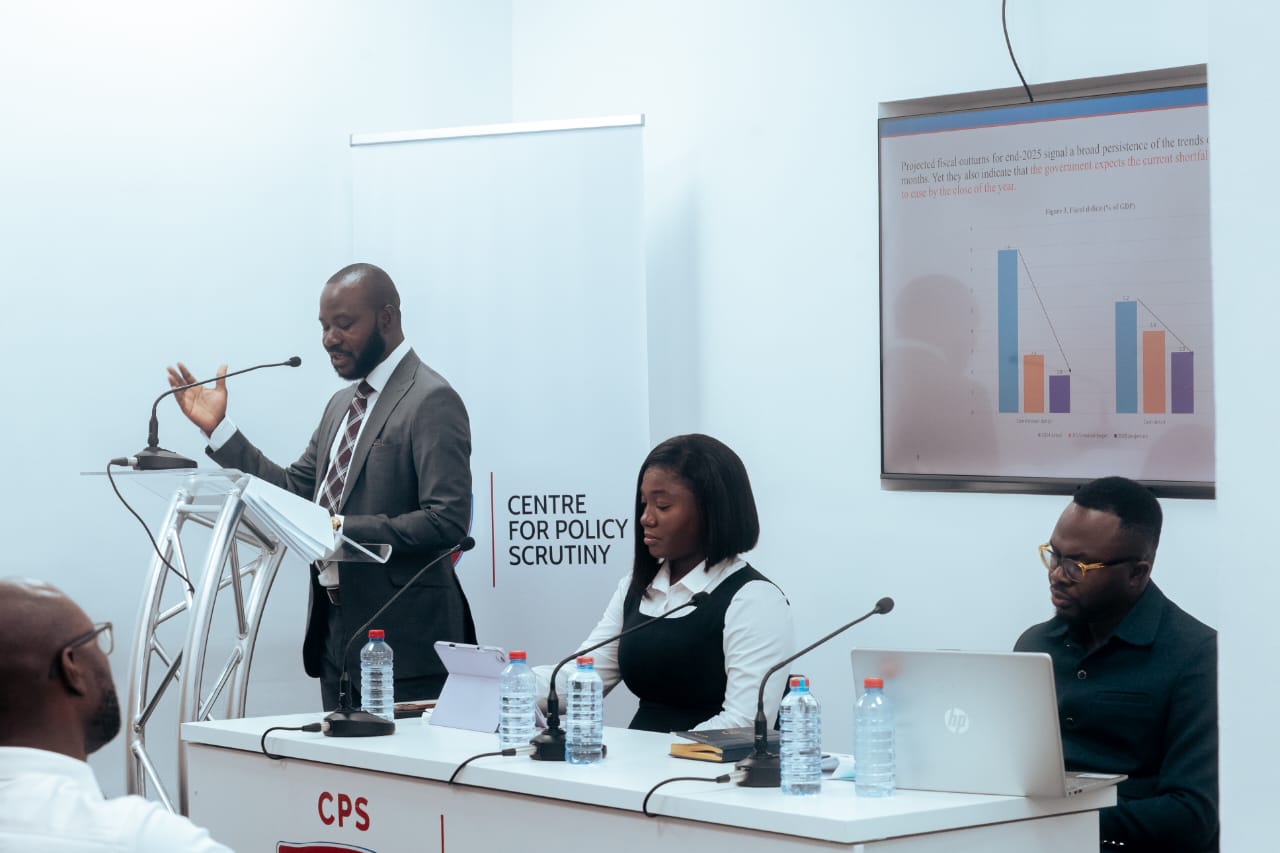

CPS Outlines Key Recommendations to Strengthen Implementation of 2026 Budget
The Centre for Policy Scrutiny (CPS), in its Policy Discussion Paper on the 2026 Budget Statement, has outlined a number of policy recommendations to guide the Finance Minister in ensuring effective and credible implementation of next year’s fiscal programme.
According to the think tank, enhancing the credibility of government’s revenue measures must be a priority. CPS argues that this requires increasing resource allocation to the Ghana Revenue Authority (GRA) to enable the efficient rollout of planned initiatives—including the deployment of technology to seal revenue leakages, particularly within the customs system.
The Centre further emphasised the need for rigorous programme and project planning, supported by transparent and cost-effective procurement processes. It noted that public-sector institutions must institutionalise continuous evaluation of government programmes to ensure accountability, value for money and alignment between resource allocation and expected outcomes.
On financing, CPS cautioned that government must remain mindful of potential market pressures—especially interest rate risks—as it ramps up domestic borrowing to support the budget. It therefore urged strengthened coordination with the Bank of Ghana to ensure that the borrowing programme aligns with domestic liquidity conditions and avoids destabilising the market.
At the same time, the Centre advised the central bank to adopt more innovative approaches that strike a balance between maintaining stability and supporting economic growth, warning that overly restrictive monetary actions could weigh on interest rates and broader economic activity.
CPS acknowledged the significant 141 percent projected increase in capital expenditure for 2026 but stressed that its full realisation will depend heavily on revenue performance. It recommended intensified efforts to close revenue gaps and strengthen enforcement in poorly assessed and high-leakage areas of the tax system.
The think tank also highlighted the need to ensure that the scaling-up of public spending in 2026 does not compromise efficiency. It underscored the importance of crowding in private investment to complement government investment and drive structural transformation.
With the services sector continuing to dominate Ghana’s economic landscape, CPS urged government to prioritise human capital development through improved education and skills training to equip the workforce for emerging opportunities.
While acknowledging the job creation commitments in the 2026 Budget, the Centre warned that many of the promised jobs may be temporary. It therefore called for deliberate efforts to create more sustainable employment opportunities capable of supporting long-term livelihoods.
CPS concluded by underscoring the centrality of macroeconomic stability for private-sector expansion and job creation. It urged government to maintain a stable and predictable macroeconomic environment that supports business confidence and growth.

