

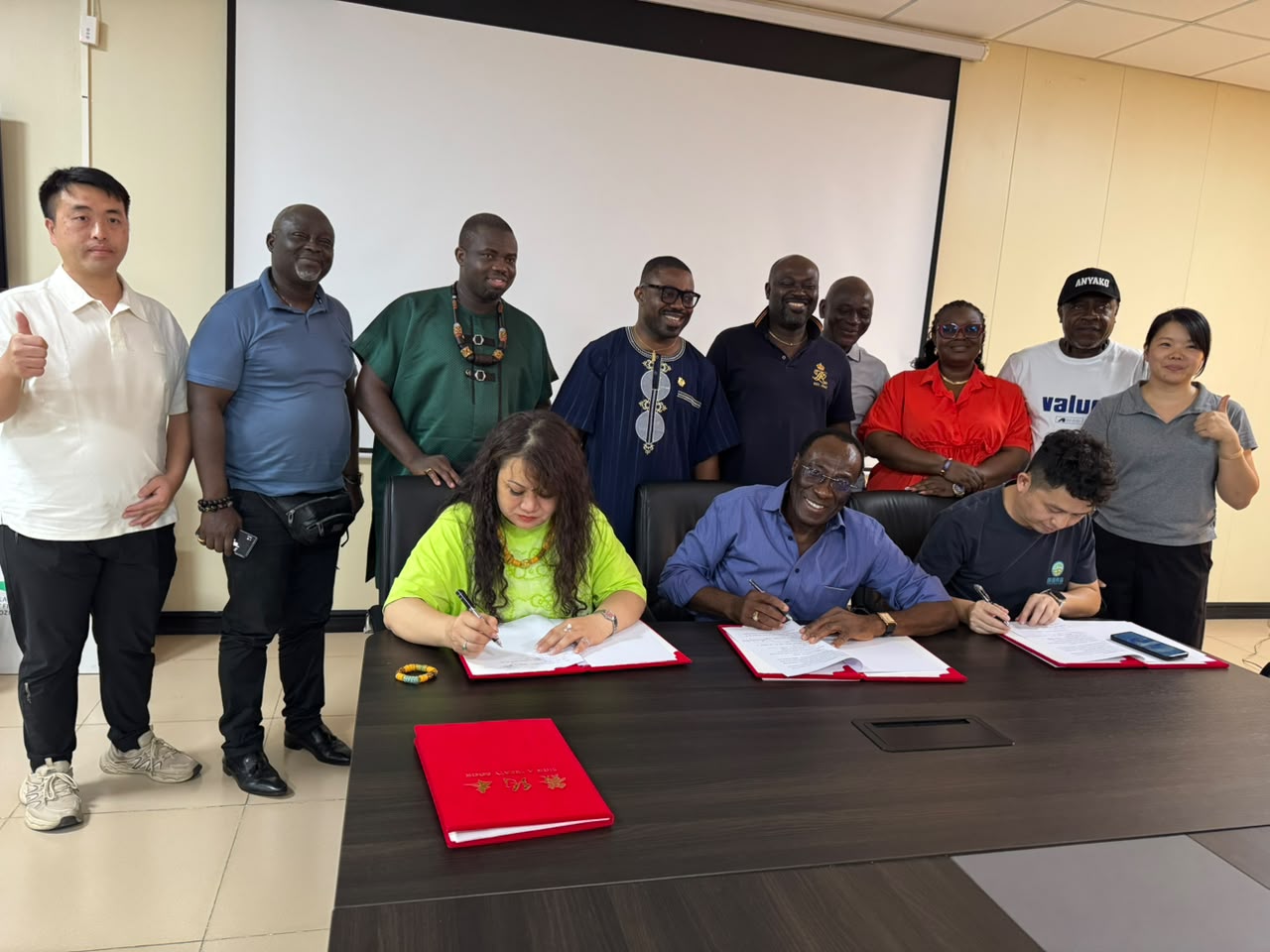

- Volta Chiefs Sign China Aquaculture Deal as Region Targets Commercial Fish-Farming Hub
The Volta Regional House of Chiefs has signed a memorandum of understanding with Chinese aquaculture processor Maoming Yuantian Food Co., Ltd. aimed at developing commercial fish farming in the Volta Basin, as traditional authorities seek foreign capital and technology to expand one of Ghana’s potentially important food-production industries.
The agreement was concluded during a week-long investment mission to China led by Togbe Tepre Hodo IV, President of the Volta Regional House of Chiefs, with engagements facilitated under Ghana’s Ambassador to China, Kojo Bonsu.
No investment value, production target, financing structure or implementation timetable has yet been publicly disclosed.
The aquaculture agreement was one of four arrangements signed by the Volta delegation with Chinese companies covering technology, construction, investment facilitation and fish farming.
The House also entered agreements with Guangdong Welleap Information Technology Company, Foshan Jinting Construction Engineering Company and SINOHUI Investment Ghana Limited.
The Maoming Yuantian agreement specifically focuses on attracting investment into commercial aquaculture within the Volta Basin, potentially linking farming with processing, cold-chain infrastructure and eventual export markets.
Togbe Tepre Hodo said the agreements were intended to reposition the Volta Region and Ghana for longer-term development through international partnerships.
He said the arrangements could provide access to Chinese capital, expertise and technology across priority sectors, including aquaculture, while the House would continue pursuing partnerships capable of “creating jobs, strengthening local production and supporting long-term economic development”.
The critical test, however, will be whether the memorandum progresses from an expression of intent into bankable projects, committed capital and operating farms.
Maoming Yuantian describes itself as a modern aquatic-products processor based in Gaozhou City in China’s Guangdong province, specialising principally in frozen tilapia fillets, processed tilapia and whole frozen fish.
According to the company’s own corporate information, it was established in August 2024 with registered capital of RMB100mn, occupies a 56,000-square-metre site and operates nine fillet-processing lines alongside freezing and cold-storage facilities.
The company states an annual processing capacity of 35,000 tonnes and cold-storage capacity of 2,500 tonnes.
That official information requires some distinction from promotional claims circulating around the Ghana agreement. Reports accompanying the signing have attributed to Maoming Yuantian a daily processing capacity of 150,000kg, more than 260,000 tilapia ponds and exports to more than 70 countries, with some accounts saying its products reach one in seven Chinese consumers.
The company’s own website supports the existence of nine production lines and international exports, but identifies annual processing capacity of 35,000 tonnes rather than confirming all of the larger claims being attributed specifically to the company.
There also appears to be a conflation between the company and the wider Maoming tilapia industry in Guangdong.
Chinese industry sources say the Maoming production area exceeds 260,000 mu roughly 17,333 hectares rather than 260,000 individual ponds, and produces more than 280,000 tonnes of tilapia annually, equivalent to roughly one-seventh of China’s output.
The same regional industry is reported to export tilapia products to more than 70 countries and territories, suggesting some of the statistics attached to the Ghana announcement may describe Maoming’s broader aquaculture cluster rather than Maoming Yuantian alone.
That distinction does not remove the commercial potential of the proposed partnership. The company operates within one of China’s major tilapia-producing regions and says its raw materials come from customs-registered aquaculture farms, while its facilities include quick-freezing systems, laboratory testing and cold-chain processes designed for international markets.
Its own export information identifies markets across Europe, the Americas, Asia and Africa, potentially giving a Ghana operation access to processing and market-development experience beyond primary fish farming.
For the Volta Region, the economic opportunity lies in developing an integrated aquaculture value chain rather than simply increasing fish volumes.
Large-scale commercial production could support demand for fingerlings, feed, veterinary and technical services, cold storage, processing, packaging, logistics and marketing, creating employment beyond farms themselves.
If implemented at scale, the investment could also strengthen domestic fish supply and reduce some of Ghana’s dependence on imported fish products, although no quantified output or job commitments have yet been announced.
The Volta Basin offers a substantial natural platform for such investment, but commercial aquaculture also carries environmental and biosecurity risks that will require careful regulation.
Expansion must address water quality, stocking density, disease management, feed use, waste disposal and the ecological effect of intensive cage or pond production, particularly where operations interact with communities dependent on the same water resources.
A credible investment framework will therefore need environmental approvals, community engagement and enforceable standards alongside the commercial agreements.
Traditional authorities could play an important role in that process because land, community consent and local participation can determine whether major agricultural investments secure long-term social legitimacy.
Chiefs attending the signing included Togbega Gabusu VII of Hohoe, Togbe Atikpladza Agbi Yao VIII of Kpalime, Togbega Sei II of Botoku, Togbui Dagadu IX of Kpando, Torgbui Tenge Dzokoto Gligui VII of Anyako and Torgbiga Adamah III of Some.
Their participation gives the initiative a broad traditional-authority dimension, although formal investment approvals will still depend on Ghana’s statutory regulatory institutions.
The immediate significance of the agreement is therefore strategic rather than financial. It signals an attempt to connect the Volta Basin’s water resources with Chinese aquaculture technology and processing expertise, but the MoU itself does not establish how much money will be invested, who will finance infrastructure, where farms will be located or when commercial production will begin.
Those details will determine whether the arrangement becomes a transformational aquaculture project or remains principally an investment-promotion commitment.
For Ghana, the stronger opportunity would be to ensure that any eventual investment extends beyond producing raw fish to local processing, feed production, skills transfer and export-market development.
Maoming’s experience shows that the commercial value of tilapia is created through an ecosystem combining farming, cold chain, processing and international distribution rather than production alone.
If the Volta partnership can reproduce that deeper value chain while protecting the basin’s environmental resources, the agreement could become more consequential than the headline promise of another foreign investment deal.

