

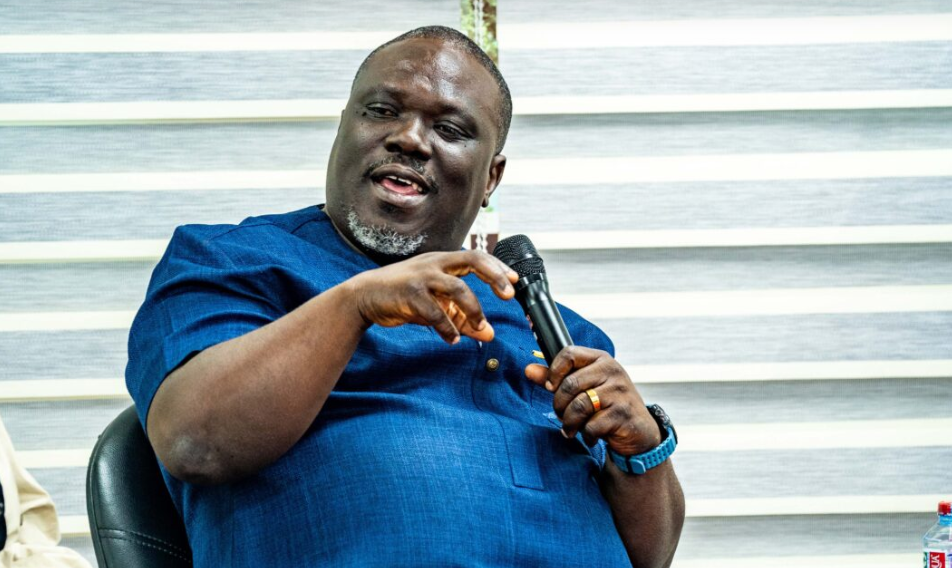

- Ghana’s Recovery Will Falter Without Structural Reforms – Prof. Turkson Cautions
Economist Prof Ebo Turkson has urged President John Dramani Mahama to move urgently on structural reforms, warning that Ghana cannot afford to wait if recent macroeconomic gains are to translate into stronger productivity, jobs and long-term economic resilience.
The call places renewed pressure on the government to move beyond short-term stabilisation and confront the deeper weaknesses that have repeatedly exposed Ghana’s economy to fiscal stress, exchange-rate volatility, inflation shocks and low productive capacity.
Prof Turkson, an economist at the University of Ghana and a member of the Bank of Ghana’s Monetary Policy Committee, has in recent months consistently argued that Ghana’s economic challenge is not only about inflation, interest rates or fiscal consolidation, but also about the structure of production, the cost of doing business and the country’s dependence on imports.
His latest warning is significant because it comes at a time when the government is pointing to improving macroeconomic indicators as evidence of recovery. But the economist’s argument is that stabilisation, while necessary, is not sufficient. Without reforms that raise productivity, expand local production, deepen exports and reduce the economy’s exposure to external shocks, Ghana risks returning to the same cycle of pressure that has repeatedly forced painful adjustment.
The point is not new in Ghana’s economic debate. In earlier comments, Prof Turkson argued that Ghana’s economy remains vulnerable because long-standing structural bottlenecks have not been corrected, including weak domestic revenue mobilisation and limited resilience to external shocks.
That warning has become more urgent as the country attempts to recover from the inflation and debt pressures that defined the post-2022 crisis period. Prof Turkson has also defended the Bank of Ghana’s inflation fight, arguing that bringing inflation down from crisis levels required difficult and costly monetary policy choices.
But monetary policy alone cannot transform the economy. It can stabilise prices, restore confidence and anchor expectations, but it cannot by itself build factories, expand exports, improve logistics, lower electricity costs, modernise agriculture or create a competitive industrial base.
That is why the reform agenda now confronting the Mahama administration is broader than fiscal adjustment. It requires changes in the real economy: infrastructure, energy pricing, access to finance, industrial policy, public-sector efficiency, domestic revenue mobilisation, export competitiveness and value-chain development.
Prof Turkson’s recent comments on Ghana’s automotive assembly industry illustrate the wider reform challenge. He has argued that the country continues to lose billions of dollars to vehicle imports, noting that Ghana imported close to US$3.00 billion worth of used and new vehicles in 2025.
For him, the opportunity is not merely to assemble vehicles locally, but to build an ecosystem of related industries, including logistics, transport services, dealerships, insurance, banking and repairs.
That is the essence of structural reform: shifting the economy from import dependence to productive capacity. Ghana’s problem is not the absence of demand. It is that too much of that demand is met through imports, placing continuous pressure on foreign exchange reserves, weakening the cedi and exporting jobs that could have been created locally.
Prof Turkson has also stressed that Ghana’s industrial ambitions will not succeed unless the business environment becomes more competitive. He has pointed to infrastructure, electricity costs and the general cost of doing business as decisive factors for attracting investment and supporting local manufacturing.
This is a direct challenge to the government. If Ghana wants to turn the 24-Hour Economy, automotive assembly, agro-processing and export development into real growth engines, it must address the cost structure facing businesses.
Special incentives may help at the margin, but they cannot compensate for unreliable infrastructure, expensive power, weak logistics, bureaucratic delays and policy inconsistency. A low-cost, predictable business environment is itself the strongest incentive for private investment.
The financial sector must also be part of the reform push. Prof Turkson has recently advised banks to adjust their strategies to a lower-interest-rate environment, warning that financial institutions can no longer rely heavily on wide lending margins and high treasury returns. Instead, banks must expand lending to the productive sector and build non-interest income through digital banking, trade finance and advisory services.
This matters because structural transformation cannot happen without credit. If banks remain concentrated in low-risk government securities and short-term trading gains, productive sectors such as manufacturing, agriculture, exports and small business will continue to struggle for patient capital.
For the Mahama administration, the policy test is now clear. The government must show that its economic strategy is not limited to stabilising inflation, managing debt and restoring investor confidence. It must also deliver the harder reforms that change how the economy produces, trades, finances investment and absorbs labour.
Those reforms will not be easy. They will require political courage, coordination across ministries, disciplined public spending, reforms to state institutions, stronger implementation capacity and a willingness to confront vested interests that benefit from the current structure of the economy.
But delay carries a higher cost. Ghana has often waited until crisis forces reform. Prof Turkson’s warning is that the country cannot continue to govern by emergency correction. The time to reform is when stability begins to return, not when the next crisis has already arrived.
The central lesson is therefore straightforward: macroeconomic recovery must become productive recovery.
If government fails to move quickly, falling inflation and lower interest rates may offer temporary relief but not lasting transformation. If it acts decisively, Ghana can use the current window to build a more competitive, export-oriented and job-creating

