

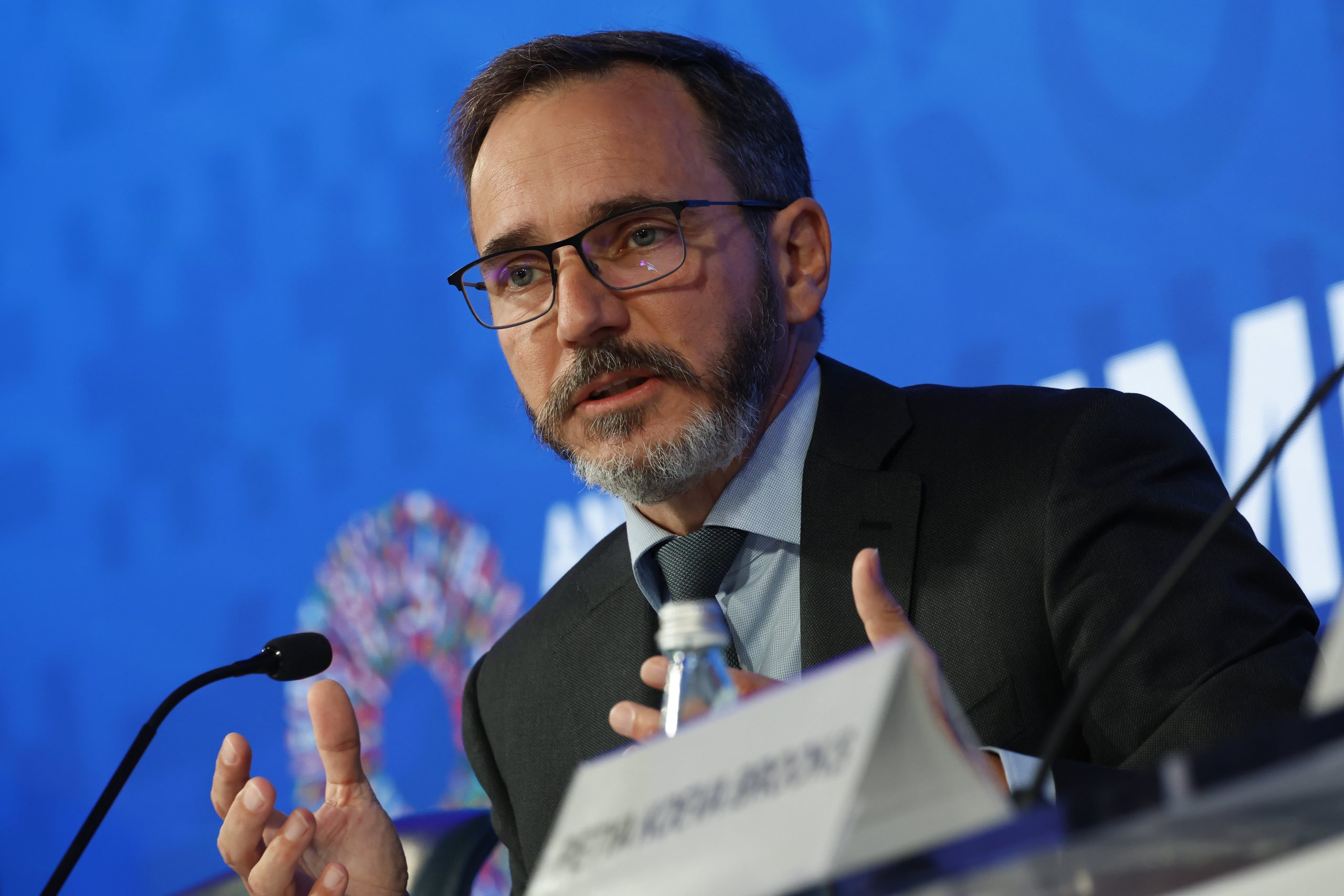

- IMF Research Chief Pierre-Olivier Gourinchas to Step Down in July
Pierre-Olivier Gourinchas, the International Monetary Fund’s Economic Counsellor and Director of the Research Department, will step down from the role and return to academia at the University of California, Berkeley, effective July 1, 2026.
IMF Managing Director Kristalina Georgieva announced the decision on Thursday, describing Mr Gourinchas’s tenure as one marked by exceptional intellectual leadership during a period of extraordinary global uncertainty.
Mr Gourinchas joined the Fund in 2022, taking charge of the IMF’s Research Department at a time when the global economy was still emerging from the pandemic shock, inflation was accelerating across advanced and emerging economies, and geopolitical tensions were beginning to reshape trade, finance and policy coordination.
“Pierre-Olivier has provided exceptional intellectual leadership at a time of extraordinary global uncertainty,” Ms Georgieva said.
“From the aftermath of the pandemic and the surge in global inflation to heightened geopolitical tensions and growing fragmentation, he ensured that the Fund’s analytical work remained rigorous and highly relevant for our members. I am deeply grateful for his outstanding service, dedication, and commitment to our membership.”
Under his leadership, the IMF said its Research Department demonstrated strong agility, producing policy-relevant analysis during periods of heightened uncertainty and maintaining the quality of major flagship publications such as the World Economic Outlook and the External Sector Report.
The Fund said those publications strengthened its ability to assess global spillovers, risks and policy trade-offs in a rapidly changing international environment.
Mr Gourinchas also helped advance IMF analytical work in areas including geo-economic fragmentation, global inflation dynamics and the determinants of global imbalances.
His tenure coincided with a period in which the Fund increasingly focused on how geopolitical tensions, supply chain shifts, climate risks, artificial intelligence and financial vulnerabilities were reshaping the global policy landscape.
The IMF said he also supported intellectual innovation through initiatives such as the AI Preparedness Index, the Structural Reforms Impact Tool, the RES DataHub, and work on the next generation of macroeconomic models.
Most recently, Mr Gourinchas led analytical work on alternative scenarios assessing the economic impact of the war in the Middle East. The IMF said the work helped inform policy discussions during the recent Spring Meetings and was particularly valued by member countries.
As Economic Counsellor, Mr Gourinchas also contributed to high-profile surveillance and programme work, helping ensure that the Fund’s advice remained analytically rigorous and operationally relevant.
Beyond the analytical portfolio, Ms Georgieva credited him with fostering a collaborative and inclusive work environment inside the Fund’s Research Department.
She said he championed staff development, encouraged intellectual curiosity and advanced talent management initiatives.
“I am profoundly grateful to Pierre-Olivier for his remarkable service to the Fund and for the example he has set as a leader and colleague,” Ms Georgieva said. “We wish him every success as he returns to the University of California, Berkeley.”
His departure comes at a delicate time for the global economy, as the IMF continues to monitor inflation risks, debt vulnerabilities, trade tensions, artificial intelligence adoption, climate-related shocks and the macroeconomic implications of the Middle East conflict.
The Fund did not immediately announce a successor.

