

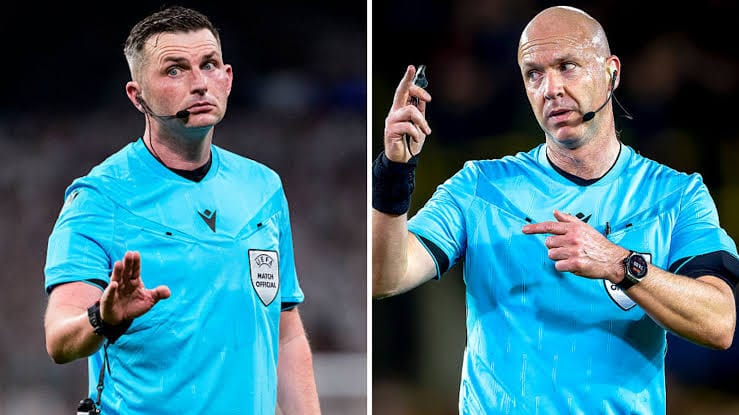

- Why English Referees Cannot Officiate Argentina’s World Cup Matches
As the 2026 FIFA World Cup enters its decisive stages, one of the tournament’s most experienced referees, England’s Michael Oliver, continues to earn praise for his performances. However, despite being among the favourites to officiate the World Cup final, circumstances beyond football could prevent him from taking charge of the biggest match of the tournament.
Oliver has already been appointed to officiate Spain’s quarter-final clash against Belgium, making it his seventh match of the tournament the most by any English referee at a single World Cup. Yet his hopes of refereeing the July 19 final depend entirely on which teams qualify.
If either England or Argentina reaches the final, neither Oliver nor fellow English referee Anthony Taylor will be eligible to officiate the match.
Political history behind FIFA’s decision
FIFA bars referees from taking charge of matches involving their own countries to maintain neutrality. However, the restriction on English officials handling Argentina matches extends beyond sporting reasons.
The decision is rooted in the long-standing political dispute between the United Kingdom and Argentina over the Falkland Islands, known in Argentina as the Malvinas. The 1982 Falklands War, which lasted 74 days, remains a sensitive issue between the two nations and continues to influence FIFA’s referee appointments.
Because of the dispute, English referees are not assigned to Argentina’s matches, while Argentine officials are similarly excluded from games involving England.
With England and Argentina on the same side of the knockout bracket, the two nations could meet in the semi-finals, meaning English officials are also excluded from matches that could directly affect England’s route to the final.
As a result, Oliver or Taylor can only be considered for the World Cup final if neither England nor Argentina qualifies.
FIFA considers more than referee performances
Appointments for every World Cup match are made by FIFA’s refereeing department, led by legendary former Italian referee Pierluigi Collina.
While referee performances remain the primary factor, FIFA also considers nationality, political sensitivities and potential perceptions of bias before assigning officials.
This policy applies to several geopolitical situations around the world. For example, referees from countries involved in political disputes are generally not appointed to matches involving those nations to avoid unnecessary controversy.
The same principle also prevented English referees from officiating Group L matches earlier in the tournament involving Ghana, Croatia and Panama because those fixtures directly influenced England’s group.
Similar rules apply in domestic football
The principle of avoiding conflicts of interest is not unique to international football.
In England’s Premier League, referees are prevented from officiating clubs they support or teams from areas closely associated with them.
For instance, Michael Oliver, who is from England’s North East, is not appointed to Newcastle United or Sunderland matches because of his regional connections.
Former referee questions the policy
Former Premier League referee Graham Scott believes football should move beyond historical political disputes when selecting officials.
According to Scott, elite referees are trained to remain completely impartial and should not be judged based on their nationality.
He argued that officials such as Michael Oliver and Anthony Taylor, who were either children or not yet born during the 1982 conflict, should not be affected by events that occurred decades ago.
Scott also described Argentine referee Facundo Tello as one of the world’s finest officials and said he would have no issue seeing him officiate an England match.
For now, however, FIFA’s long-standing policy remains in place, meaning the composition of the World Cup final will determine whether England’s top referees can be involved in football’s biggest occasion.

