

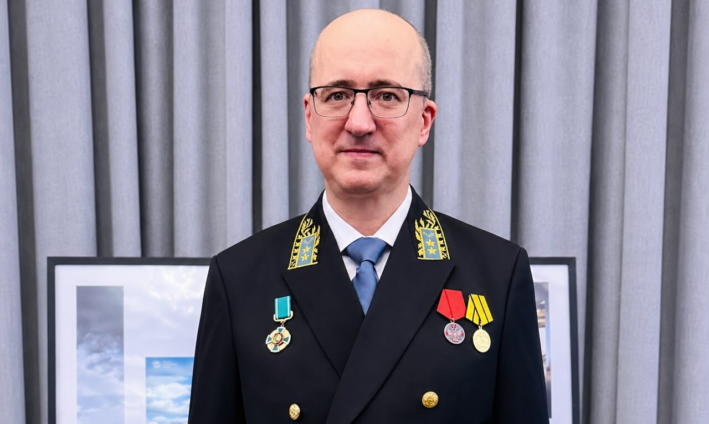

- Ghana-Russia Trade Tops US$800 Million As Moscow Eyes Deeper Economic Ties
Bilateral trade between Ghana and Russia has surged to more than US$800 million, as Moscow seeks to deepen economic cooperation with Accra through investment, technology transfer and stronger private-sector partnerships.
Trade between the two countries rose from US$247 million in 2022 to more than US$800 million in 2024, representing an increase of at least 223.89%, according to Russia’s Ambassador to Ghana, Andrei Ordash.
The sharp rise marks a significant expansion in Ghana-Russia commercial relations and comes as both countries seek to move beyond traditional diplomatic cooperation in education, health and energy into more strategic economic areas, including agriculture, manufacturing, mining, logistics and infrastructure.
“Our economic performance speaks for itself. Trade between our countries has grown from US$247 million in 2022 to more than US$800 million in 2024,” Ambassador Ordash said in an interview with the Ghana News Agency.
For Ghana, the development is important because it comes at a time when the country is trying to diversify investment sources, strengthen industrial capacity and position itself as a commercial gateway into Africa under the African Continental Free Trade Area.
Ghana hosts the AfCFTA Secretariat, giving it strategic diplomatic and commercial relevance as foreign partners look for entry points into the continent’s integrated market. Russia appears to see that positioning as central to its Africa strategy.
Mr Ordash said Ghana had emerged as a reliable and promising partner for Russia in West Africa, citing the country’s political stability, economic progress and strategic location as reasons Russian businesses are taking greater interest in the Ghanaian market.
“We see enormous, untapped potential in our trade and economic ties. Ghana is keen to modernise its economy and sees Russia as a partner in achieving a technological leap forward,” he said.
The Russian envoy said one of his priorities would be to promote stronger business-to-business partnerships and encourage Russian companies to participate in Ghana’s industrialisation agenda, including the government’s proposed 24-hour economy initiative.
That ambition suggests Moscow is looking beyond commodity exports and imports. Instead, Russia wants to build long-term investment partnerships, joint ventures and technology-led projects that can support Ghana’s industrial transformation.
Energy is expected to be one of the main areas of cooperation. The Ambassador pointed to the Memorandum of Understanding between the Ghana Atomic Energy Commission and Russia’s State Atomic Energy Corporation, Rosatom, as a major step toward Ghana’s ambition to develop its first nuclear power plant.
According to him, the partnership would not only involve the construction of a nuclear facility but also the training of Ghanaian engineers and technical experts to operate and maintain it, thereby strengthening local technical capacity in the energy sector.
Agriculture is another priority area. Russia is already known globally as a major supplier of grain and fertiliser, but Mr Ordash said Moscow wants cooperation with Ghana to move beyond exports into agro-industrial production, research collaboration and technology transfer.
He said the two countries were exploring partnerships between Ghanaian institutions and Russian research centres to introduce agricultural technologies capable of improving productivity, strengthening food security and supporting Ghana’s agricultural modernisation agenda.
“Ghana sees Russia as a partner for a technological leap forward in the agricultural sector,” he said.
Mining also features strongly in the proposed cooperation. Ghana’s reserves of gold and bauxite present opportunities for joint investment and resource development, according to the Russian envoy.
For Ghana, this creates both opportunity and caution. Russian capital and technology could support value addition, mineral processing and infrastructure development. But any deeper engagement in mining will also require strong transparency, environmental safeguards and local content discipline to ensure that partnerships produce broad economic benefits rather than merely extractive gains.
The AfCFTA dimension may be the most strategic part of the evolving relationship. Mr Ordash said Russia regards Ghana as a key partner for accessing the wider African market. He said Russian companies could establish manufacturing plants, assembly facilities and logistics centres in Ghana to distribute products across the continent under the AfCFTA framework.
“We regard Ghana as a key partner for accessing the vast African market within the framework of the African Continental Free Trade Area,” he said.
The Ambassador also urged Ghanaian businesses not to limit their engagement with Russia to imports of wheat, energy resources or fertilisers, but to pursue joint production facilities and logistics centres.
“Do not limit yourselves to importing our wheat, energy resources or fertilisers; let us work together to build joint production facilities and logistics centres,” he said.
That message is significant. It reflects a shift from trade in finished goods toward a partnership model based on production, assembly, logistics and technology. If properly structured, such cooperation could support jobs, local value addition and Ghana’s industrial policy agenda.
Commercial ties are already gaining momentum. In November 2025, 65 leading Ghanaian business executives participated in the “Made in Russia” International Forum, where they established direct contacts with Russian companies to explore investment and trade opportunities.
The success of this renewed push will depend on whether trade growth is converted into bankable projects. Ghana has often attracted diplomatic interest from major global powers, but the real economic value comes only when statements of intent become factories, technology partnerships, logistics platforms, skills transfer, financing arrangements and export capacity.
Russia’s renewed interest also comes amid shifting global geopolitics, as Moscow seeks to deepen ties across Africa and African countries look for diversified partnerships beyond traditional Western and Chinese sources of capital.
For Ghana, the opportunity lies in using competition among global partners to secure better investment terms, stronger technology transfer, deeper local participation and market access under AfCFTA. The risk is that geopolitical relationships may produce headline trade numbers without enough domestic industrial transformation.
The Ambassador expressed confidence that existing bilateral mechanisms, including the Joint Intergovernmental Commission on Trade, Economic, Scientific and Technical Cooperation, would help move practical projects forward.
“I hope that, years from now, we will be able to say trade between our countries has reached a qualitatively new level; joint ventures have become operational; Ghana has been given real tools for a technological leap forward; and our countries have grown even closer to one another,” he said.
The trade numbers show that Ghana-Russia economic relations are expanding. The next test is whether that expansion can move from trade volumes to productive investment.
For Ghana, US$800 million in bilateral trade is important. But the bigger prize will be whether Russian engagement helps build factories, finance infrastructure, support agriculture, deepen energy capacity and position Ghana as a serious AfCFTA production and logistics hub.
That is where the relationship will be judged not by diplomatic warmth, but by measurable industrial value.

