


Ghana’s Cocoa Crisis: Who Will Stand with the Farmer?
The Ghana Cocoa sector’s crisis has been decades in the making, fuelled by mounting debt to a tune of GHS 33 billion by mid-2025, falling world prices, and structural inefficiencies. In February 2026 an emergency cabinet session and the Finance Minister press conference unveiled sweeping reforms: immediate payment of farmer arrears, a cut in the farmgate price to align with market reality, a new financing model using domestic cocoa bonds, debt conversions, and a revised COCOBOD Act to guarantee farmers 70 % of the Free-on-Board (FOB) price.
This op-ed assesses those measures in detail, fact-checking government claims and public data, and outlines the potential impacts on farmers and the sub-sector. We found that many of the proposed reforms are sound but come with significant trade-offs. Short-term farmer incomes will fall with the price cut (from GH¢58,000 to GH¢41,392 per tonne), but prompt arrears payments and the 70 %-FOB guarantee should partially offset this. COCOBOD’s bloated payroll ($12 million monthly, $144m yearly) and hidden operating expenses contribute heavily to costs, implying an annual outlay well over $150m, likely exceeding $250m when fuel, transport and utilities are included.
A forensic audit and payroll review (already begun) are essential to cut waste, but data gaps prevent accurate budgeting. Implementation risks include political resistance, currency fluctuations, and institutional inertia. In the medium term, legislation enacting automatic price-adjustment and value-add mandates (50 % domestic processing from 2026/27) will strengthen sustainability. Longer-term reforms should restructure COCOBOD into a lean regulator as recommended by several stakeholders and liberalise marketing under strict quality control.
Our policy recommendations call for (a) immediate protection for farmers’ livelihoods through full arrears payment and short-term subsidies; (b) legalising the 70 %-FOB price floor and implementing procurement and payroll audits to unlock savings; (c) a phased shift of COCOBOD from a commercial body to a regulator, with private Licensed Buying Companies (LBCs) and exporters competing for cocoa purchases (and a long-term setup of the African Cocoa Commodity Exchange (AfCx) among the major producers of the commodity as proposed by ICO); and (d) continued support through road infrastructure financing by government, capacity-building for farmer cooperatives, and exploring modest bailouts if market shocks recur.
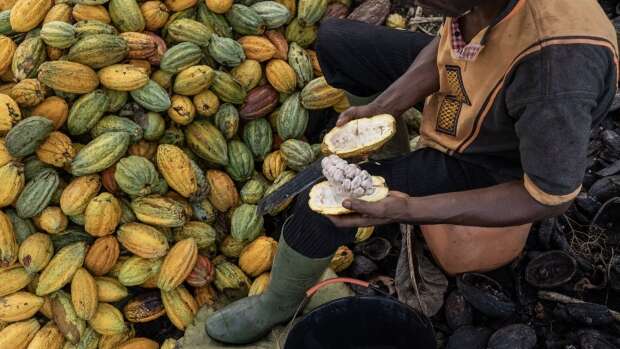
Ripe cocoa pods on a cocoa farm in Ghana. Farmers harvest the crop, but often lack fair, timely payment.
We have followed Ghana’s cocoa saga for years as children of cocoa farmers, and the recent world market price collapse was painfully predictable. Production fell 45 % short of targets in 2023/24 (432,145 tonnes vs 786,672 tonnes forecast), partly due to aging farms and climate factors. Meanwhile, aggressive pricing left Ghana’s cocoa uncompetitive, for much of late 2025, Ghana’s declared farmgate price (GH¢58,000/tonne, US$5,300) exceeded Côte d’Ivoire’s price by about 20 %, prompting illegal smuggling.
By December 2025, cocoa world prices had plummeted to roughly US$4,200/tonne, below the cost of transporting beans to port (US$6,400), so global buyers balked. COCOBOD’s finances blacked out in the absence of timely syndicated loans, a buyer-led model failed, and COCOBOD defaulted on a US$70M bridge loan. The result is a cash-strapped COCOBOD, GHS 33 billion in debt, and thousands of farmers with unpaid cash and empty storehouses (as Reuters reported, ‘thousands of farmers without money for food, children’s school fees, and basic farm maintenance’).
Against this backdrop, the government legally accountable to cocoa growers convened an emergency Cabinet meeting on Feb 11, 2026. The Cabinet ‘considered historical and systemic problems’ in the sector and directed immediate reforms. By Feb 12, Finance Minister held a press briefing to announce the plan. He framed it as protecting farmers and the industry’s finances; he cut the producer price for the remainder of 2025/26 from GH¢58,000 to GH¢41,392 per tonne (GH¢2,587 per bag) reflecting 90 % of an achieved FOB around US$4,200 to restore competitiveness.
Significantly, he also pledged a 70% FOB price guarantee to farmers in a new COCOBOD Bill. Other measures include paying all outstanding arrears immediately, converting GH¢5.8B of legacy debt to equity, shifting GH¢4.35B in cocoa-road liabilities off COCOBOD’s books, and aggressively courting domestic processing (allocating the current unsold beans to local plants and mandating 50 % processing from next season). Finally, an Attorney General–led forensic audit of COCOBOD’s past eight years was ordered, and management announced internal audits of payroll and inventory.
Two controversial data points are the $12 million monthly payroll and the ‘70% of FOB’ farmer-share claim. CEO Ransford Abbey himself disclosed that COCOBOD’s wage bill is about US$12M each month. That implies roughly $144M per year in salaries alone, which aligns with independent reports. If one adds fuel, transport, electricity, and other overhead, commentators estimate total annual operating costs are well above $200M. However, even the confirmed payroll suggests COCOBOD’s annual expenses in the quarter-billion-dollar range, accentuating the need for rigorous audits.
Regarding the farmers’ share of FOB, the government insists on a minimum 70 %. In fact, the Feb 11 Cabinet meeting confirm that the initial farmgate price (GH¢51,660/tonne) was set at exactly 70 % of an assumed $7,200 FOB. The Finance Minister’s statement emphasise that the new COCOBOD Bill will guarantee a minimum of 70 % of gross FOB price to farmers. In practical terms, if cocoa sells at US$5,000/tonne, farmers would receive at least US$3,500. Contrarily, Côte d’Ivoire’s system traditionally pays farmers a lower base, though with bonuses, resulting in Ivory Coast farmers actually capturing a higher share of export value than Ghanaian farmers historically.
Particularly, the latest pricing aligned Ghana’s farmgate to 90% of current FOB (US$4,200), meaning farmers were temporarily taking US$3,780/tonne (90%) until the ‘haircut’. Thus, the 70 % figure reflects a floor, not always the exact payout. The 70% target is an official policy, but actual shares have fluctuated with global prices. Ghana’s share was 70 % when world price was $7,200, rose to 90 % as prices fell, and will be fixed at 70 % going forward. This complex calculus stresses the need for transparent calculation in the new law.
The announced reforms can be grouped into four pillars. Below we evaluate each:
- Cutting the farmgate price (from GH¢58,000 to GH¢41,392) will immediately lower farmers’ revenues on new deliveries; for a 64kg bag, the price drops from GH¢3,610 to GH¢2,587. This saved COCOBOD/Ghana roughly $1,700 per tonne of subsidy and should spur buyers, but it hurts farmers in the short-term. To assuage the blow, the government has ordered urgent payment of arrears to cocoa farmers who sold at the old price, which is fiscally costly but politically necessary. Longer term, fixing 70 % of FOB provides farmers a guaranteed price floor, addressing chronic underpayment. This echoes recommendations that farmers need a clear, transparent pricing system. If implemented well, the new automatic price-adjustment law should stabilise incomes against volatile markets. If cocoa prices remain low, even 70 % of FOB may not cover farmers’ costs, so supporting services (inputs, credits) are still needed.
- Abandoning the failed buyer-led model and syndicated loan, both of which left COCOBOD asset-light and debt-heavy in favour of a domestic cocoa bond scheme is a bold shift. Under the new plan, Ghana will issue local bonds to raise working capital, repaid within the crop season by sales (rotating fund). This keeps financing more in-country and ties loan repayment to actual output. The plan will revive Licensed Buying Companies (LBCs) and the state Produce Buying Company (PBC) as active cocoa purchasers, increasing competition and reducing reliance on a few foreign buyers. On one hand, this could reduce interest costs and align incentives (COCOBOD no longer must pre-sell all output at low prices just to service debt). On the other, it exposes Ghana to currency and interest risk; selling bonds in cedi depends on stable macroeconomics, and if the cedi weakens, interest burdens could bite. The conversion of GH¢5.8 billion legacy debt to equity and shifting GH¢4.35 billion in road costs away from COCOBOD will both improve balance sheets. The most likely impact may be better short-term liquidity (farmers get paid promptly); over time, reduced foreign funding dependency. The risk however bothers on implementation complexity and ensuring bond sales at reasonable rates; potential hidden contingent liabilities if COCOBOD still needs cash beyond one season.
- Ghana already processes only 30–40 % of its cocoa locally, whereas neighbouring Côte d’Ivoire processes a majority. The reforms mandate immediate domestic allocation of unsold 2025/26 beans and at least 50% processing from 2026/27. This is intended to create jobs and keep more export value at home. It also revives under-capacitated state plants (Cocoa Processing Co., CPC) and expands the local milling industry. The fiscal impact in the short term may see Ghana earning less foreign exchange by exporting fewer raw beans. However, building up local chocolate or powder exports with tax incentives could boost foreign earnings eventually. The processing plants must be competitive; high local electricity costs (twice those in Ivory Coast) could offset gains unless addressed. Government support (e.g. subsidised power, financing for plant upgrades) will be crucial.
- The reforms explicitly target COCOBOD’s bloated bureaucracy and opaque operations. Forensic audits and criminal investigations of the past 8 years signal zero tolerance for corruption. Management’s pledge of payroll and inventory audits should root out ghost workers and stolen inputs. These steps respond to critics; including Minority MPs who have pointed out COCOBOD’s unacceptably high overheads and called for vigorous audit and accountability. In Parliament, COCOBOD’s CEO acknowledged the need for a new pricing mechanism and funding model and to align Ghana’s prices with global markets, reflecting official acceptance of the diagnosis. While audits may cause internal turmoil, they are broadly popular with taxpayers. They may reveal that Ghana’s target of 70–75 % of FOB in reality incorporated hidden costs (as Adam argued, some “cost items” in pricing might be removed). Streamlining COCOBOD could free funds for farmers. However, public scrutiny can also lead to politicisation and delays if not managed carefully.
Markedly, some experts caution against drastic moves. Opposition MP, Amin Adam criticised the price cut as short-changing farmers and argued that Ghana’s own fiscal expansion (e.g. bailouts) might have been a better response. He noted that some measures like covering cocoa roads from the main budget were already in an IMF-consulted turnaround plan, and warned that cutting farmgate prices without assistance undermines rural incomes.
Indeed, Ghana’s central bank must now guard against an ‘overvalued cedi’ to keep export prices competitive. In our view, the government’s combination of price cut + minimum share + arrears payment is defensible. This stops bleeding by attracting buyers back while protecting farmers’ longer-term take-home. Care must be taken to accompany this with immediate subsidies or credit support so smallholders cocoa farmers can plant and care for their farms without defaulting financially.
Our Policy Recommendations
For the Short-term (2026), government must begin staggered cash advances or input subsidies as crops are harvested at the new price. Ensure all outstanding payments are cleared swiftly so that farmers regain trust and liquidity. Create a transparent schedule of payments with civil society oversight. Finalise and enact the COCOBOD bill quickly. Parliament should expedite actions on the new bill ensuring automatic price adjustment and the 70 % rule. This legal guarantee will reassure farmers about the future and remove ad hoc pricing battles.
Include clear mechanisms for calculating the gross FOB and timing of payments. Empower the Auditor-General to conduct parallel financial reviews. Release a preliminary report on COCOBOD’s staffing and spending by Q2 2026 to guide public debate. Enforce the Attorney General’s audit mandate, but also protect whistleblowers. Use the audit findings to make immediate corrective actions (e.g. prosecute and recover misused funds).
In the medium-term (2026–2027), let’s implement the new financing model. Launch the first issuance of domestic cocoa bonds for the 2026/27 crop, with interest rates tied to market benchmarks. Monitor bond uptake and have the government backstop any shortfall. Gradually wind down dependence on syndicated foreign loans. Invest the $500m World Bank facility (or similar funds) to improve cocoa roads and electricity supply in growing areas, reducing costs for processors. Encourage private-public partnerships to build or expand processing plants through tax incentives or concessional credit.
Ensure CPC and PBC are recapitalised and managed professionally, with performance targets. Following the Ivory Coast example, introduce pilot e-auctions or allow licensed private buyers to compete in select districts under strict quality control and transparent pricing. This “meso-model” approach can increase efficiency without abandoning regulation. Provide training and financial services to farmers and cooperatives so they can leverage better prices or forward contracts.
For the long-term (2028+) COCOBOD must be restructured to serve its regulatory purpose. As stakeholders urge, transform COCOBOD into a regulatory and service agency rather than a trader. Spin off its commercial arms (buying and marketing) into independent companies (state-owned or privatised) that buy beans competitively. Retain only public goods functions: research (CRIG), quality control (QCC), and setting standards.
Plan a multiyear downsizing with voluntary buyouts and retraining. Institute routine performance audits and consider an independent sector regulator or public-private council to oversee cocoa policy. Keep the price-adjustment formula under review (e.g. whether 70 % remains adequate) through a committee of stakeholders. Given that younger Ghanaians are leaving cocoa, support farm youth and alternative crops. Encourage downstream investments (chocolate brands, agro-processing) that create rural jobs. Only when these structural shifts take hold will Ghana fully realise the “smart regulation plus competition” model that uplifts farmers.
Conclusion
Ghana’s cocoa reforms, announced in early 2026, represent a significant effort to break a vicious cycle of debt, subsidies, and underinvestment. The measures from price cuts and socialised bonds to processing mandates and audits could stabilise the sector if thoroughly executed. However, success hinges on follow-through. Transparent implementation, support to cushion farmers, and a relentless focus on efficiency will be decisive.
As stakeholders, we remain cautiously optimistic. The new reforms align with many long-standing recommendations, even those penned prior to the farmgate price crash. But Ghana cannot simply wish its way to abundant cocoa; it must relentlessly execute these reforms, monitor outcomes, and adjust course. If it does, Ghana’s brown gold, once a foundation of our economy can again deliver prosperity to farmers rather than hardship.

