- Ghana Shifts From IMF Bailout to Policy Coordination Instrument (PCI)
Ghana has formally shifted its engagement with the International Monetary Fund from a bailout programme to a non-financing Policy Coordination Instrument, marking a new phase in the country’s post-crisis economic management strategy. The Presidency said the transition follows the successful conclusion of Ghana’s Extended Credit Facility programme with the IMF, describing the move as the “definitive end” of the country’s financial bailout relationship with the Fund.
But the new framework does not mean Ghana is walking away from IMF-backed discipline. Instead, the Policy Coordination Instrument, or PCI, is designed to provide a policy anchor, signal reform commitment and help unlock confidence from private investors, development partners and international financial institutions.
The shift comes after IMF staff reached agreement with Ghana on policies to be supported by a 36-month non-financing PCI, alongside the sixth and final review of the ECF and the 2026 Article IV consultation. The Fund said the PCI will focus on sustaining growth-friendly fiscal adjustment, safeguarding debt sustainability, strengthening fiscal transparency and governance, enhancing the monetary and exchange-rate framework, reinforcing financial-sector stability, and supporting economic diversification and inclusive growth.
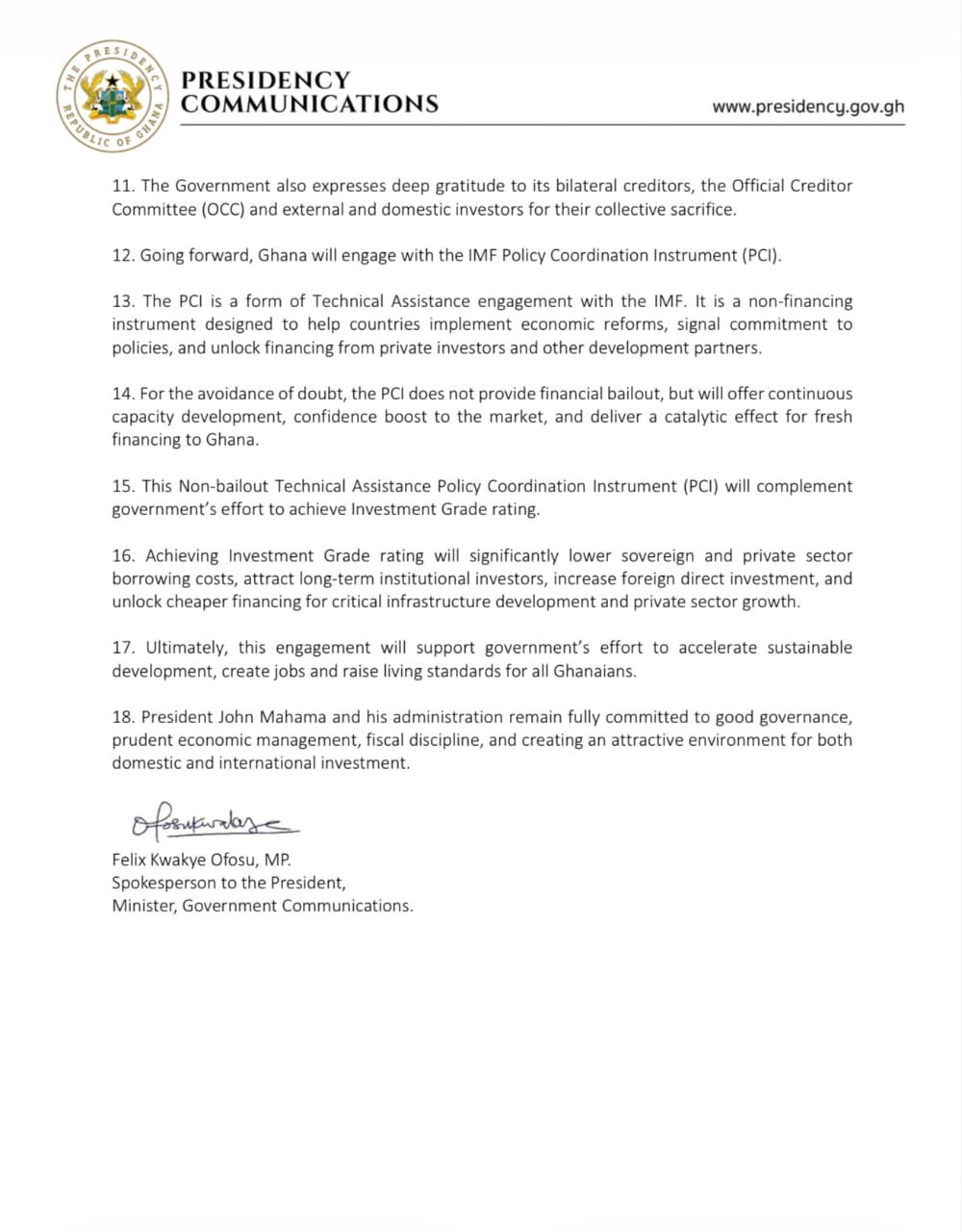
For government, the PCI is being framed as the next stage in Ghana’s recovery architecture. According to the Presidency, the instrument “does not provide financial bailout”, but will offer continuous capacity development, boost market confidence and deliver a catalytic effect for fresh financing to Ghana. It said the arrangement will complement government’s effort to achieve an investment grade rating.
Ghana is no longer seeking emergency IMF financing, but it still needs a credible external policy framework to convince markets that the country will not return to the fiscal slippages, debt accumulation and weak buffers that triggered the recent crisis.
The IMF has also been clear that the PCI represents a pivot from crisis stabilisation to reform consolidation. It said Ghana’s ECF-supported programme delivered substantial stabilisation gains, including lower inflation, rebuilt international reserves, improved confidence in the cedi, stronger fiscal performance and marked debt sustainability gains.
The Presidency’s statement said those gains include a stronger cedi, sharply lower public debt as a share of GDP, improved sovereign credit ratings and gross international reserves rising to about US$14.5 billion by February 2026, equivalent to almost six months of import cover.
Government said Ghana’s sovereign rating has improved from restricted default and junk status to ‘B’ with a positive outlook, representing five distinct rating-level upgrades. It attributed the improvement to stronger fiscal performance, normalised creditor relations, stronger external buffers and renewed market confidence.
The policy question now is whether Ghana can preserve those gains without the pressure of a financing programme.
Under the PCI, the IMF will not disburse funds. The value of the arrangement lies in credibility. It provides a formal monitoring framework that can reassure investors that fiscal consolidation, debt management, monetary policy discipline and structural reforms remain on track.
For a country seeking to return fully to capital markets and lower sovereign borrowing costs, that signalling function matters.
The Presidency said achieving investment grade status would significantly reduce sovereign and private-sector borrowing costs, attract long-term institutional investors, increase foreign direct investment and unlock cheaper financing for infrastructure development and private-sector growth.
That ambition is bold. Ghana’s recent debt restructuring still looms over investor memory. Domestic investors absorbed losses, external creditors remain in restructuring discussions, and the country’s credibility will depend on years of consistent policy execution, not one successful programme review.
The IMF itself has warned that the new fiscal space created by improvements in the debt trajectory must be carefully calibrated. Staff assessed that lowering Ghana’s primary surplus to 0.5% of GDP from 2027 would remain consistent with debt sustainability, but only if further progress is made in public financial management, fiscal risk management, state-owned enterprise governance and control of quasi-fiscal activities.
The instrument gives Ghana room to spend more on development needs, youth employment and social priorities, but it also keeps attention on the risks that could quickly reverse the recovery. These include state-owned enterprise liabilities, energy-sector arrears, cocoa-sector weaknesses, Bank of Ghana balance-sheet risks and fiscal indiscipline.
The IMF has already flagged the energy and cocoa sectors as areas requiring continued reform. It called for action to reduce distribution and collection losses at the Electricity Company of Ghana, finalise private-sector participation in distribution, clear legacy arrears and reduce generation costs. In the cocoa sector, it called for deeper reforms to strengthen COCOBOD’s long-term financial sustainability, streamline costs and allow more frequent farmgate price adjustments.
For markets, the PCI will therefore be read as both a confidence device and a restraint mechanism.
It may help Ghana attract fresh financing by showing that the country remains committed to prudent policy after exiting the bailout. But it will also expose any policy reversals, fiscal slippages or reform delays more quickly. That transparency could be uncomfortable politically, but useful economically.
The Presidency said President John Mahama and his administration remain fully committed to good governance, prudent economic management, fiscal discipline and creating an attractive environment for domestic and international investment.