
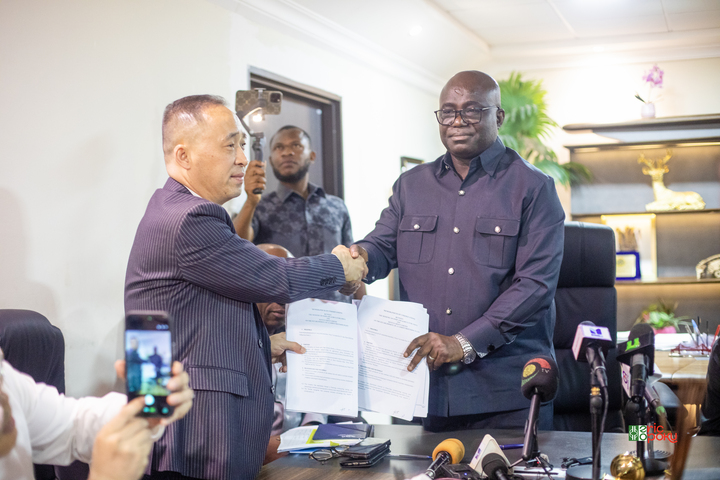

- MoFA signs Sentuo agro-processing and fertiliser pact in push for industrial agriculture
Ghana’s agricultural transformation drive has taken a more industrial turn after the Ministry of Food and Agriculture signed a strategic memorandum of understanding with Sentuo Group Limited to develop agro-processing capacity and local fertiliser manufacturing in what officials are presenting as a key building block in the Mahama administration’s farm-to-factory agenda.
The agreement, announced by the ministry under the leadership of the Minister and Asunafo South Constituency Hon Eric Opoku, is aimed at shifting Ghana away from its longstanding dependence on raw commodity exports and imported farm inputs towards a more integrated agro-industrial model built around value addition, input security and domestic processing.
At the centre of the arrangement is a plan to establish industrial-scale processing facilities for commodities including cashew, maize, rice, soybean and oil palm, alongside packaging, storage, quality control and export systems intended to strengthen Ghana’s competitiveness in higher-value agricultural trade. The agreement also includes plans for a national fertiliser manufacturing plant and integrated input supply system designed to reduce dependence on imported fertilisers and improve supply stability for farmers.
For a country that has long struggled with the economics of exporting raw produce while importing processed goods and key farm inputs, the logic is straightforward. Processing more at home should, in principle, reduce post-harvest losses, expand export earnings, create industrial jobs and retain more value within the domestic economy. Local fertiliser production, if commercially viable, would also soften Ghana’s exposure to global input price swings and foreign exchange pressure. Those ambitions are explicit in the MoU’s framing.
Hon Opoku cast the deal in precisely those terms. “This partnership represents a decisive shift from exporting raw commodities to building a resilient agro-industrial economy that creates value, jobs, and prosperity for our people,” he said. On fertiliser, he argued that Ghana had for too long left its farmers exposed to imported input volatility, adding that the initiative was meant to secure “fertilizer independence” and improve affordability and consistency of supply.
The timing is significant. Ghana is already scaling up one of its largest fertiliser support efforts. The 2026 budget outlines 272,000 metric tonnes for nationwide distribution, more than 164,000 metric tonnes in targeted fertiliser support for intensified production, GH¢2.7bn for cocoa fertiliser support, and coverage expected to reach more than 661,000 farmers. The Sentuo partnership is being positioned as a way to complement those interventions with local production capacity rather than continued reliance on imports.
That matters because Ghana’s agricultural policy problem has often not been the absence of programmes, but the weak industrial backbone behind them. Input subsidies can lift production in the short term, but without local manufacturing, storage, processing, and logistics systems, the wider value chain remains vulnerable. The Sentuo agreement appears intended to address that deeper constraint by linking primary production more directly to industrial capacity. This inference is drawn from the scope of the MoU described in the statement.
Under the proposed structure, Sentuo Group will finance, design, construct, and operate the facilities under a public-private partnership model, while MoFA will focus on policy coordination, regulatory facilitation, and alignment with national agricultural programmes. The company has also committed to deploying modern technology, mobilising technical partnerships, and prioritising local content, skills transfer, and job creation.
That PPP structure is important because it signals the government’s recognition that public ambition alone will not be enough. If the programme is to scale, it will need private capital, operational discipline, and commercially credible execution. In that sense, the deal fits a broader policy pattern under the administration: using state policy to create direction while leaning on private investors to deliver capacity on the ground. This is an analytical reading of the structure set out in the announcement.
Hon. Opoku also tied the initiative directly to employment and industrialisation. “This project will create thousands of direct and indirect jobs, empower our youth with technical skills, and position Ghana as a leader in agro-industrial production across the region,” he said, framing the MoU not simply as an agriculture intervention but as part of a wider economic transformation agenda.
The political framing is equally deliberate. The ministry is presenting the agreement as part of President John Dramani Mahama’s broader economic reset, aligned with the Feed Ghana Programme and the 24-Hour Economy policy. In that formulation, agriculture is no longer being treated only as a food security issue, but as an industrial platform capable of driving jobs, export earnings and import substitution.

