

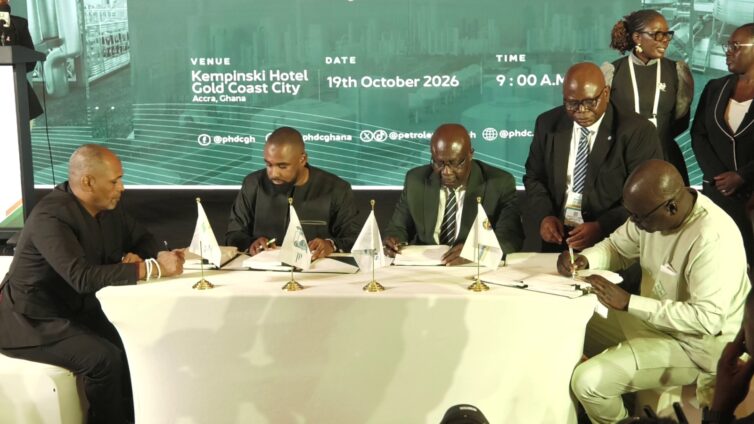

- Ghana Signs US$28bn Petroleum Hub Investment Deal for Phase 2 Project
Ghana’s agreement with an international consortium to invest US$28bn in the second phase of the Petroleum Hub Project is an audacious statement of industrial intent. It is also a test of whether the country can convert an enormous headline commitment into financed infrastructure, productive jobs and lasting economic value.
The Petroleum Hub Development Corporation says construction at Jomoro in the Western Region is expected to begin in the first quarter of 2027 and conclude in 2031. The investment is being presented as a major component of the government’s 24-Hour Economy programme and a route towards reducing Ghana’s reliance on imported petroleum products.
If delivered, the project could reshape Ghana’s energy economy. Domestic refining, storage and related petrochemical activity could retain value presently exported through the purchase of finished fuels, support round-the-clock industrial operations and provide a platform for supplying regional markets.
But the sheer scale of the announced investment demands scrutiny. US$28bn is not merely another foreign investment figure. It is a sum several times larger than Ghana’s annual public investment programme and sufficiently large to affect employment, infrastructure, foreign-exchange flows and the Western Region’s development trajectory.
The first task must therefore be distinguishing an investment agreement from committed and deployable capital. Signing establishes intent and a framework for co-operation; it does not automatically mean that the full amount has been raised, reached financial close or become available for construction.
The credibility of the deal will ultimately depend on the identity and financial capacity of consortium members, the proposed debt-and-equity structure, conditions precedent, implementation milestones and the allocation of commercial and sovereign risks.
“Today’s agreement sends a strong signal to the international investment community. It demonstrates that Ghana remains the trusted destination for long-term investments underpinned by political stability,” Dr Aubynn said.
That confidence is valuable. Ghana is rebuilding credibility after a sovereign debt crisis, debt restructuring and a period of restricted access to international capital. Attracting private investment into productive infrastructure would offer a more sustainable growth route than financing transformation through repeated government borrowing.
The distinction between private capital and public exposure, however, must remain clear. Government support may be necessary for land, permits, connecting infrastructure and regulatory certainty. But guarantees, tax concessions, purchase commitments or foreign-exchange protections could transfer substantial risks to the state.
The public should know what Ghana has promised, what investors must provide and what happens if financing or construction targets are missed. Transparency is not hostility to investment; it is protection for both the investor and the country.
The consortium’s representative, Boubacar Belco Bah, pledged compliance with Ghanaian law and international standards while emphasising technology transfer and skills development.
“Industrial progress must be measured by work and safety, community protection and long-term sustainability,” he said.
Ghana should resist measuring success only by the project’s dollar value or number of facilities. The more meaningful indicators will include the proportion of contracts awarded to competitive Ghanaian companies, the number and quality of permanent jobs, technology transferred to local professionals, tax revenue generated and linkages created with domestic industries.
The government says the completed petroleum hub could generate more than 700,000 direct and indirect jobs across all phases. Such projections can mobilise public support, but they must be accompanied by a transparent employment methodology.
Construction jobs differ from permanent operational positions, while indirect employment estimates can become inflated when multiplier assumptions are unclear. Publishing annual targets by skill category, gender, location and employment duration would allow the public to evaluate whether the jobs promise is being fulfilled.
The project also intersects with Ghana’s foreign-exchange challenge. The country imports substantial volumes of refined petroleum products, creating recurring demand for dollars. Greater domestic refining could reduce part of that pressure, but only if facilities are commercially competitive and can reliably source crude.
Regional demand offers a significant opportunity. Ghana’s ports, relative political stability and access to neighbouring Sahelian markets could support a petroleum-processing and distribution platform serving West Africa. Yet regional competitiveness will depend on product pricing, port efficiency, transport corridors and predictable regulation.
Energy and Green Transition Minister Dr John Jinapor promised government support and said he would help create the enabling environment required to meet the project’s objectives.
“You have my full support,” he told the corporation, pledging to shepherd the process and ensure that government meets its obligations.
That support must involve more than administrative acceleration. A project running until 2031 needs regulatory continuity across political cycles, co-ordination among ministries and agencies, and credible mechanisms for resolving disputes without weakening national standards.
Community participation will be equally important. Jomoro’s residents will experience the project’s consequences most directly through land acquisition, population growth, pressure on housing and public services, environmental risks and new commercial opportunities.
The environmental dimension cannot be treated as a compliance footnote. Refining and petrochemical facilities can generate emissions, hazardous waste and risks to water, fisheries and coastal ecosystems. Strong impact assessments, emergency-response systems and independent monitoring will be essential to retaining public trust.
Ghana must also reconcile a large petroleum investment with its green-transition commitments. The answer is not to pretend fossil fuels will disappear immediately, but to ensure new facilities are efficient, prepared for tighter carbon standards and capable of supporting cleaner products and lower-emission operations.
The proposed 2027 start date provides a near-term credibility test. Before groundbreaking, authorities should publish a phased implementation plan showing financing milestones, regulatory approvals, land status, infrastructure requirements and expected construction packages.
The US$28bn agreement could become a turning point in Ghana’s industrial development. It could deepen domestic value addition, improve energy security and create a new export platform.
But ambition alone does not construct refineries, train workers or protect communities. Ghana’s success will depend on disciplined execution, transparent risk allocation and the determination to ensure that value created at Jomoro circulates through the wider economy.
The decisive headline will not be that Ghana signed a US$28bn agreement. It will be that the capital arrived, the facilities operated competitively and ordinary Ghanaians captured a fair share of the value created.

