

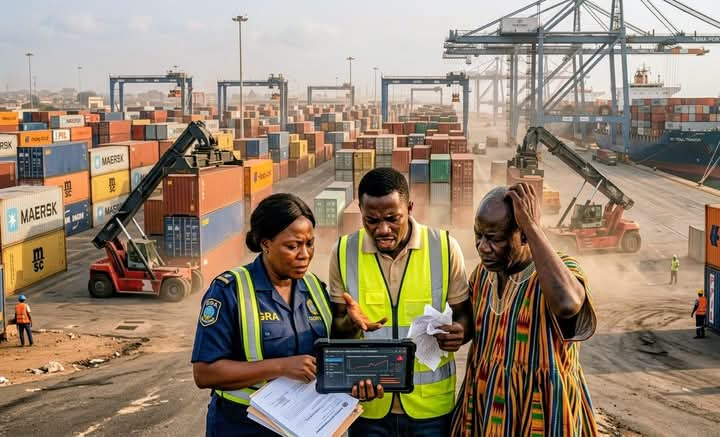

The Algorithm Against the Invoice: Surviving the Publican AI Crisis at Ghana’s Ports
The intersection of global trade and artificial intelligence is supposed to usher in an era of unprecedented efficiency. But what happens when an algorithm overrides the law?
In Ghana, the mandatory rollout of the Publican Trade Solution, an AI-driven customs valuation system introduced in early 2026, has ignited a fierce battle over legality, transparency, and operational survival.
Pitched as a silver bullet against customs fraud, the system has instead triggered a coalition of freight forwarders, importers, and trade associations to demand its immediate suspension.
To understand the friction at ports like Tema and Takoradi, we must look beyond the gleaming promise of new technology. When centralization chokes logistics and a machine dictates arbitrary taxes, does technology remain a facilitator, or has it become a barrier to trade?
The government’s rationale is rooted in a legitimate need to protect the public purse. By aggregating global trade data, Publican AI is designed to flag undervalued imports and prevent state revenue leakages.
Ghana Revenue Authority’s Commissioner-General Dr. Anthony Kwasi Sarpong has championed the system, projecting a massive forty-five percent boost in customs revenue.
The state defends this push by pointing to a staggering statistic: between 2020 and 2025, commercial banks transmitted over $127 billion out of the country, yet only $52 billion worth of physical goods were declared. For the Ministry of Finance, Ghana, this gap is undeniable proof of systemic under-declaration.
But is a blanket algorithmic penalty the right cure?
Not all of that transferred wealth represents physical goods; a vast portion covers service payments, debt servicing, and legitimate financial transfers. By enforcing an AI system that treats any invoice lower than a hidden global median as fraudulent, the state is effectively draining private sector working capital.
Deputy Minister of Finance Thomas Nyarko Ampem recently boasted that the AI is raking in an average of $3 million a day in extra revenue, projecting close to a billion cedis a month.
While the government celebrates this windfall, one must ask: is this newfound wealth genuine revenue recovery, or simply a multi-million-dollar daily tax on the survival of the Ghanaian consumer?
As Clement Boateng of the Ghana Union of Traders Associations starkly noted, duties have doubled and even quadrupled in some instances. When a machine forces duties to quadruple, that cost does not disappear; it is passed directly onto the shelves of local markets.
Ghana is by no means the first nation to invite artificial intelligence into its customs sheds.
When countries like India introduced the Turant Customs system, or Brazil rolled out its SISAM machine-learning platform, they shared the exact same ambition of leveraging big data to seal revenue leaks.
Yet, almost immediately, these nations crashed into the very same legal and operational wall currently bruising Ghanaian traders. The international trade community quickly pushed back against algorithms generating arbitrary reference prices that ignored actual business transactions.
How did these global players resolve the friction? They did not discard the technology; rather, they corrected its legal application.
They recognized that under the World Trade Organization – WTO’s Customs Valuation Agreement, a framework Ghana is firmly bound by, the primary basis for taxation must be the Transaction Value, which is the actual price paid by the buyer.
Global ports realized you cannot legally mandate customs officers to default to a machine-generated figure simply because it yields a higher tax bill. Instead of using AI as a final judge, advanced economies repositioned it purely as a risk-management engine.
If an algorithm in Brazil or India flags an invoice as abnormally low, the shipment is categorized as high risk, shifting the burden of proof to the importer. Once banking records validate the transaction, the actual value legally stands.
This global lesson in technological humility seems entirely lost in the current Ghanaian rollout, which directly conflicts with Sections 67 and 68 of Ghana’s own Customs Act.
Paul Kobina Mensah of the Ghana Institute of Freight Forwarders perfectly captured this frustration, noting that while the industry supports revenue protection, they cannot support policy action that is rushed, opaque, and mathematically disconnected from the law.
Furthermore, the GRA insists the AI accelerates clearance times to a mere five minutes. This is technically true, but only if the trader quietly accepts the legally dubious, inflated valuation.
The moment a trader disputes the machine’s figure, that promised efficiency evaporates into a bureaucratic nightmare.
Unlike other nations that empower local officers to resolve AI disputes on the spot, the GRA has heavily centralized the appeals process. A dispute originating at the Paga border must now be formally submitted to a Secretariat in Accra that convenes only twice a week.
As Eric Amoah Amponsah of GIFF questioned, instead of running a decentralized system, everybody has to rush to the capital; how exactly does an AI help in this situation?
To clear the crippling port congestion and align with global best practices, the state must immediately pivot. Beyond repositioning the AI as a mere detective rather than a judge, the GRA must embrace Post-Clearance Audits.
Holding cargo hostage pending an Accra-based valuation dispute incurs massive demurrage costs. The globally accepted practice is to release the goods based on the declared value, followed by a rigorous audit of the importer’s financial books later on. If fraud is discovered, the state can then apply severe punitive fines.
Coupled with this, the dispute mechanism must be radically modernized. If the state insists that Accra must superintend these appeals to ensure strict oversight, then geography can no longer be an excuse for delay.
In a digital age, why force a trader to travel hundreds of kilometers to defend an invoice?
The GRA must deploy secure video links connecting local ports directly to the Accra Secretariat. Furthermore, this appellate body must evolve from a part-time committee sitting twice a week into a robust, full-time virtual tribunal.
Operating at least eight hours a day, seven days a week, this digital committee could scale its operations to match the real-time volume of port disputes, resolving issues within hours rather than weeks.
Above all, there must be a demand for algorithmic transparency. If a trader’s financial liability is dictated by a machine managed by a foreign service provider, do they not have a fundamental legal right to understand exactly how that reference price was calculated?
Modernizing Ghana’s ports is a necessary evolution, but government efficiency cannot be built on the back of private-sector uncertainty.
Artificial intelligence is a remarkable tool, but when unchecked by the realities of global trade law, it makes for a terrible tyrant.
By recalibrating Publican AI to support human judgment rather than replace it, Ghana can bridge its revenue gap without sacrificing the survival of its trading community.

