
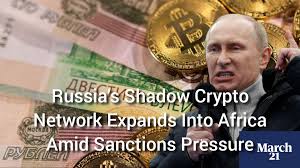

- Africa becomes proving ground for Russia’s sanctions-era payment architecture
Africa is increasingly being drawn into Russia’s search for financial escape routes, with new reports suggesting the continent is becoming a test bed for a parallel payments network designed to operate beyond the reach of Western sanctions. According to Business Insider Africa, Russian crypto firm A7 is expanding its African footprint as Moscow seeks alternative channels for cross-border settlement after being cut off from key parts of the global financial system.
The significance of that shift lies not simply in geography but in purpose. The report says A7 is building a network to move rubles and digital assets outside Western-controlled systems, including SWIFT, with activity reportedly linked to Togo, Nigeria, and Zimbabwe. It also cites an investigation by RFI saying the effort carries backing from Russia’s defence-linked PSB bank and sanctioned businessman Ilan Shor, underlining that this is not being framed as a normal commercial expansion but as part of a broader state-aligned workaround strategy.
That makes Africa relevant in a very specific way. The continent’s fast-rising use of cryptocurrency, driven less by speculation than by practical payment needs, offers exactly the kind of environment in which alternative settlement systems can take root. Business Insider Africa notes that Sub-Saharan Africa recorded more than $205bn in on-chain crypto value between 2024 and 2025, a 52 percent year-on-year increase, while more than 54 million Africans now use digital assets for payments, savings, and remittances. Countries such as Nigeria, Kenya, and South Africa are described as leading this adoption wave, with Nigeria alone estimated to have more than 25 million crypto users.
In that sense, Africa’s role in the story is not accidental. High remittance costs, currency volatility, limited banking access, and a young, mobile-first population have made crypto more utilitarian on the continent than in many mature markets. Those conditions, the report suggests, make blockchain-based alternatives both practical and scalable for actors looking to bypass conventional financial plumbing.
The timing is also important. Business Insider Africa says the expansion comes as Russia faces tighter U.S. sanctions and increasing exclusion from traditional international payment channels. It adds that the European Union last October proposed sanctions on A7A5, a rouble-backed stablecoin linked to sanctioned actors, with measures aimed at preventing EU entities from participating directly or indirectly in transactions involving the token.
That regulatory backdrop turns A7’s African push into something more than a crypto-market curiosity. It becomes part of a larger geopolitical contest over who controls cross-border finance and how far sanctioned states can rewire payment systems using digital tools. If Russia can deepen footholds in markets where regulatory oversight is lighter and demand for cheaper payment rails is real, then Africa could become not only a user base but an experimental zone for sanctions-resistant finance. That conclusion is an inference based on the reported expansion strategy, sanctions pressure, and African adoption trends.
There is also a diplomatic dimension. The report points to A7-linked visits to Togo and Madagascar amid expanding Russian diplomatic and security ties in parts of Africa, suggesting the effort may be unfolding alongside a wider geopolitical outreach strategy. Russian Foreign Minister Sergey Lavrov was cited at an Africa-Russia conference in Cairo describing A7 as Russia’s “first international financial platform,” a phrase that hints at state ambition well beyond niche crypto activity.
For African policymakers, the development poses a complicated question. On the one hand, the infrastructure gap in payments, remittances, and cross-border settlement is real, and alternative technologies can offer genuine efficiency gains. On the other hand, becoming a venue for sanctions-evasion architecture could expose local financial systems to reputational, regulatory, and diplomatic risks far beyond the immediate appeal of new payment tools. That is an inference from the sanctions context and the nature of the network described in the report.
For markets, the deeper implication is that Africa’s digital-finance rise is now attracting not only venture capital and fintech platforms, but also geopolitical actors looking for room to manoeuvre. The continent’s payments future is no longer just a development story. It is increasingly becoming part of the global contest over financial power, sanctions enforcement, and monetary sovereignty.

